Environment
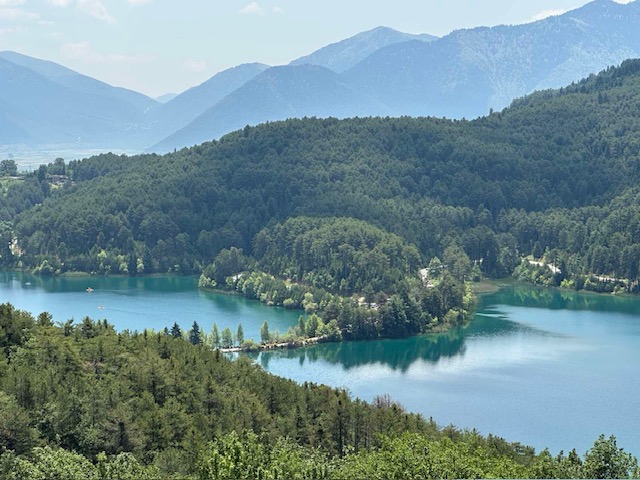
Landscape
Greece lies at the southeastern edge of Europe. It is a country of mountains and seas, where it is difficult to be far out of range of either - a factor of major influence on the country’s economic and historical development. It covers an area of 131,957 square kilometres, of which approximately one-fifth consists of islands (9,835 islands, islets and rock-islands, of which around 220 are inhabited), explaining in turn the country’s strong maritime tradition throughout its history.
Biodiversity
Greece is one of the richest countries in Europe in terms of its biodiversity, and when it comes to the varieties of its endemic herbs and medicinal plants, on a global scale it is second only to Madagascar. Approximately 6,000 plant species have been recorded, with a large number of endemic species, due to the isolation of mountains and islands. Nearly all mammal species recorded are indigenous, as well as 85% of freshwater fish species.
Greece hosts a large variety of Mediterranean habitats included in the reference list of the Natura 2000 initiative : from open sea, tidal areas and sea dunes, to several types of shrubs and grasslands and Mediterranean mountainous forests of coniferous. The Greek list of Natura 2000 sites includes 241 Sites of Community Importance (SCI) and 202 Special Protection Areas (SPA).
Detailed information on the management of protected areas, biodiversity conservation, promotion and implementation of sustainable development actions and climate change mitigation in Greece are available on the website of the Natural Environment & Climate Change Agency (NECCA) :
Climate Change
Greece, being a contracting party to all major international environmental conventions, treaties and protocols, has set the climate, peace and security nexus as a priority of its candidacy for the election as a non-permanent member of the UΝ Security Council for 2025-2026.
As a European Union member state, Greece contributes significantly in the joint effort to reach EU climate neutrality by 2050 (European Green Deal).
The devastating effects of global warming are being felt painfully not only in Greece but around the world. The countries of the Mediterranean basin in particular have experienced extreme weather phenomena (massive floods, fires, heatwaves, landslides) that resulted in unprecedented destruction.
Greece, along with all the countries of the Mediterranean Sea, is particularly vulnerable to the rising sea level caused by climate change. Greece has the longest coastline in Europe and the 10th longest in the world (14,000 km or 8,700 miles).
The first Climate law of Greece was adopted by the parliament in May 2022, after an extensive public consultation, and it provides a coherent framework for improving the adaptation and climate resilience of Greece and ensuring the climate neutrality of the country by 2050. Measures and policies are foreseen to enhance climate change adaptation, intermediate targets are set for the reduction of net anthropogenic greenhouse gas emissions (at least 55% and 80%, for 2030 and 2040, respectively, compared to 1990 levels), a carbon budget mechanism is foreseen for key sectors of the economy, and indicators are set for monitoring and evaluating the progress of the relevant objectives. The establishment of a governance and participation system for climate action is also anticipated. The time span of the law’s implementation stretches up to 2050.
Cultural and natural heritage protection from the impact of climate change
Greece has been at the forefront of the ongoing endeavor to protect natural and cultural heritage from adverse climate change impacts. In this framework, Greece, with the supporting partnership of UNESCO and the WMO (World Meteorological Organization), launched the proposal “Addressing climate change impacts on cultural and natural heritage”, at the UN Climate Action Summit, in September 2019.
Protection of the marine environment - Our Ocean Greece 2024
Greece is a country inextricably linked to the sea, historically, culturally, economically, and socially. Its extensive coastline and countless islands and islets, as well as its rich maritime heritage dating back to ancient times, render Greece a maritime nation positioned at the crossroads of three continents. The country’s economic landscape is significantly shaped by maritime activities such as shipping and tourism. Almost 20% of the world merchant fleet in terms of tonnage capacity is of Greek ownership. Tourism, on the other hand, contributes more than 20% of the country’s GDP constituting the backbone of its economy. Fisheries and aquaculture are also important maritime activities for the country.
Firmly committed to the protection of the ocean, which is fundamental to life on our planet and the future of humanity, Greece hosted the 9th “Our Ocean Conference'' , in 2024. "Our Ocean Greece 2024" was the 9th International “Our Ocean Conference”, and took place in Athens, on 16-17 April, 2024.
Within the six Areas of Action of the Our Ocean Conference 2024 (Marine Protected Areas, sustainable blue economy including offshore windfarms, climate change, maritime security, sustainable fisheries, marine pollution) the Greek Government consistently takes concrete steps for a clean and healthy ocean, where protection and sustainable use go hand in hand.
During the 9th Our Ocean Conference, important aspects for ensuring the sustainable management and conservation of the seas and oceans and their resources were emphasized such as: (a) Sustainable tourism in coastal areas and islands including adapting tourism to climate change, (b) Green shipping, (c) Reduction of marine plastic and microplastic pollution. An additional priority area was: (d) Green transition in the Mediterranean, a sea connecting three continents, as a horizontal element across the six Areas of Action of Our Ocean Conference.