Griechenland in Deutschland


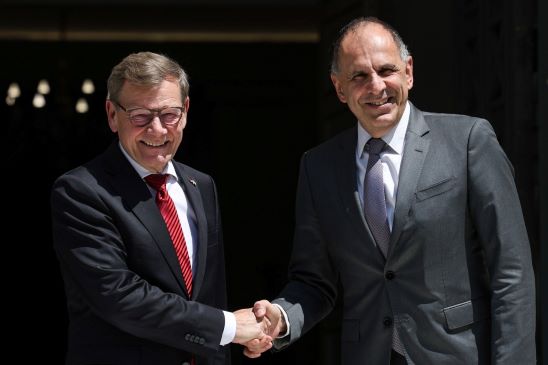
Minister of Foreign Affairs George Gerapetritis’ statements following his meeting with the Minister of Foreign Affairs of the Federal Republic of Germany, Johann Wadephul (Athens, 04.05.2026)
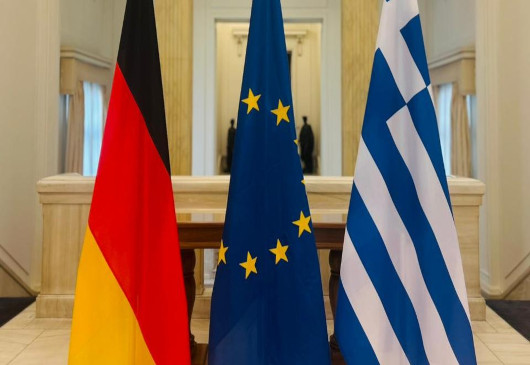
Joint Statement by the Ministers for Foreign Affairs of the Hellenic Republic and the Federal Republic of Germany on the establishment of a Partnership for Strategic Cooperation
Minister of Foreign Affairs, George Gerapetritis message on World Greek Language Day (09.02.2026)
Announcement by the Ministry of Foreign Affairs regarding the unanimous decision by UNESCO to proclaim February 9th as World Greek Language Day (Uzbekistan, 12.11.2025)

Dear Compatriots,It is with profound emotion that we commemorate once again the anniversary of the Greek War of Independence, a defining historical milestone which led to the establishment of the...
Wir möchten Sie darüber informieren, dass am 10.01.2026 das neue Wehrpflichtgesetz 5265/2026 in Kraft getreten ist, das wesentliche Änderungen für im Ausland lebende Personen mit sich bringt,...
Aufforderung zur Angebotsabgabe für Wasseraufbereitung
Aufgrund von starken Wetterbedingungen bleibt die Konsularabteilung der Griechischen Botschaft am Freitag, den 08.01.2026, geschlossen.
Sehr geehrte Bürgerinnen und Bürger,wir möchten Sie darüber informieren, dass das Konsulat der Botschaft der Hellenischen Republik am 24.12.2025 bis 13:00 Uhr für Sie da sein wird.Wir wünschen Ihnen...
C. FILIS: It is a great pleasure and honor to welcome the Greek Minister of Foreign Affairs, whom I would like to thank sincerely for taking the time to join us despite what is an exceptionally demanding period. Thank you, Minister. Let me start by asking you, how do you...
The issue of the accession process of the Western Balkans has recently been particularly high on the agenda both for Europe and for Greece. Yesterday, in the context of the EU Foreign Affairs Council, we had the opportunity to discuss it with the Ministers of the EU Member States, and...
At today’s Foreign Affairs Council, we will have the opportunity to discuss major issues currently high on the agenda, namely Gaza, Ukraine and the Western Balkans. Greece is at the forefront of most peace initiatives in the wider Middle East. Greece, with strong alliances, plays a leading role. At every...
It is a great honor, a great pleasure to be in Amman today for the trilateral summit among Jordan, Cyprus, and Greece. On behalf of my Prime Minister and the Greek delegation, I would like to wholeheartedly thank His Majesty and Minister Ayman Safadi for their warm hospitality. We truly...
Essen und Landwirtschaft


Greek Mediterranean Diet
The Greek Mediterranean Diet is one of the healthiest diets. It is characterized by a nutritional model that has remained constant over time and space, consisting mainly of olive oil, cereals, fresh or dried fruit and vegetables, a moderate amount of fish, dairy and meat, and many condiments and spices, all accompanied by wine or infusions. According to many researches carried out in the last 50 years in parts of the Mediterranean, including Crete and southern Italy, the Mediterranean diet model is responsible for the longevity of its inhabitants and the absence of heart diseases or diseases of the digestive system.
The Greek Mediterranean Diet though, is not only a diet, but rather a way of life, as it constitutes a set of skills, knowledge and practices, promoting social interaction, since communal meals are the cornerstone of social customs and festive events.
Since November 2010, the Mediterranean Diet has been recognized by UNESCO as an Intangible Cultural Heritage of Greece along with Italy, Spain and Morocco, thus reinforcing it not only as a fundamental part of their history and background, but also as a great contribution to the world.
Learn more about Eating Greek and The Cretan Diet.