


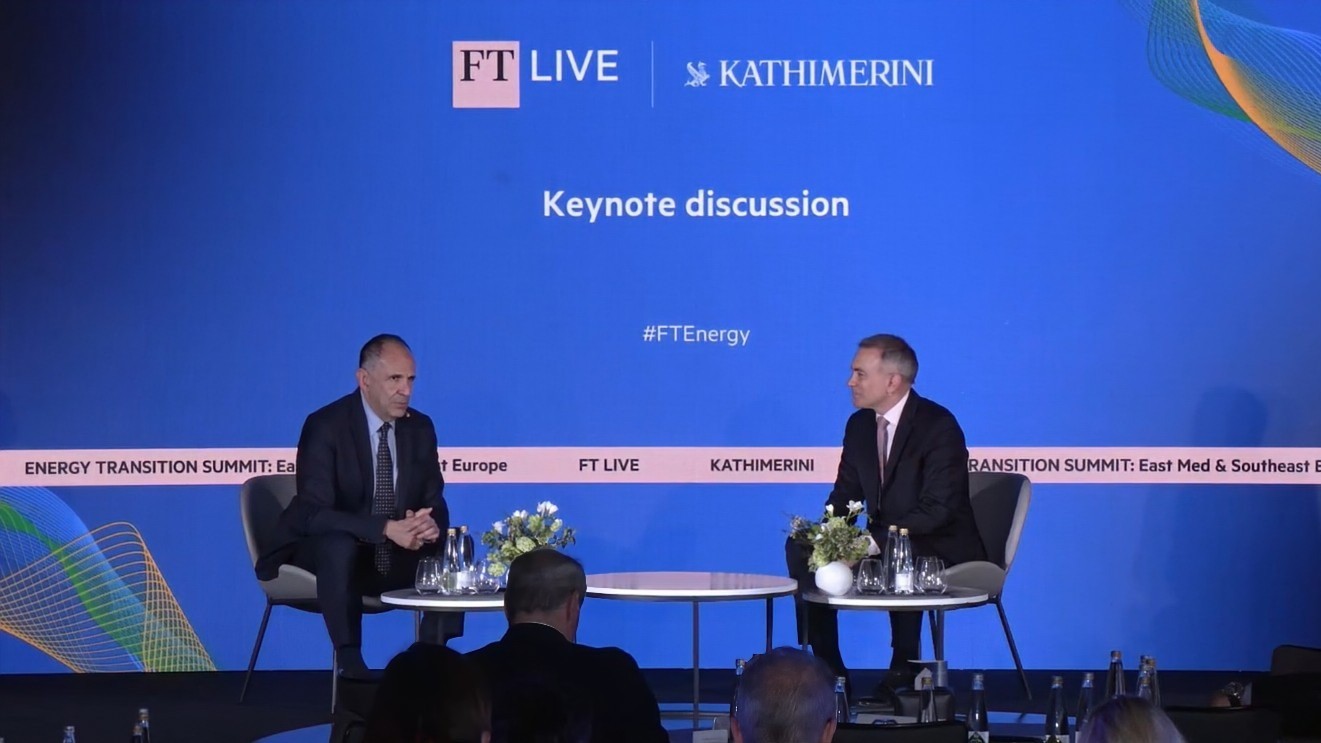
C. FILIS: It is a great pleasure and honor to welcome the Greek Minister of Foreign Affairs, whom I would like to thank sincerely for taking the time to join us despite what is an exceptionally demanding period. Thank you, Minister. Let me start by asking you, how do you envision Greece's strategic role evolving within Europe and the Eastern Mediterranean at a time when the international system appears increasingly fragmented and transactional?
G. GERAPETRITIS: First of all, I would like to thank you wholeheartedly for this very honorable invitation. It is wonderful to be among truly important people, and it is a great opportunity to present the Greek government's basic positions on foreign security policy. Indeed, we live in a very turbulent world. I think it's probably the most volatile period after World War II. We see a significant crisis of multilateralism. International organizations have essentially failed to deliver any meaningful results in all crises worldwide, especially when it comes to armed conflicts in the Middle East or in Ukraine. So, I think there is a clear diminution in the actual power of international organizations. That means that there is ample space for medium or strong powers to intervene. And this causes a significant upset. I think international security architecture, as we have known it, no longer exists. So, we need to actually revisit our fundamental premises. For us, it's important, I think, to actually work on the basic pattern, which is strong multilateralism and adherence to international law. And, you know, Greece is the bridge between North and South, East and West. The geographical position is very critical, but I think the role we have been called to perform is also critical.
In my eyes, being an elected member of the Security Council of the United Nations at this very period - apart from a true nightmare for the Minister of Foreign Affairs - I think is a tremendous opportunity to actually further increase our diplomatic footprint. At the same time, during the last 3 years we have worked very hard in order to upgrade our international relations with the neighboring powers, but not only neighboring powers. You see, we are at our best, for example, with the Gulf countries, with Israel, with the United States, with India. I think we follow a pattern of high politics when it comes to our diplomatic footprint, at the same time we are at the core of the European Union and the United Nations. I think Greece is aspiring to be part of any solution of the ecumenical problems and not part of the problem itself. This is going to be our fundamental diplomatic motto. We are clearly in favor of building bridges instead of creating ruins.
C. FILIS: No matter how obsolete the UN and the European Union seem to be nowadays. Minister, to what extent can Greece balance its traditional alignment with the United States while simultaneously supporting the idea of a greater European strategic autonomy in defense and foreign policy?
G. GERAPETRITIS:To be totally honest, I'm not a keen supporter of balancing when it comes to international affairs. I think on some occasions balancing could bring some temporary positive results, but, in principle, what is important is a rules-based policy, a coherent policy, and to be totally honest, this is how we have developed our foreign affairs strategy. In my eyes, it is important to have a steadfast foreign policy, and this is how you get the dividend from the international arena. We all understand that it's a totally different scenery now in the international arena, especially after the new Administration in the United States, which I think changed the overall mindset of international relations. We see a much more active role of the United States, with a simultaneous retreat of the significance of international organizations.
But on the other hand, I think that the American elections operated as a wake-up call for the world and for Europe. And I always want to see the positive side of phenomena. I have to tell you that there is now much greater awareness and recognition that Europe truly needs an autonomous strategy, while obviously building upon the post-war international architecture and the transatlantic relationship. It is still the basis, I think, for global security, but at the same time, to develop a more autonomous stance. We know that we have been discussing the strategic autonomy of Europe for quite a few years, but now is the moment to actually deliver it into facts. And I think there are three basic pillars that we are currently working on: the pillar of competitiveness, the pillar of security and deterrence, and the pillar of cohesion. I am absolutely positive that this discussion is going to be fruitful and constructive.
Greece is indeed a key actor when it comes to the debate about the future of Europe. We strongly believe that we need to reshuffle the burden-sharing approach that we had post-war when it comes to defense. We have the privilege, the negative, I would say, privilege to spend a significant portion of our budget to defense above the threshold of 3%. So, for us, the adjustment is not going to be painful, but clearly, for Greece, it is a new era, for Europe, it is a new era, and we are totally ready to be a significant part of this new world.
C. FILIS: Let us turn to the Middle East. Given the ongoing instability there, how does Greece position itself as both a pillar of regional stability and a credible interlocutor with actors that often stand on opposing sides.
G. GERAPETRITIS: I think we have an amazing privilege that we have a strong strategic relationship with Israel, whereas at the same time we have an amazing relationship with the Arab world. We have built very strong links with the Arab world, besides the historical tradition of Greek diplomacy.
C. FILIS: By the way, we have played the role of the bridge between Egypt and the European Union. Can you tell us a bit more about that?
G. GERAPETRITIS: Absolutely. We performed a very constructive role. We took the initiative to actually bring together the European Union with Egypt to release European funds when it comes to the economy of Egypt, which was somewhat trembling because of the situation in the broader Middle East and especially with the situation with the closing of the Strait. The situation now seems to be stabilizing in the broader region, but, at the same time, I think it poses a lot of challenges. Very timely the Greek foreign policy focused on the significance of maritime security and freedom of navigation.
I just want to recall that the signature event of the Greek presidency in the United Nations last May - May 2025 - was exactly about the freedom of navigation before all the events in Iran. And it was the Greek Prime Minister himself who actually convened the meeting with all the other leaders in New York. And unfortunately, we now encounter a very difficult situation when it comes to global trade because of the Strait of Hormuz. For us, being at the same time at the heart of the events while maintaining our key role, but first of all, our coherent policy, is of high significance.
If you ask me how we manage to have this type of relationship at the same time with the United States and Israel and the whole of the Arab world, I would say that this is the dividend we get for being consistent and coherent, because, for us, transaction is not an option when it comes to foreign policy. I think the most important thing is to maintain fundamental values, and this is the basis of our policy: adherence to international law. We do not ignore reality. We do have some pragmatic approach in things, but this can only be combined with fundamental values, a value realism, as I would say. And I will have the honor to host in a couple of hours the Saudi Arabian Minister of Foreign Affairs. This comes after the visit we had with the Prime Minister to the UAE and the visit of the Qatari leader here in Athens. I think it is important that, at this very moment, it seems that Greece is not only the gateway of the Arab world and especially the Gulf countries into Europe and into the world, but most importantly, it's the most reliable ally in the broader region.
And that makes us a very honest interlocutor. And this is how we're going to build our alliances and synergies. It's important. And I know that you're going to ask about this. Greece is going to be a very critical part of the new IMEEC Corridor. For us, the route India - Middle East - Europe - and I would like to say, through a theoretical intangible extension, to the United States - I think this is going to be the future of international relations. It is important that Greece is a critical part of it.
C. FILIS: Great. Let's turn, because we have less than 5 minutes, to the Greek-Turkish relations. And I am wondering whether they have entered the phase of sustainable de-escalation, or are we simply witnessing a temporary tactical pause shaped by broader geopolitical pressures and dynamics?
G. GERAPETRITIS: I know this is one of your favorite topics. And to be totally honest, I think that especially in this period of time, it is important to have good neighborly relations with all our neighbors. And this is how we perceive our foreign policy, not only with Türkiye, but also with Libya, with the Western Balkans, and we take a series of initiatives in all these regions in order to signal the importance of Greece as a mediator, but also as a leading power in Eastern Mediterranean.
When it comes to Türkiye, I would say that it was a fundamental decision that we took with the Prime Minister 3 years ago to actually try and reset our relationship with Türkiye, and it's important that we did. In an organized and well-ordered manner, with 3 pillars in this dialogue, with a Declaration that essentially enhances all aspects of our bilateral relations. I think it is important that now we have some tangible results, including the significant decrease of violations of Greek airspace, but also the tremendous decrease in the absolute numbers of irregular entries of migrants into Greece.
We all understand that there is a major difference that makes things even harder, which is the delimitation of maritime zones and in particular continental shelf and Exclusive Economic Zones. It is my firm conviction that, unless we solve this problem, there can be no really long-term and sustainable peace and prosperity. So, we have been trying to work on this. We haven't yet agreed on the scope of this discussion, but I think it's important that we maintain open channels of communication. It's amazing how many times I have intervened and my Turkish counterpart has also intervened in order to ease tensions that were about to emerge. I think that type of dialogue is absolutely essential, especially at these times.
My vision is a neighborhood of peace and tranquility. The same applies to Libya. We had significant setbacks in our relationship with Libya. In the last couple of years, we have established a very functional relationship with both sides of Libya. Libya is in our direct neighborhood in the region, on the southern side. So, it's important that we have a functional relationship and that we established our technical committees concerning the delimitation of maritime zones.
At the same time, we're heavily involved in the discussion concerning the pre-accession phase of the Western Balkans into the European Union. We took a series of initiatives, including the Delphi Declaration, that signals our commitment to the European path of the Western Balkans. And I have to tell you in full honesty, Greece is now everywhere. We are very strong. We have a presence that surpasses the size of the country. And it's good because it is important that you do not signal-project your power. You just let the others project the powers for you.
C. FILIS: Well, we have exceeded our time limit. However, given that, as you said, Greek-Turkish relations are one of my favorite topics and it is very timely, so I'm tempted to ask you regarding the issue that has generated considerable discussion in recent days: How does Greece intend to address Türkiye's reported attempt to codify the revisionist doctrine of the “blue homeland” into law? While the exact content of the proposed legislation remains unclear, a number of press reports and leaks have already surfaced. Clearly, we should reserve judgment until the final text is made public. That said, has Greece already formulated a response? And if so, what shape is it likely to take?
G. GERAPETRITIS: You see, the new era of foreign policy is that we cannot do any meaningful foresighting, because there are so many parameters that are totally unclear and vulnerable that you cannot have a very clear vision. What you actually do is that you produce answers for all possible scenarios. And this is what we do. Now, when it comes to the alleged legislation, Türkiye's legislation about the legitimization of the so called “blue homeland”, what I say is that international law should prevail over our domestic intentions or visions, and this is how we operate our bilateral relationship. That means that we need to take into account what the Law of the Sea essentially entails, and I do realize that Türkiye has deliberately abstained from signing and ratifying the United Nations Convention on the Law of the Sea (UNCLOS). But, at the same time, those provisions are part of international customary law, which means that it is essentially binding upon all states, both signatories and non-signatories. So, if any country chooses to actually unilaterally take steps, which, according to international law, should be organized on a multilateral or bilateral level, this is only of domestic use and has no international enforcement. What I need to say is that, in order to have sustainable peace, we need to work together. Any type of unilateral activity that wishes to materialize the intentions of a country is essentially bound to fail.
C. FILIS: OK. These were realizations. How are we going to react?
G. GERAPETRITIS: There are many ways to actually react to this, and I have to tell you that we are relatively strong in reactions. And, you know, we prefer to act rather than react. I think in the last three years, what has been proven is that we are the masters of action, if one sees what happens, for example, with the Maritime Spatial Plan, with the environmental maritime plans, with Chevron, with our international relations, with our position within the international organizations. I think we need to first see what the actual content of the legislation is. I do not want to actually make any forecasts. This is not for the Minister of Foreign Affairs to do. Clearly, I think that the proper forum for the reaction is both the bilateral stage and the international fora.
Greece is part of the European Union, at the absolute core of the United Nations. We have a lot of fora to address our potential complaints, but I hope that there is going to be a reason in what everybody is thinking. We have made significant efforts with Türkiye, and, to be totally honest, I think we have made significant improvements, and it would be a total waste to actually have a significant setback. Greece is always going to be a very strong and keen supporter of peace and prosperity. We're very deliberative, we're very constructive, and we want to work together with all neighboring countries for the sake of global peace and prosperity.
C. FILIS:Minister Gerapetritis, thank you very much for your insightful remarks and for your valuable contribution to our summit.
G. GERAPETRITIS:Thank you so much.
May 14, 2026