


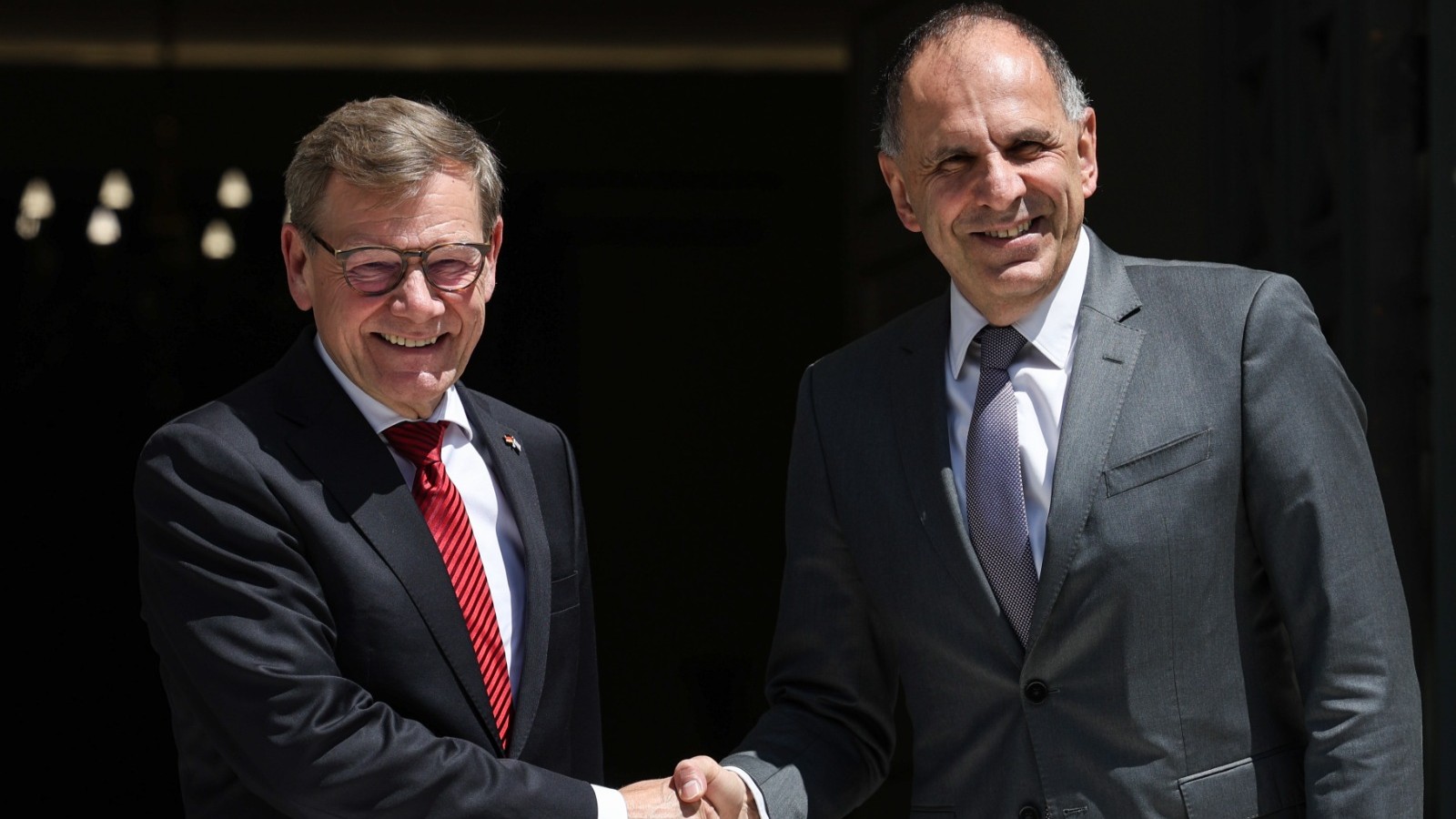
G. GERAPETRITIS: It is with great pleasure that I welcome today in Athens my dear colleague and friend, the Minister of Foreign Affairs of the Federal Republic of Germany, Johann Wadephul. We are bound by much: our legal training, our deep conviction in the value of institutions and human freedom, our belief in international multilateralism.
Today, we resume where we left off last March, during my visit to Berlin. The purpose of these successive visits is the will on both sides to strengthen our bilateral relations and to broaden our cooperation in areas of common interest.
Dear Minister,
We are living in complex times. The post-war security architecture is being challenged, traditional alliances are being tested, and we are called upon to adapt to this new, not always, favorable reality.
The challenges are numerous and by no means simple. Within the European Union, we are advancing the transition towards strategic autonomy, while within NATO we are promoting a reconfiguration of the distribution of defense burdens. In both organizations, the adoption of a 360-degree policy, which directs attention and strategic interest equally to all regions, including the Global South, is now a prerequisite.
I would also like to take this opportunity to congratulate you, dear Johann, on the organization of the International Conference for Sudan, today’s gravest humanitarian crisis. No contemporary crisis remains geographically confined. We must combine our efforts and the means at our disposal in order to address these crises.
Greece and Germany, as EU member states and NATO allies, are called upon to manage unprecedented situations.
Greece has consistently and by every means available stood in favor of international peace and stability.
In the wider Middle East, the extension of the ceasefire between the United States and Iran gives rise to hope for a return to negotiations. In Lebanon, direct talks between Lebanon and Israel may contribute to sustainable peace and stability in our region. As regards Gaza, it must remain at the center of diplomatic efforts, with top priority accorded to the enhanced and unhindered provision of humanitarian aid, as well as to the full implementation of the Peace Plan.
At this particularly sensitive juncture, compliance with International Law and with the fundamental principles of the UN Charter - drafted and adopted when the meaning of total destruction had become evident - must be universal. Today, unfortunately, our world does not seem to be moving towards peace.
Greece reiterates its readiness. A few days ago, we undertook the responsibility of hosting in our country passengers of the Global Sumud Flotilla, who disembarked in Crete from an Israeli vessel with the assistance of the Hellenic Coast Guard. Among them were nationals of 34 countries, including 6 German nationals. Beyond the self-evident humanitarian nature of this initiative, we also sought to reaffirm the obligation to uphold International Law and to respect human dignity - values that are enduring and non-negotiable.
I would particularly like to emphasize the universal obligation to respect freedom of navigation. This concerns not only global trade, but also the peace and prosperity of all peoples. Greece highlighted this imperative, in a timely manner, in its capacity as an elected member of the UN Security Council during the Greek Presidency in May 2025.
We support the international initiatives for the unhindered and safe passage through the Strait of Hormuz, and we intend to assume an active role in cooperation with the maritime community.
It is important to prevent the evolving crisis from taking uncontrollable dimensions for the global economy, the international food supply chain, and the daily lives of citizens.
Directly linked to the Middle East is also the security environment in the wider Eastern Mediterranean region.
I had the opportunity to convey to the Minister Greece’s positions regarding the challenges, as well as Greece’s sensitivities with regard to regional balances, which we consider as self-evident that partners and Allies such as Germany take fully into account.
In particular, armaments, and their non-use against Allies, constitutes a necessary condition.
We are convinced that the Eastern Mediterranean can become a maritime corridor of peace and cooperation, with multiple benefits for the peoples of our region, as well as more broadly for the European continent. It is precisely towards this objective that we are working with our neighboring countries.
Dear Minister,
There is much that binds our two countries together. German philosophy and culture are deeply rooted in ancient Greek literature, and the contribution of German scholars to the study and promotion of the classical spirit has indeed been profound. Goethe’s Iphigenia in Tauris, inspired by Euripides’s tragedy, constitutes in fact the transition from antiquity to the eighteenth century and beyond, investing the classical antiquity with the values of modern humanism.
Likewise, important institutions of the Greek State draw on the German legal tradition.
It is also worth mentioning that for decades, hundreds of thousands of Greeks have lived and worked in Germany, while Greece is one of the most popular travel destinations for German citizens.
I firmly believe that people-to-people diplomacy is the strongest and most beneficial form of diplomacy, for building mutual trust between peoples.
We are building our common future fully aware of the inalienable history. As regards the unhealed wounds left by the darkest period of modern history, the time has come for us to work together so that they may heal.
At the same time, the channels of information, which for decades had shaped not just an information but also a mutual understanding framework, and had not been closed even during the period of military dictatorship in Greece, should remain open.
Today, we also placed particular emphasis on the further development of the Greek-German Action Plan, which we signed ten years ago, in 2016. We agreed to upgrade our cooperation to a Strategic Cooperation.
An upgrade that is not just symbolic but substantial, since, from now on, we will be working jointly and systematically in all fields to maximize benefits for both our countries and peoples.
We exchanged views on broadening our relations in areas where our cooperation can be strengthened even further, such as in trade, investment, renewable energy sources, shipping, higher education, digital technology and innovation, and the economy.
Greece is now a pole of stability and progress. Over the last years, it has achieved the largest and fastest reduction in debt as a percentage of GDP ever recorded by any economy in the history of modern economies, and it has regained the confidence of the markets. The Greek economy remains on a positive trajectory; it has recovered successfully and demonstrates high resilience, constituting a successful example within the European Union.
We also discussed issues of bilateral concern, including within the EU framework.
We addressed migration management, especially in view of the entry into force of the EU Pact on Migration and Asylum. On the particularly sensitive issue of irregular migration, our countries have, despite difficulties, found common ground. We once again emphasize the need for a common and coherent policy for tackling this issue, which knows no geographical boundaries.
As a frontline country, we believe that the effective protection of the external borders of the European Union and the control of migration flows must constitute a shared priority, while fully respecting the principles of solidarity, burden-sharing in a fair and beneficial manner and humanitarian values.
Our discussion also focused on issues relating to the enlargement of the European Union. Greece has consistently played a leading role - since the time of the Thessaloniki Agenda - in advancing the European integration process of the Western Balkans, which is a strategic priority of the European Union.
As I informed you during my recent visit to Berlin, and also in the framework of the Foreign Affairs Council in Brussels, the first step has now been taken: the adoption of the Delphi Declaration between Greece and the Western Balkans. This Declaration codifies the fundamental principles and objectives of this accession process, while also referring to Greece’s Presidency of the Council of the European Union in the second semester of 2027, where we are expecting to have the opportunity to welcome a new member state to our Union.
It is of great importance that all parties involved work with renewed momentum towards this perspective. We know that Germany has played a leading role and is investing in this common perspective. A renewed vision must be given to the Western Balkans, without, of course, any concessions on the EU accession criteria, particularly the full implementation of the rule of law, the Fundamentals and good neighborly relations.
We could not, of course, fail to also refer to Ukraine, an issue which, over the past four years, has fundamentally reshaped the discussion on European security. I reiterated Greece’s firm and unwavering position in favor of respect for Ukraine’s independence and sovereignty, and stressed the need for a unified EU stance in support of a sustainable and just solution to the Ukrainian issue.
Dear Johann, I would like to thank you for the exceptional discussion we had today. In two days, you will mark your first year in office as Minister of Foreign Affairs of the Federal Republic of Germany, and I would like to thank you for your significant contribution to the deepening of our shared European vision. I warmly welcome you today in Athens, and I am confident that your visit will serve as a new impetus for an even more dynamic development of our bilateral relations.
Thank you.
Questions & answers
JOURNALIST: Good evening, Pierros Tzanetakos, from the public television. This is a question for both Ministers. Greece and Germany are participating in the initiative of France and Britain to deploy a naval force in the Strait of Hormuz in order to ensure freedom of navigation. Earlier, a few hours ago, the American President announced the launch of ‘‘Operation Freedom’’, as he described it, with the aim of freeing the ships that are located in the Persian Gulf. And I wonder if this is an opportunity for the Europeans to rush immediately to the field in order to defend their own interests, but also to project their defense capacity, and whether such a move could improve Euro-American relations, which, by general admission, are under strain. Especially in the case of Germany, after the latest decisions, intentions, let's say, of the United States to withdraw thousands of soldiers from German soil.
And if you allow me, a question for Mr. Wadephul because it concerns our colleagues in Germany but also bilateral relations, since Mr. Gerapetritis mentioned them. If there is a chance that we will see a change or some reconsideration of the decision to close Deutsche Welle. Thank you very much.
G. GERAPETRITIS: Thank you for your question. I will try to formalize the answer, telling you and the distinguished participants that Greece, as a great maritime nation, is in favor of free and unimpeded navigation. We believe that navigation is not just a commercial matter. Navigation is the link that unites peoples, the link that ensures the supply of the world and, above all, it is the link that brings together all distant peoples. Accordingly, any obstruction of free navigation constitutes a massive blow to the global community.
Greece, as an elected member of the Security Council, had already raised the issue of freedom of navigation since last May, even before the issues of the blockade of the Strait of Hormuz arose, precisely highlighting the importance of freedom of navigation. We will do everything in our power to continue, in cooperation with the shipping community, the unhindered and free movement of ships.
I would like to point out that, specifically with regard to the Strait of Hormuz, we consider it unacceptable that ships currently in the Gulf are being prevented from leaving.
Greece is participating in all initiatives, just as Germany is, to open the Strait of Hormuz - including the British and the French one. We welcome every effort made in this direction. We are willing to contribute in the future, when the situation normalizes, to have a defensive, auxiliary presence in the Strait of Hormuz, as we already do within the framework of the European mandate in the Red Sea, highlighting with our presence the value of freedom of navigation.
With regard to European Union - United States relations, I would like to point out that we consider this relationship to be of the utmost importance. We believe that the security pillar created after the Second World War, the NATO alliance, which largely guaranteed the new security architecture, should remain active and strong. Despite any problems, we believe that it is extremely important for this cooperation to continue. It is obvious that the idea of strategic autonomy, which is being developed within the European Union, will help in this direction, will help Europe to come of age geopolitically, but will also help in a fairer distribution of defense burdens within the Alliance. We believe it is important for Europe to stand by the United States and in particular for Germany, which is a large and powerful European country, to guarantee, with its active participation, the sustainability of the Euro-Atlantic relationship.
JOURNALIST: Michael Fischer, German Press Agency (DPA). Minister Gerapetritis, Mr. Wadephul just stated that Germany wishes to cooperate closely with Greece in the field of armaments. Greece has already concluded a number of such agreements with France, the United States and Israel. Does Greece, in general, need military equipment from Germany? If so, what kind of equipment? And how do you assess the fact that Germany has repeatedly cooperated with Türkiye in the field of armaments and has recently approved the procurement of Eurofighter combat aircraft?
G. GERAPETRITIS: Thank you very much for your question. I would like to note that, as a matter of fact, defense cooperation between Greece and Germany already exists. The Hellenic Navy and the Hellenic Army are already equipped with German-origin systems, which are currently operational.
With regard to further cooperation, I would like to underline that any procurement of defense equipment must fulfill two conditions. First, it must ensure interoperability; and secondly, there must be a necessary degree of diversification so as to avoid over-dependence. Above all, what we must keep in mind is that defense must serve both national and European interests. Because whether we are talking about German or Greek defense, we are, in fact, both participants in the same collective defense, which is the European defense. In the context of strengthening the strategic autonomy of the European Union, it is therefore absolutely necessary to establish common rules, a shared understanding, and common capability.
As regards armaments procurement between Germany and Türkiye, you understand that Greece cannot dictate to any country how it conducts its own defense procurement. What we do consider, however, to be a minimum requirement is that it must be ensured that when such systems are procured to third countries, they will not be used against an ally.
It is of critical importance for our common European defense, particularly today, when the challenges facing Europe are significant, and when we have jointly taken - together with Germany and the other EU member states - the major decision to build a single European defensive shield, to strengthen our collective defense in the most effective manner possible.
May 4, 2026