


Dear friends,
Dear compatriots,
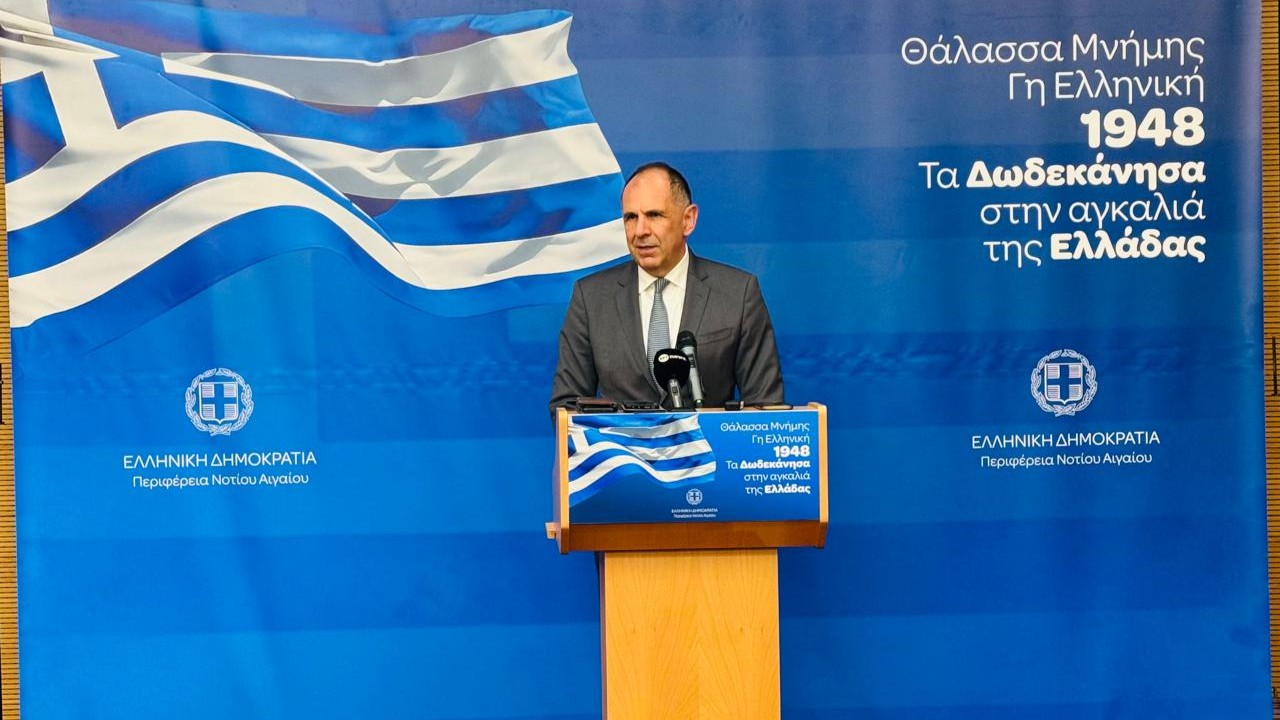
It may sound like a cliché to say that I feel particularly honored to be here with you today, but I would like to confess that I truly felt a need to be among you today - not as a way of decompressing from the hardships we have been facing at the Ministry of Foreign Affairs in recent months and years, with all the achievements of the post-war international security architecture seemingly having collapsed - but rather because here one can truly experience the uplifting feeling of the Greek spirit of our islands. Here, the heart of Greece beats a hundred times stronger; here, the sense of duty and responsibility we carry is heightened by the historical dimension of the Dodecanese. In the Dodecanese - the last to be integrated into the national territory - it is precisely here that one can feel this aura of what it means to be Greek, of the Greek soul. I thank you very much, Mr. Governor, for the honor of inviting me to be here today on behalf of the Greek Government.
My remarks today will be personal in nature. That is why I have no notes. I learned the history of the integration of the Dodecanese from my father. I heard it in many versions, because he himself had been involved in the early uprising in Karpathos that led, a few years later, to the integration. Therefore, whatever I say to you today comes from the heart. And whatever you hear concerning foreign policy comes from a sober approach and from a sense of responsibility that weighs heavily upon me, given the immense responsibility we bear toward our country as I stand today at the helm of Greek diplomacy at the most difficult moment since the Second World War.
The Dodecanese, Mr. Governor, esteemed Members of Parliament, Mr. Mayor, dear Consul, dear friends, have been “the most coveted bride” throughout the centuries. They have been a crossroad of many civilizations. They have been a crossroad of three continents. They lay on the European silk road. They bridged the East with the West, the North with the South. That is why so many laid claim to our islands: the Persians, the Genoese, the Venetians, the Knights, the Crusaders, later the Ottomans, the Germans, and the Italians. They were “the most coveted bride” indeed.
Yet - and this is perhaps the most important point - despite the immense and constant pressures and claims upon them, the people of the Dodecanese never wavered in their Greek identity. I repeat: although the Dodecanese were the last Greek land, the last land of Greek spirit, to be integrated into the territory of our homeland, their Greek identity never faltered. We came close to integration several times. In 1830 the Dodecanese could have joined the national body, the small Greece recognized through the London Treaties and Protocols. Instead, rather than the Dodecanese and Samos being integrated, Euboea became part of the Greek state. Later, in 1920, when Greece, as one of the victors, negotiated the benefits resulting from the First World War, the Dodecanese briefly came under Greek sovereignty through the Peace Treaty, with a short transitional period of Italian administration of Rhodes. However, the Asia Minor Catastrophe brought the Italian claims back into play. The claims of both the Italians and the Turks over the Dodecanese never ceased. Thus, we experienced yet another setback - another delay - after 1922, and we had to wait twenty-five more years before the Dodecanese were finally integrated into the national territory.
The Greek identity of the Dodecanese was so strong that it remained unaffected even by attempts at subjugation. In mainland Greece there was, of course, Ottoman rule. In the Dodecanese, however, beyond Ottoman rule, there was also a very strong Italian presence, which sought precisely to suppress the Greek soul of the people - either through the “carrot,” such as granting Italian citizenship, or through the punishing “stick,” the violence inflicted upon the Dodecanese people by the harsh Italian occupation. Let us not forget that.
I referred earlier to something that for those of us born in Karpathos is a true badge of honor: the uprising of Karpathos on October 5, 1944. At that time a handful of people - including my father - effectively expelled the Italian administration and the Germans who were on the island, and assumed the island’s administration themselves. A week later, after a heroic effort by residents of the small neighboring village of Arkasa who managed to reach Egypt to carry the message of the uprising, British ships arrived in Karpathos and took over the administration for seven months.
Karpathos was for the most part free even before the liberation of the rest of the Dodecanese, which occurred in May 1945 with the landing of British forces here in Rhodes. Then came the great moment with the Paris Peace Treaty of February 1947, the landing of the British, and the formal transfer of Rhodes over to Greek administration in March. And of course, tomorrow marks our great anniversary, the anniversary of the integration of our islands into Greece on March 7, 1948. Greek historiography has recorded something that I believe is the most characteristic example of the Greek identity of the people - how deeply they longed for this union, how it reflected the aspirations of generations. The intergenerational desire of centuries for union with the homeland was captured in a moving episode: on March 31, 1947, when the islands were handed over to Greek administration, the Greek delegation was accompanied by the future first President of the Third Hellenic Republic, Michalis Stasinopoulos, who served as a political advisor to the administration at the time. He recounts in a truly chilling way - one that I believe we can all feel - that when the official ceremony took place and the islands were united with the Greek state, the residents of Rhodes went to the island’s cemetery to convey the news of the union with Greece to their dead. Such was the longing of generations to be united with the motherland.
It is truly a great moment for all of us, a great moment for Hellenism. And it is the clearest proof that Hellenism cannot be extinguished by any violence or under any regime. Whoever attempts in any way to suppress Greek identity will achieve only one thing: to make it even more resilient. Today the Dodecanese are once again at the forefront. These are difficult times. A few hundred kilometers from here, from Rhodes, a war is raging the likes of which no society has seen since the Second World War. It is a war in which ten states are directly involved and many more indirectly. It is a war affecting a vast geographical region. The great powers of our time are involved, and its significance is measured not only in the thousands of victims each day but also in the profound impact it will have on both the present and the future.
Greece maintains a principled stance in this war, as it has done for years. It consistently aligns itself with International Law without any concessions. The protection of civilians under Humanitarian Law is non-negotiable. At the same time, we stood on the right side by recognizing that Iran cannot develop nuclear or ballistic programs of such a nature that they pose a threat to regional and international peace. We stood firm in the face of any attack or threat against our brotherly nation of Cyprus. And we supported shipping and freedom of navigation, which are crucial not only for maritime transport - which is so vital for Greece - but also because shipping guarantees the global supply chain and prevents a major economic crisis from reaching our doorstep.
What is happening today in the wider region of Iran is unprecedented, and we are addressing it as such. I would like to outline the fundamental perception guiding our foreign policy - the foreign policy of our homeland. We believe that our foreign policy must be resolute and consistent, one that enhances our country’s international footprint. Greece is not among the great powers. It is not so in terms of population or territory. Yet it possesses a diplomatic footprint far greater than its size. In recent years, Greece has managed to position itself at the heart of all major international organizations. It has been elected as a member of the United Nations Security Council - a very exclusive club of fifteen countries that help shape the international security architecture. It has forged strategic alliances with those who today defend freedom and security: strategic partnerships with the United States, Israel, the Gulf countries, and also India, creating an axis of alliances that broadens our international reach. It has supported our national cause by putting forward legitimate claims based on International Law. And it has developed cooperative frameworks that strengthen not only Greece but Hellenism as a whole.
In recent years we have also relied on a triptych that, I believe, has greatly strengthened our country: strong diplomacy, resilient economy, upgraded defense. Today Greece is stronger than ever. This was demonstrated when Cyprus requested support through our defense capabilities. There could have been no other response but the one we gave without hesitation: we will support Cyprus in every possible way so that these threats fall into the void. It is a historic brotherly duty.
At the same time, we have strengthened the defense of our islands. As the Governor vividly mentioned earlier, we have seen images of the deployment of powerful systems, which I want to emphasize are defensive systems. Greece harbors no aggressive ambitions toward anyone. It is not in our DNA to do so. But we have an extremely strong determination to defend our national cause without compromise, and when it comes to our islands, this is something from which we will never deviate. The defense posture of our country and the defensive shielding of our islands are our first and absolute priority, and we will never back down on this.
You know, power is a very relative concept. Power does not need to be imposed or displayed. Power is demonstrated through will, intention, and the perception that others have of your strength. Today the Prime Minister decided to respond to a request from neighboring Bulgaria to support it with the defensive means we possess, redeploying certain units - again of a defensive nature - within Greek territory to ensure the security of our wider neighborhood against potential aggressive actions. Just think: small Greece today responds to requests from other countries to help provide regional security.
The years that have passed recently have been years of great strength. Greece emerged from a painful economic crisis and managed to stand on its feet again. It strengthened its citizens - though not as much as we would wish, and more must still be done, especially for our border regions. However, it moved past the image of the “black sheep” of the European family and became a strong pillar, even a driving force behind initiatives at the European level.
An outward-looking Greece strengthened its defense, which for many years had lagged due to economic hardship. Today we can take pride in our upgraded fleet and in the capabilities provided by our military aircraft and the Hellenic Air Force. These represent real strength - not because we seek it for its own sake, but because we feel an obligation to develop it for the generations of Greeks who will come after us. Whenever one chooses a policy, the first thing one must consider is what will be passed on to future generations - just as our heroic compatriots did, preserving for centuries, since the 14th century, the Greek soul, the Greek spirit, and the Greek education of the Dodecanese. They did not alter their identity. They insisted on union with Greece until, in the end, it was achieved. That is the greatest legacy. Our duty to previous generations is, in essence, our commitment to future generations.
Before thanking you for the great honor of being among you today, allow me to reiterate that in recent years Greece has multiplied its strength. Today, it not only possesses power but also commands the perception of power, and this is recognized by all. I believe this is something that would bring joy to the souls of all the Dodecanese people, of all the generations who came before us. Many happy returns to all.
March 6, 2026