


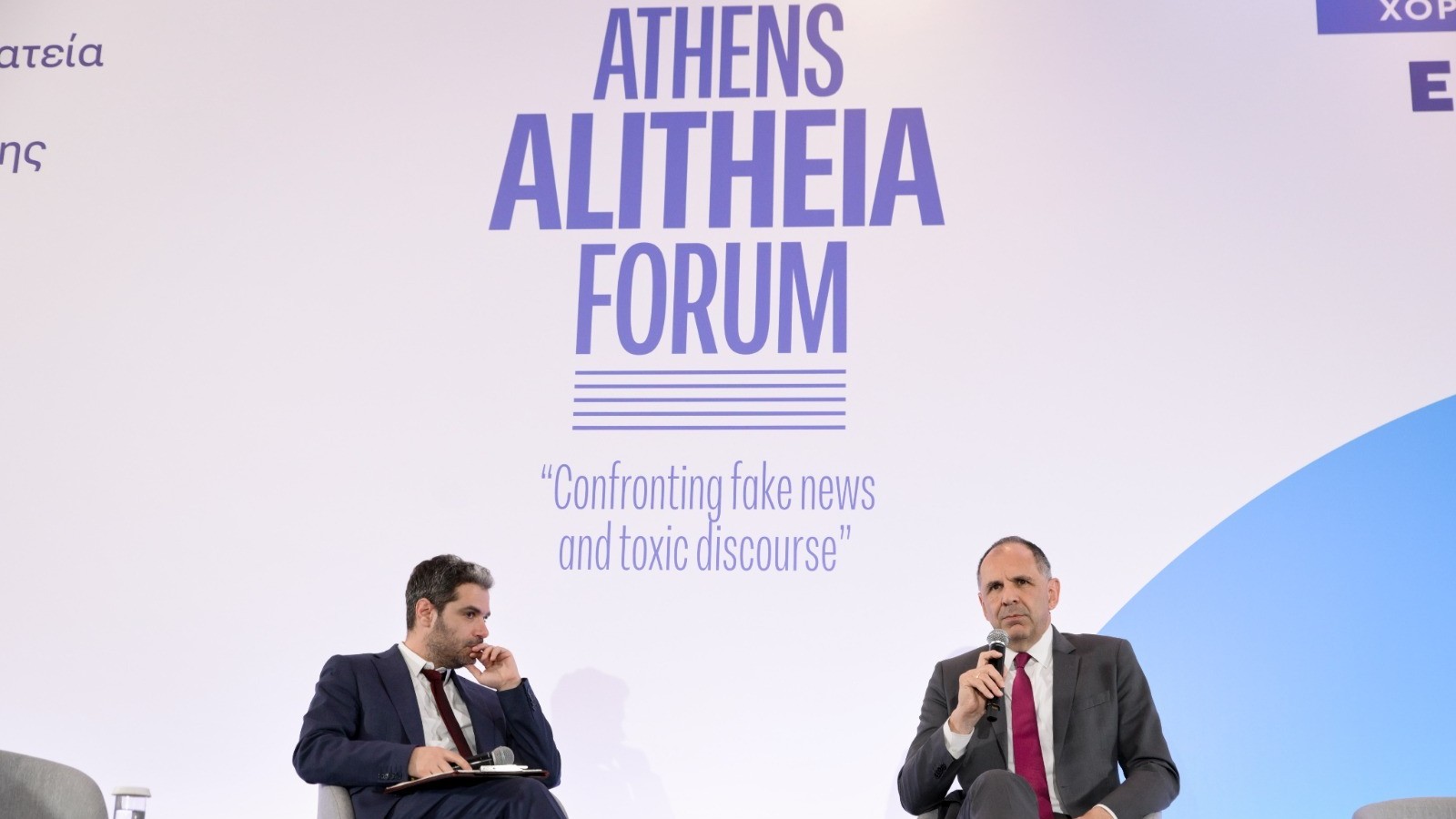
JOURNALIST: Good evening from us too. We would like to thank the General Secretariat of the Government for the invitation. It is a pleasure today to speak with the Minister of Foreign Affairs, at a time when, Minister, your role and your position are at the forefront of the news, for unfortunately for the wrong reasons, because of the war in the Middle East. We will also talk about this, but not only about this. Our topic is different. Fake news and how false information can even create an international crisis. And to begin with, I would like your opinion on whether it is possible, in today's era, for false information to reach the point of even creating an international crisis. In other words, not to remain simply at the level of social media, rumor-spreading, or the negative sentiment among citizens, but to go a step further.
G. GERAPETRITIS: First of all, I would like to warmly thank the Deputy Minister and you, Mr. Papantoniou, for the invitation. It is a great honor to be among you today and to discuss a very critical issue, not only for international security, but I think also for democracy itself. Unfortunately, fake news is based on a very legitimate means, which is the development of technology. And like all great discoveries, great advances, progress, does not come without a price. Cutting-edge technology also comes with a great price, which is linked to misinformation, which unfortunately, in our days, takes on an extremely aggressive character. The vast majority of people, of citizens, are now being informed through social media. As a result, this information is unsubstantiated, unverified. Furthermore, the accuracy and integrity of the news is now sacrificed on the altar of speed. Speed, which I think has become an endemic characteristic now, and haunts us all. Shortly before coming here, I saw two posts, since posts are the subject of our discussion. The first post is about a bomb, captured by a camera, which strikes a World War II Japanese warship. It was clearly obvious that the image was fake, it being a color image of high definition…
JOURNALIST: The comments below must be interesting, what did most people think it was?
G. GERAPETRITIS: The post got five million unique views in a few hours. Five million viewers, the vast majority of whom, I think, believed that something like this was actually happening. And then I saw something even worse. I saw photos of bombings in Ukraine, which had been transferred to the Middle East today. And of course, the comments claimed that these were bombings in the Gulf countries, in Iran, in Lebanon, in Israel. And it was completely believable. After searching, I found that the time needed to create such a false impression, for an expert, is 15 to 30 seconds. So, we all understand how low the cost and required time for such a production is, but at the same time how high the price for democracy and peace is.
JOURNALIST: Α very nice example, Minister. My question is about this. Five million views. It may have been believable to a certain extent that we do not know of, or those who created the post might know. To what level can this reach? It may remain only at the level of citizens or it may even create a crisis at a higher level? That is, to influence developments high-up in the pyramid.
G. GERAPETRITIS: But in most cases, the purpose is to create a crisis. If you see what is happening today in the international arena, you will simply realize - I imagine with regret, like all of us - that this type of false transfer of information is done consciously. Not simply with the aim of misinforming citizens, but either to alter the characteristics of democracy, or to create an international crisis. Imagine, in the last year alone we have had multiple cases of electoral processes with tens of thousands of bots and false information, by a specific sender, in an attempt to influence the democratic choice of citizens. Because democracy without freedom and integrity of information is incomprehensible. It is a prerequisite.
JOURNALIST: And what is the defence against this? From both a technical and a practical point of view. That is, the Ministry of Foreign Affairs has to deal with - we are talking about a theoretical scenario now - such a phenomenon, which concerns our own country. Are there any defence mechanisms?
G. GERAPETRITIS: The mechanisms exist and are constantly developing. We should simply know that, with the development of technology, any antibody that is created always creates a new form of research and innovation on it. So, we should definitely be constantly vigilant.
JOURNALIST: Do we have an example on this?
G. GERAPETRITIS: Of course. I am pleased to tell you that from April 1st, a new specialized platform will operate at the Ministry of Foreign Affairs, the Global Media Center, which will aim to gather all the news from any medium, from any institution.
JOURNALIST: Are you giving us news now?
G. GERAPETRITIS: I am giving you news. The Global Media Center will be about matters of Greek interest, and will proceed with a clarification of current affairs, so that we know the origin and integrity of the news, there will be processing and an immediate reaction, through public diplomacy. It is a project, which was funded by the Recovery and Resilience Fund and in a few days, it will enable the country to know, first, what news is circulating, second, the level of their integrity and third, the recommended steps for the reaction against it.
However, I want to be completely honest with you. I do not feel that the reaction can be beneficial, definitive and sustainable, unless it reaches the level of becoming part of our own education. In other words, if there is no digital education at all levels starting from the school itself and the family environment, I consider it impossible to truly address this scourge. Because disinformation - conscious misinformation - is the modern form of totalitarianism.
JOURNALIST: Of course, this is slower, what you are saying, compared to the other. Because the consequences of misinformation and fake news can have an immediate impact and there must be a mechanism that will be even more immediate.
G. GERAPETRITIS: We used to say that the greatest danger to democracy and peace was demagogy.
JOURNALIST: It has always been so.
G. GERAPETRITIS: Unfortunately, demagogy is nowadays, rather, a very mild characteristic. Speech in general is always open to criticism. The multiplying medium is not open to similar criticism. What we are observing today is what the international bibliography also refers to as the era of post-truth. Post-truth is in reality osmosis, a blurred landscape between reality and emotion, so that everyone perceives each event, not in its absoluteness, in its reality, but experiences it as an emotion. Unfortunately, modern information, modern manipulation, is mainly done with an attempt to subordinate the image to emotion. Many times, we see the use of children, for example, in order to create a major crisis, since we are referring to issues of international crises.
How many times have we not seen cases of news that also include images. Artificial intelligence is no longer checked for its accuracy, except following a very complex process. How many times have we not seen news that precisely use young children in order to provoke emotion at the expense of citizens, at the expense of states, at the expense of peoples?
JOURNALIST: Minister, what you are describing also raises a question for me, which I really wonder about: could fake news and this type of misinformation constitute - if it does not already constitute, - a form of hybrid warfare in the future? That is, essentially, should we include fake news and misinformation in the official - I put it in quotation marks - threats?
G. GERAPETRITIS: It is currently considered a registered, fourth global threat, in all international reports.
JOURNALIST: So, it is already a threat.
G. GERAPETRITIS: It is already a threat nowadays and has an absolutely upward trend in its potential and effectiveness, positioned after armed conflicts and other forms of hybrid threats. In fourth place among the real threats and following the climate crisis, in fourth place among all threats that plague humanity today, is disinformation.
We must understand that disinformation is a medium that is impossible to combat. As I said before, it is low-cost and immediate. It is impossible for anyone to be able to counter it effectively.
I would like to say the following. I was thinking about it now that I was reading the title of today's event "Alitheia". "Truth", as you know, etymologically arises from the negation prefix "a" and from the word “lithi” - oblivion, which means that it corresponds to something not subject to oblivion, that is, it remains in eternity as a real ontological context. Unfortunately, today, the real fact does not have self-existence. That is, if anyone attempts to diminish the absoluteness of the fact, it is certain that they will succeed, and they will succeed in an absolutely effective way. Therefore, in this era of post-truth, there are incidents that are forgotten, and they are easily forgotten.
I sometimes make the point, I used to make this point with my students. In reality, what we experience today in the information society - which has many good qualities but also these negative aspects that we are discussing today - is that reality is no longer a clear painting, like the classic painting of the Renaissance. It is a purely impressionistic painting, without extreme lines, with absolutely blurred fields, so that no one can distinguish where each edge of reality lies. So, to this small dystopia, which we all pay as the price of the technological age, we should have a universal educational response.
JOURNALIST: Minister, we have a war in progress. I don't know if the question has a specific answer, but if we could say right now, in 2026, with this particular war in progress, what percentage of the war is influenced by fake news? Would you have an answer to this question?
G. GERAPETRITIS: I think it greatly influences the representation of war around the world. If we look at what is happening right now, the reactions of the rest of the world - and I'm not just talking about the countries at war but also about the countries neighboring the conflict - we will see that the collective consciousness is formed mainly based on the information that is circulated via the internet and especially via social networks.
JOURNALIST: Which are also fake, to a certain extent…
G. GERAPETRITIS: Which are incomplete to a significant extent.
JOURNALIST: In terms of percentage, do we have an idea of how much this could be?
G. GERAPETRITIS: Note what the peculiarity is. That the news item circulated via a social network, has a unique value, but it also carries an amplifying value. The news item reported by a reliable media source has a unique value. However, news that are fake and transmitted through algorithms in an amplifying manner carries a geometrically increased value. Therefore, it depends on the way a news item is transmitted. And, since those who seek a systemic amplification of information usually accomplish it through such means, unfortunately false information has an infinitely more amplifying effect than true information.
JOURNALIST: Minister, earlier, responding to my question, you mentioned a mechanism that would be able to monitor, check fake news and in a certain way halt them, if I understood correctly. So, another question arises, which I think we will face, sooner or later. Where does control end and the right to expression begin? And what kind of debate can this create? Because, you understand that such checking, such control, can very easily produce different kinds of problems and create the impression – as we also live in rather conspiratorial times - that we want to control information.
G. GERAPETRITIS: Freedom of expression is the basis of modern western civilization. It is a right that, in reality, has emerged in its absolute form. It is one of the few rights that the West, and especially the American view of things, has perceived as an absolute right that cannot be subjected to restrictions. Modern democracies were built on it.
JOURNALIST: But does this debate scare you? That at some point it will begin? “Don’t stop me. I will say whatever I want, despite the fact that you want to impose restrictions on me and silence me.”
G. GERAPETRITIS: Two parameters are crucial here. The first is that the safest way for the truth to be lost is in a sea of information. The second is that mechanisms aimed at manipulating the truth are much more potent than the truth itself. So, in my opinion, what we must address, is not controlling the flow of information. In this case, reality has surpassed regulation.
If one attempts to create a regulatory framework for the control of truth, they will fail. Why is that? Because in reality, technology is to such an extent beyond and above the law that the law cannot manage it. What can we do? We can juxtapose the truth, with what we call public diplomacy, that is, make sure the truth can be effectively opposed to any lie and, above all, to really foster the value of truth. Because, at the end of the day, truth is not just a trait inherent to democracy or freedom. Truth is a prerequisite for real coexistence between people.
JOURNALIST: You responded in a diplomatic manner, as a good Minister of Foreign Affairs and I accept it because it was a diplomatic answer. Have you, as Minister of Foreign Affairs, faced fake news that worried you, that set off the alarm?
G. GERAPETRITIS: I face them every day.
JOURNALIST: Regarding our country?
G. GERAPETRITIS: Regarding our country, on a daily basis. Every day there is fake news regarding the facts. I would like to make the distinction, because I think it is necessary to do so for reasons of academic integrity.
I distinguish between criticizing, which can and should be done, especially against and at the expense of public figures. All public figures must have a high level of tolerance towards criticism. The issue of truth, of facts, is another matter. Facts, precisely because they have an ontological dimension, cannot be distorted. You can criticize as much as you want. But facts should be accepted by all. Unfortunately, this type of osmosis between facts and criticism is the root of the problem. For every country, as we speak, there is a risk stemming from disinformation. And I am not just referring to its public image, I am also talking about infiltration, which can be carried out by foreign countries to exert influence and can, in a sense, appear under a democratic shroud, to influence the citizens’ conscience and, in reality, permeate the collective subconscious. And, as we are currently experiencing a tectonic turmoil, tectonic changes in the international architecture and, specifically, security, what I want to underline is that we should all be vigilant. In essence, confirming any information should become second nature to those of us dealing with public affairs.
JOURNALIST: Minister, last question, because we cannot fail to comment on what concerns us all, the war in the Middle East. An estimate on the probable duration of this war?
G. GERAPETRITIS: You all realize that if I were to make an estimate, it would belong to the realm of metaphysics, because nowadays nothing is more predictable than unpredictability. We examine all possible hypothetical scenarios for any potential development. However, I must look beyond these, which are obvious, and see that there is hope for a possible de-escalation of the crisis and of the tensions. We understand that for the countries involved, already enduring a huge cost, even in human lives, as well as in erosion of the social fabric, the consequences are very significant. But the consequences are now evident all over the world and will have a multiplier effect, on the economy, on potential migration, on geopolitics. I feel that perhaps we are in a phase of relative de-escalation. I do not expect that hostilities will stop overnight and we will sit down at the negotiating table. However, I do feel that there is increasingly a general understanding that this war will have no winners.
JOURNALIST: To wrap up, do you believe that the imprint of the war will be indelible or the wound can be healed, when the war concludes, as it concludes?
G. GERAPETRITIS: The wider Middle East is a region that has been in constant turmoil for centuries. It is an open wound and I think that we must perceive it as such. What I want to stress is that any treaty to end the war, any treaty on the future of the wider region, must first and foremost have a sustainable character. And for a peace treaty to be sustainable, it must not leave peoples humiliated. Through this extremely negative situation, this dystopian situation, all the peoples of the wider region must emerge, at the very least, with a better level of security and the ability to coexist harmoniously. Because, as history has taught us, humiliating treaties are merely ephemeral.
JOURNALIST: Minister, thank you very much.
G. GERAPETRITIS: Thank you so much.
March 10, 2026