


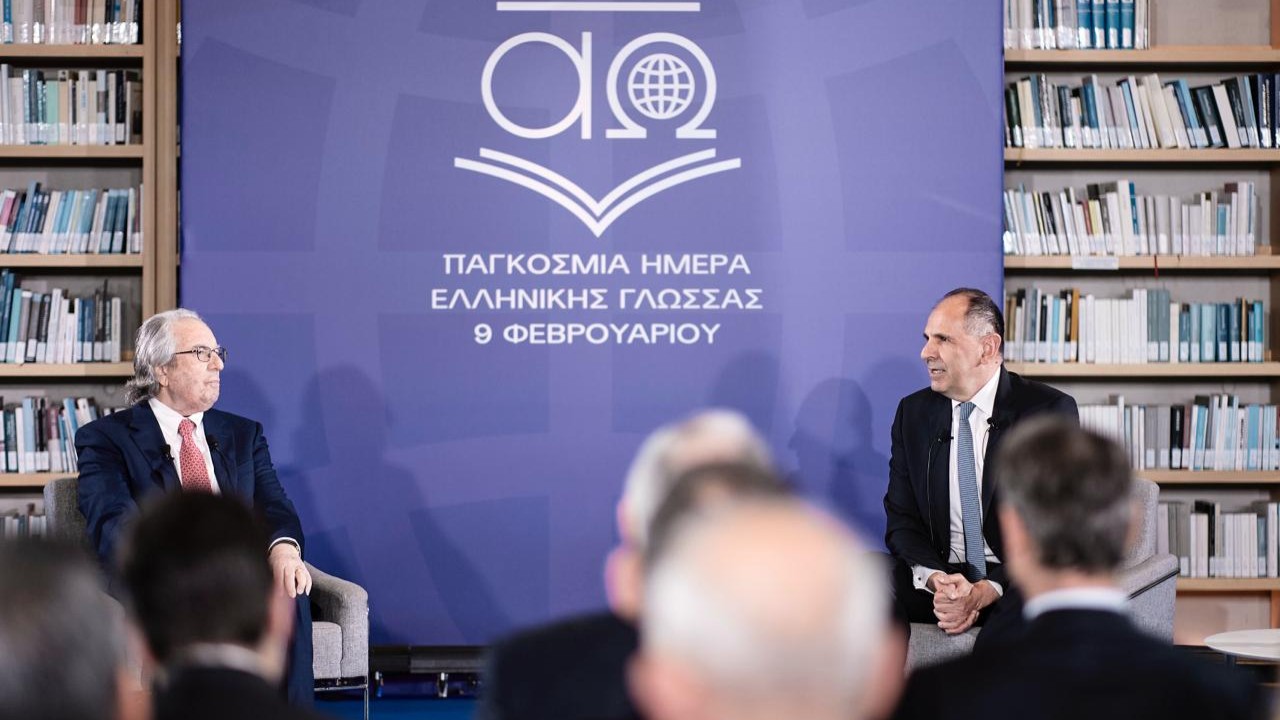
G. GERAPETRITIS: First of all, I would like to thank you all for your presence here today. Professor, today is not merely a day that symbolizes continuity, preservation, and the vitality of the Greek language. It is Greece’s day, and our conviction is that this day will gradually, throughout the world, become the day that highlights the greatness of universal Hellenism. Because language is not merely a means of expression, it is culture itself and, ultimately, freedom.
I had the great honor of working with Professor, Mr. Babiniotis. I wish to confess to you that, amid my preoccupation with Greek-Turkish relations, Libya and Syria, the brightest interludes of the past year, Professor, were the discussions we held on language and its continuity, the effort we undertook together with the Ministry of Culture and the Ministry of Education, Religious Affairs and Sports, with our Permanent Mission to UNESCO and above all with the Professors of linguistics, Mr. Babiniotis, and Mr. Klairis and their associates, for a major endeavor, which led to today’s successful outcome.
Professor, today the entire world speaks Greek, and this is a great honor we bear as a country, but also a great responsibility: to preserve and perpetuate this precious jewel we possess, our language, which has survived for four thousand years. Since language is not merely a means of expression, it is something more, Professor.
G. BABINIOTIS: Language is, in reality, our thought process, Professor and Minister. It is a particular joy for today’s gathering to have the highest level of political and intellectual leadership present. And I am pleased to see faces in the audience, from the Rector of the University of Athens and the National Technical University, to professors of the University of Athens who also serve language and linguistics.
At the outset, I would like to emphasize something that may also be politically useful. What is that? On this issue, the national issue that language truly is, there was a kind of indirect consensus, Mr. Prime Minister. In 2017, the SYRIZA party issued a Joint Ministerial Decision to promote Greek as a global language. This, however, did not progress. And in May 2024, I once again raised the issue with an article of mine on the website protagon.gr, and from there the PASOK party also acted in parallel, drawing on my article, and requested from the President of the Hellenic Parliament at the time that the Parliament support the globalization of the Greek language, something that was not institutionally possible. In parallel, this effort of the Greek Government began. Mr. Koumoutsakos from the diplomatic corps spoke with you, Mr. Prime Minister, along with the Minister of Foreign Affairs, Professor Mr. Gerapetritis, and the Deputy Minister at the time, Mr. Kotsiras, to encourage him. And then addressing us linguists, particularly myself, to support this effort scientifically, with a difficult text that should not offend representatives of other countries by suggesting that Greek is superior to their language, but rather persuade them of the real and historical fact that Greek is a language of culture that shaped European civilization, Western civilization, and through European civilization all forms of culture, and of course all European languages and, through them, other languages more broadly.
And what you said, Minister and Professor, is always important: that language and words are not only about language and words. They are our thought process; they are the function of cognition. That is, words exist for concepts. They would have no reason to exist, if the concepts we wish to express did not exist. And when we link concepts and create meanings, then we link words and create sentences. Through syntax, once again, language serves thought. Indeed, a great philosopher, Husserl, in one of his books written in English, stated that language was not created merely for communication, it was created for the expression of thought. Such great emphasis is placed on the function of thought.
And it is there that not only vocabulary but - as the President of the Republic also stated - syntax and grammar play a very significant role, because the backbone of language is syntax. The Greeks, having cultivated philosophy, science, theatre, and everything that constitutes an expression of civilization, were compelled, along with their concepts, to find ways to denote them. Thus, an enormous vocabulary developed in all fields, about which the English say: “The Greeks have a word for it” - and they do not say this by chance. It is for this reason. At the same time, however, Plato, Aristotle - to remain within the field of philosophy - could not have expressed such profound, complex meanings and ideas without cultivating syntax and grammar in depth.
It is not accidental that the Greek verb has 285 forms. The Greek verb. Moreover, in the Thesaurus Linguae Graecae, where Greek texts from Homer to the historians of the Fall of Constantinople have been digitally recorded, the Greek thesaurus contains 105 million words. One hundred and five million words. Not that these are distinct words, dictionary lemmas, but the words used in the 12.000 texts that have been recorded. And when we say 12.000 texts, the greatest philologist in Europe, Ulrich von Wilamowitz, stated that the texts that have survived amount to only one fifth of the total. If we therefore take 12.000 as a base, around 60.000 texts must have existed. But because these were neither all recorded, nor taught, nor used, they gradually disappeared, and thus only 12.000 texts from 4.000 authors remain.
G. GERAPETRITIS: The question, if you allow me, Professor, is how many words from the 105 million in the thesaurus are used today, and whether this lexical impoverishment, this brevity of expression, which unfortunately appears today even in public discourse, can be reversed. The reality is that the Greek language possesses immense depth and wealth. Through reborrowings it has influenced all languages, continental, European, even Spanish, but in reality, today we experience a significant contraction in everyday verbal expression, and there are, of course, important reasons for this.
G. BABINIOTIS: Let us come to that as well, but beforehand, regarding the first part of your thought - because sometimes Greeks say things that may be considered a form of linguistic arrogance - I would like to tell you something and ask you to bear it in mind. What does a giant of philological and linguistic science, Pierre Chantraine, write in the Etymological Dictionary of Ancient Greek: History of Words, published by the Triantafyllidis Foundation, translated and now also available in Greek? I would like to tell you what Chantraine says, who was also the scholar who introduced into his dictionary the forms of Linear B, the Mycenaean script. Others had not yet included these forms. When he begins a dictionary entry, if a Mycenaean form exists, he begins with the Mycenaean.
Pierre Chantraine therefore states: “In this choice of ours - namely, the emphasis on the history of vocabulary - we had the opportunity to benefit from a privileged situation. We are able to follow the history of the Greek language already from the second millennium BC, thanks to the Mycenaean tablets of Knossos, Pylos and Mycenae, up to Modern Greek, demotic and katharevousa, in a continuity during which the language has not undergone profound changes in terms of its structure, despite significant differences between periods”. And he concludes: “Greek presents an uninterrupted history, and Modern Greek, in the form of “demotic” or “katharevousa”, constitutes the direct continuation of the Greek language of Homer and Demosthenes, while the language of the Byzantine period provides the link that connects the two parts of the chain. We undertook the project of tracing the history of vocabulary, emphasizing continuities and deviations in a diachrony which, through various unforeseen events - listen to this - extends across forty centuries”. This is the assessment of the greatest authority on Greek language, Pierre Chantraine, author of the etymological dictionary, who always reaches as far as Modern Greek.
Today, Professor, I would like us to emphasize this as well: that we are not speaking of a celebration limited to antiquity and the ancient language. Given this unbroken continuity of spoken language to the present day, when we celebrate the Greek language, we celebrate the Ancient, Medieval and Modern Greek language. And Chantraine strongly emphasizes this. It is therefore a complex matter. But you are right, Professor and Minister, when you say that today a certain problem exists, let us call it that. Why? Because our interest in language as a value has diminished. In the past, whoever wrote or spoke was very careful about what they said and wrote. In recent times, we are very hurried and produce our discourse, spoken or written, in a very short time.
G. GERAPETRITIS: Verbal brevity.
G. BABINIOTIS: Indeed, and therefore we have not accorded language, the very expression of our thought, the value it deserves. And by exposing language, we expose our way of thinking.
G. GERAPETRITIS: I believe this leads us, Professor, to a deeper concern, which is the relationship between language, ethos and democracy. We often ask ourselves what the true value of democratic discourse is. And I think that language is not merely the limits of our thought, but in reality, a prerequisite of our freedom. If citizens do not have a good understanding of language, they will never become free, because they will not discover the foundation of democracy, they will not be informed, they will not be able to choose those leaders, who will serve the common good. And unfortunately, in the era of rapid information, of phenomena in which spell-checkers instantly correct texts or even where dictation is carried out mechanically by artificial intelligence, the words lose their value and become detached from their ontological content.
G. BABINIOTIS: This problem exists, but I am pleased that, as a professor, as a politician and as an intellectual, you focus on democracy. The first great international word of Greek origin is democracy, and the second is dialogue. Whatever language one considers, dialogue exists, and it is a prerequisite of democracy.
I would like to tell you that when we speak of the ancient world, and especially of the political systems of Athens and other great cities, democracy is the subject to which all aspects of life refer. Thus, it is explained - and I would like the audience to hear this - that German academies of the humanities, from 1815 to this day, publish Greek inscriptions, 150.000 Greek inscriptions in fifty volumes. Why inscriptions? Because decrees, decisions, and everything related to public discourse, democracy, and institutions have been transmitted through inscriptions. And, thus, German scholars publish these inscriptions saying - note this - that in this way they bring the world into contact with our civilization. They use “our” because they view Greek civilization as European and, as such, as co-owned by them.
Therefore, democracy is inseparably linked with freedom of speech and the cultivation of discourse. Let us not forget that democracy was also linked with rhetoric, not rhetoric for the sake of eloquence, but rhetoric that persuades through arguments. This is why rhetoric was practiced as an educational process.
And something else about freedom, Mr. Minister. Freedom is also what characterizes all people in the use of language. We are all idio-stylistic, meaning that each of us, whether educated or less educated, chooses, when speaking or writing, the words, syntax, and grammar we use. Each of us has our own style. We may not all be geniuses, but we are all idio-stylistic. This is a form of freedom and the highest form of economy. And I “challenge” the competent Ministers. The highest form of economy can be found in language. Why? Because with twenty-four sounds, twenty consonants and five vowels, we denote all the words of Greek, over 100.000, and if each has three meanings, three hundred thousand meanings, all expressed with twenty-five sounds. Five vowels and twenty consonants. And let us consider the alphabet, the Greek invention. What did the Greeks do? They invented the vowels. Because vowels are the basis of Indo-European languages. Consonants are articulated with vowels. With twenty-four letters we write and denote the three to four hundred thousand meanings of the Greek language. Is this not economy?
That is why the great figure of the seventeenth century, Galileo, said - listen to what he said: that the greatest invention of humankind is the Greek alphabet. Because with twenty-four letters one can express even one’s most intimate thoughts on a sheet of paper.
G. GERAPETRITIS: And as the historian Hering also said: “Let us speak Greek in order to rest”. Because through Greek concepts, reflected in Greek vocabulary and the Greek alphabet, the soul itself can truly find repose.
G. BABINIOTIS: That is so. And it is not accidental that this vast number of words, of thoughts that is, has passed into European languages and, through them, more broadly. The greatest English linguist, David Crystal, author of The Encyclopedia of the English Language at Oxford, writes: “English as a classical language”. What does Crystal maintain? That two-thirds of English words are of Greek and Latin origin. Since two-thirds derive from classical languages, English is therefore a classical language, that is his argument. And here is the proof.
G. GERAPETRITIS: Professor, I would like to conclude by returning to the consensus you mentioned at the beginning. Indeed, the recognition of World Greek Language Day was a longstanding effort of the Hellenic Republic. It is a significant endeavor. Of course, we should not always indulge in self-congratulation, this was not always the case historically. Only in Greece, I believe, could there have been a revolution over a language issue, the “Evangelika”, the “Oresteiaka”, over whether the Gospel or the ancient dramas should be translated. This, however, also reflects the intensity with which the Greek people attach to their great and precious asset, the Greek language, and, above all, their pursuit of consensus on language. The recognition of World Greek Language Day could constitute a major legacy, given that consensus is not always present. And constitutional revision, as is well known, is forthcoming.
Professor, I would conclude by saying the following: today we have the great honor of celebrating, for the first time, World Greek Language Day. We must and ought to be proud of our language. I would ask the audience, if you have time, to take a look at the booklet that was distributed to you. We invited fifteen major figures of language and culture to write about the Greek language. The richness of this booklet is unique, and there we will truly see that it is not only the Greeks who believe our language is precious, but the entire world.
Let us see our value, and acknowledge it. Above all, we must preserve it as a major legacy. And for us, the major task - the Prime Minister has already provided the direction - is a major program for the promotion of the Greek language abroad, through specialized education, which will concern not only children of Greek origin, but non-Greek children as well. We were deeply moved, Professor, to hear children speaking Greek.
I would like to share that today, at the Hellenic Parliament, we honoured five distinguished Greeks who have founded and continue to operate an outstanding public charter school in Miami, Florida, where 95% of the students are not Greek. They learn the Greek language, speak it fluently, and are admitted to the world’s top universities.
The Greek language must serve as a major diplomatic vehicle, a vehicle of soft diplomacy. And through this, I would like to thank you most warmly for your presence. I thank you all, may we always be well and continue to celebrate this day.
G. BABINIOTIS: It is both an honor and a pleasure!
G. GERAPETRITIS: Thank you very much!
February 9, 2026