


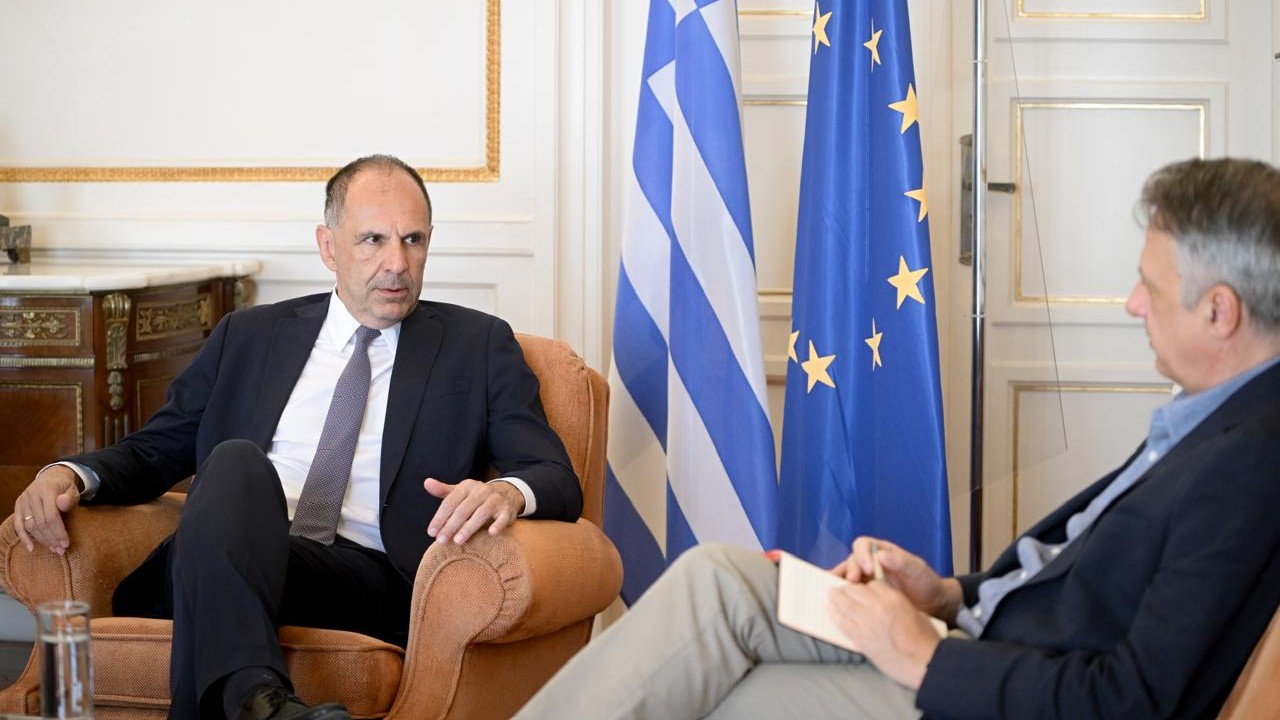
JOURNALIST: Minister, are we witnessing the end of “calm waters”?
G. GERAPETRITIS: Calm waters are not an end in themselves, but a means of serving our national objectives. This policy followed a period of prolonged and escalating tension with Türkiye, which posed a tangible threat to peace in our region and could even have led to conflict. The choice, therefore, to establish a functional relationship with our neighbouring country was clear and beneficial to our national interests: reducing crises while simultaneously strengthening Greece on multiple levels.
First, violations of our National Airspace decreased, migration flows from the east were minimised, the islands of the Eastern Aegean were given breathing space and developed economically, and, despite tensions, no major crisis occurred.
Second, we made use of this time to grow our economy and strengthen our defence. In particular, our Armed Forces, which had suffered an enormous blow as a result of the economic crisis, were significantly reinforced and today enjoy a position of superiority in the air and at sea, with Rafale aircraft, upgraded F-16s, Belharra frigates, the new multidimensional force structure, as well as the new cutting-edge weapons systems we expect in the coming period, particularly the F-35s.
Third, Greece has strengthened its diplomatic standing and today stands at the height of its power. We are at the core of all major international organisations, with strategic alliances with key countries such as the United States, France, Israel, Egypt, India, and the Gulf countries. At the same time, we healed festering wounds, such as in our relations with Libya, and expanded our diplomatic footprint across the world.
Fourth, the improvement in our relations with Türkiye contributed decisively to the resumption of informal discussions on the Cyprus Issue, following a long period of stagnation, under the auspices of the UN Secretary-General.
Fifth, for the first time, Greece put forward, in an unequivocal manner, legal and political arguments in support of our national positions, such as Maritime Spatial Planning and the programme for the development of our subsea resources, which safeguard our sovereign rights in practice.
JOURNALIST: And what about the “Athens Declaration”? Should we consider it “dead”?
G. GERAPETRITIS: Dialogue with Türkiye is not an invention of the present government. All the
Greek governments since the restoration of democracy have engaged in discussions with Türkiye, at times in an unstructured and unproductive manner, with 64 rounds of exploratory talks that did not contribute anything substantive to strengthening our national positions.
The Athens Declaration established, for the first time, a structured dialogue based on three pillars. The structured dialogue functioned as a channel for de-escalation in relations between the two countries. Of course, we did not expect our longstanding differences to miraculously disappear - after all, the Declaration itself provided that the parties retain their respective legal positions. However, in an extremely volatile and unpredictable international environment, with wars raging across our broader neighbourhood, it is important to have a clear and defined framework for communication and peaceful resolution of our differences. And, indeed, this framework also rests, for the first time, on Türkiye’s explicit acceptance of the universally recognised principles of International Law.
JOURNALIST: In any case, we see Türkiye building a leading role in the region and, as far as we are concerned, attempting to “create faits accomplis”. First of all, do you agree with this assessment?
G. GERAPETRITIS: Türkiye’s actions in the Aegean and the Eastern Mediterranean constitute a reaction to our own initiatives, which aim to safeguard our sovereign rights on the basis of International Law. They form part of a broader attempt by Türkiye to build a profile as a regional power, with a strong defence industry and a presence in other countries. Unfortunately, Türkiye’s presence in countries such as Libya and Syria is not always beneficial. Indeed, Türkiye’s latest interventions in Syria appear to be fostering a tendency towards further assertiveness, with spill-over effects for security in the wider region. No fait accompli, however, can be created unilaterally. This is what the international legal order dictates, and we always ensure, either independently or through our international alliances, that this is made clear and conveyed to all.
JOURNALIST: So, to put it simply, what do we do? Will our strategy change and, if so, in what direction?
G. GERAPETRITIS: Greek foreign policy is not determined by others. It is formulated independently, as an exercise of our sovereignty, not through the prism of the foreign policy or initiatives of Türkiye or any other state. We consistently pursue our strategic plan, respond with action to empty threats, and take the strength of our national defence and our geopolitical position to new heights.
Greece will continue to shape its foreign policy in our region, not only vis-à-vis Türkiye but vis-à-vis all countries, on the basis of International Law and good neighbourly relations. But always through proactive initiatives of a kind never undertaken before, and without compromising our national rights. If this bothers some, at home or abroad, they will have to get over it. The Greece of passive diplomatic inaction is irrevocably a thing of the past. It has been replaced by a self-confident Greece that takes the initiative.
JOURNALIST: Let me raise a practical issue. Ankara has announced two environmental parks. Under the pretext of protecting them, it is requiring permission for passage to Lemnos and Kastellorizo. Do you consider such a scenario unlikely? Would that constitute a “casus belli” for Athens?
G. GERAPETRITIS: The Turkish environmental parks, as announced, are illegal and produce no legal effects, because they extend beyond Turkish territorial waters into undelimited international waters of the overlying Greek continental shelf. Of course, the relevant Presidential Decrees do not include any terms or restrictions relating to environmental protection, but only coordinates. In any case, the position of the Greek Government is clear: any attempt to infringe upon our sovereign rights will be addressed through every appropriate means. Our primary objective is, of course, the peaceful settlement of disputes, but we are fully prepared for every scenario. For us, patriotic duty does not lie in empty rhetoric and cries for war. It lies in enhanced strength, constant preparedness and an unwavering willingness to defend our homeland.
JOURNALIST: You say that the Turkish parks “produce no legal effects”. How do you think such an argument is received in the White House today?
G. GERAPETRITIS: Although we are living in an international environment in which the security architecture is nowadays shaped more by power and less by rules, I believe that no one wants a global jungle. The Western tradition of commitment to international multilateralism and International Law constitutes our defence against any opportunistic revisionism. Yet one does not negate the other. We invoke International Law; we build our strength. In cooperation with our allies, such as the United States, with which we enjoy excellent relations and maintain an open line of communication, we work tirelessly to strengthen our national positions. Obviously, we cannot determine the foreign policy of other countries, even our allies. What we always ensure, however, is that Greece’s positions are heard and that we have the necessary support and standing for them to be taken seriously at all times.
JOURNALIST: Nevertheless, Minister, it is clear that Tayyip Erdoğan has strong leverage in Washington. We might say that Donald Trump “emboldens” him. Who is backing us?
G. GERAPETRITIS: In recent years, our country has not only ceased to rely on others for support; rather, it has been providing support to other states. This has been evident in Cyprus, the Balkans, the Middle East and the Gulf countries. In today’s multipolar world, it is not enough to be strong; you must also project strength. And, as far as we are concerned, this projection is reinforced by the regular expressions of gratitude from states for the security we provide them. While others desperately seek external assistance and focus on appearances rather than substance, we are building our strength and preparing for the Presidency of the UN Security Council next October and the Presidency of the Council of the European Union in the second half of 2027. Our country is at the centre of major international policy developments. We did not need anyone’s backing to determine the terms for the participation of non-EU countries in European defence programmes such as SAFE; we did not need anyone’s backing to join the F-35 and F-16 upgrade programmes; we did not need anyone’s backing to confront the hybrid migration attack at Evros. At the same time, we play a leading role in the European Union’s EUNAVFOR ASPIDES operation to protect freedom of navigation in the Red Sea, as well as in EUNAVFOR IRINI in the Central Mediterranean. We do not need to borrow courage from others; it is in our DNA.
JOURNALIST: We get rather measured support from Europe. As usual, one might say. On the other hand, are we perhaps overinvesting in our relationship with Israel?
G. GERAPETRITIS: Allow me to disagree. The European Union operates through convergence and compromise, but it does work. And it demonstrates that, when necessary, it innovates, takes initiatives and stands by its Member States. If you read the European Council Conclusions, the reports of the European Commission and the European Parliament, and the positions developed in the context of initiatives on European defence and strategic autonomy, you will realise that solidarity towards both Greece and Cyprus is substantive.
On the other hand, our relationship with Israel is strategic in nature. It is a long-standing relationship in which Cyprus also participates actively within the framework of the trilateral cooperation we have developed. We engage in dialogue with Israel as strategic partners, but we also engage with the entire Arab world. Our foreign policy operates on multiple levels, with open channels and partnerships guided solely by the objective of strengthening our country’s international standing. I understand that a force multiplier for us, such as our relationship with Israel, may bother some. I want to be clear: none of Greece’s alliances is formed to threaten another country. However, the Greek State does not take instructions from anyone as to how it develops its bilateral and multilateral relations.
JOURNALIST: Let us return to the Aegean. What are we doing with our own parks? Are we moving forward? Are we abandoning them?
G. GERAPETRITIS: For the first time, Greece established its Maritime Spatial Planning framework, recording the outer limits of its continental shelf and Exclusive Economic Zone. In a single document, which forms part of the European acquis, it recorded its maritime zones, both those already delimited by agreement with neighbouring states and their potential outer limits where no such agreement exists.
In addition, two new National Marine Parks were designated, in the Aegean and the Ionian. This is an environmental initiative of major importance for biodiversity conservation, habitat protection and raising awareness of the marine environment. This naturally includes restrictions on human activity, navigation and fishing. These restrictions are environmental in nature and aim to protect vulnerable marine ecosystems. At the initiative of the Ministry of Environment and Energy and in cooperation with the relevant ministries, the implementing Presidential Decrees will be issued in the coming period.
JOURNALIST: However, we all understand the difference. We limited ourselves to 6 nautical miles, while Türkiye extended its parks into international waters. Was that “self-restraint” a mistake? I am also asking in relation to the initial intention to establish a park in the Dodecanese.
G. GERAPETRITIS: International Law cannot be applied à la carte. Greece acts exclusively within the framework of International Law and, in particular, the International Law of the Sea. This is not “self-restraint”; it is a self-evident obligation, a conscious choice reflecting responsibility and institutional seriousness by a country governed by the rule of law that respects the international order. This is what a responsible Government does, so that in the future it has a legal interest enabling it to invoke International Law in all its aspects. In this way, we expanded Greece by extending our territorial waters in the Ionian Sea and up to Cape Tainaron; we exercised our sovereign rights through the agreements delimiting the Exclusive Economic Zone with Italy and Egypt; we entrusted energy giants with the exploration and exploitation of deposits south of Crete; we introduced Maritime Spatial Planning; and we are moving forward with the Marine Parks in the Aegean and the Ionian Seas. Indeed, when in Greek political history have we ever seen so many initiatives that safeguard our rights?
Those who criticise us for Türkiye’s expected reactions to these Greek actions should first explain why they themselves did not dare to undertake even one of the actions on this list.
JOURNALIST: Nevertheless, a situation appears to be taking shape in which Türkiye does not recognise a continental shelf for the Greek islands, disputes others, announces marine parks and passes a law on the “blue homeland”. Minister, is the status quo in the Aegean changing step by step?
G. GERAPETRITIS: Türkiye’s historically unfounded and groundless arguments are not new; they go back decades: “blue homeland”, “grey zones”, demilitarisation of the islands. Nor did we expect Türkiye to abandon these positions. We put forward our own arguments in response, which, for the first time, are now on the table. And we call on Türkiye to join us in referring to the International Court of Justice the only dispute that can be brought before international jurisdiction - the delimitation of the continental shelf and Exclusive Economic Zone - on the basis of International Law. Those who do not fear International Law adhere to it and, where no common ground exists, refer the matter to international jurisdiction. Those whose positions are not grounded in International Law refrain from ratifying international treaties and engage in unilateral illegal actions. In such a case, however, there is a price to be paid vis-à-vis the international community. If the reported Turkish draft law on maritime jurisdiction zones is inconsistent with the International Law, there will be consequences.
JOURNALIST: Egypt. What would its accession to the Mecca Agreement mean for us? Are you having second thoughts about the presence of the Patriot battery in Saudi Arabia?
G. GERAPETRITIS: Egypt is a strategic partner of Greece. Greece and Egypt are pillars of stability in the region and maintain a strategic partnership founded on historical ties and a shared understanding of the major issues in the region. At the same time, together with Cyprus, we maintain stable and substantive trilateral cooperation, which has demonstrated its added value and resilience.
Our relationship with Saudi Arabia is also strategic. Saudi Arabia was in fact the first country in the Middle East with which Greece institutionalised a High-Level Strategic Cooperation Council, reflecting the importance we attach to our cooperation. Moreover, Saudi Arabia is among the countries that have clearly opposed the Turkish-Libyan memorandum. The agreement on the deployment of the Greek Patriot battery in Saudi Arabia is exclusively defensive and deterrent in nature and is linked to the protection of critical infrastructure, which also bears directly on Greek and European energy security. It also provides significant added value for the training of our military personnel and the testing of systems under real operational conditions. Greece always monitors regional developments with due seriousness and adjusts its stance on the basis of the national interest, Greek defence priorities, and its international commitments.
JOURNALIST: Turning now to the Greece-Cyprus electricity interconnection cable, the participation of France’s Meridiam has been secured, while surveys in areas of the Eastern Mediterranean are still pending. Nicosia has raised the issue of protecting the surveys. Do you envisage a role for the Armed Forces in providing such protection?
G. GERAPETRITIS: The Greece-Cyprus electricity interconnection is a project of major importance that will lift Cyprus’ energy isolation. The recent entry of France’s Meridiam as majority shareholder in the Great Sea Interconnector company confirms the project’s financial and technical viability and its value. It goes without saying that our country, in coordination with the Republic of Cyprus, will take all necessary steps to ensure its full and unhindered implementation.
JOURNALIST: What “offensive weapons” do we have at our disposal? Would the Government consider extending territorial waters south of Crete to 12 nautical miles?
G. GERAPETRITIS: The extension of our territorial waters to 12 nautical miles is an inalienable right, which Greece may exercise unilaterally at a time and in a manner of its choosing.
JOURNALIST: What is your relationship with your Turkish counterpart like now? Do your personal channels of communication remain open?
G. GERAPETRITIS: The Minister of Foreign Affairs of Türkiye and I have achieved a satisfactory level of communication regarding each side’s positions and red lines. Thanks to this communication, major crises have been avoided over the past three years and a functional relationship has been built for the benefit of both peoples.
JOURNALIST: Your domestic critics regard the calm waters as an illusion and the Government’s policy in the Southeastern Mediterranean as, at the very least, “soft”. What is your response?
G. GERAPETRITIS: In both Greece and Türkiye, in the context of irresponsible and opportunistic political discourse, even simple communication between two politicians is sometimes demonised. But we must understand that without dialogue, no problem can be resolved. And, in any event, dialogue does not mean retreating from our national positions. Those who advocate cutting off bridges with Türkiye should at least have the sound judgement to explain what consequences such an irresponsible stance could entail.
As to the substance of the matter, in order to assess whether the calm waters policy has succeeded, beyond the self-evident fact that it secured for us a period without major crises amid extremely adverse geopolitical shifts, we need to compare where we stood in 2023 with where we stand today and consider whether the intervening period has served our national interests. In 2023, Greece had definitively emerged from the economic crisis and was on a path of steady growth; it still bore the scars of the major migration crisis and the pandemic crisis; it was still in the process of strengthening its Armed Forces; and it was gradually expanding its diplomatic footprint across the world, while Türkiye had consolidated its longstanding claims, had signed the legally null and void Turkish-Libyan memorandum and maintained a strong international presence.
The intervening period of calm waters has been crucial and beneficial to the balance of power: Greece is today an extremely strong international player with a voice in international affairs across the board; it is in an exceptionally resilient fiscal position; and its military strength has reached new heights, while during the same period we institutionalised our arguments in the Aegean and Eastern Europe. Yes, we want peace. But we want it from a position of strength. With self-confidence and without fear or insecurity. This is the Greece of today.
August 23, 2026