


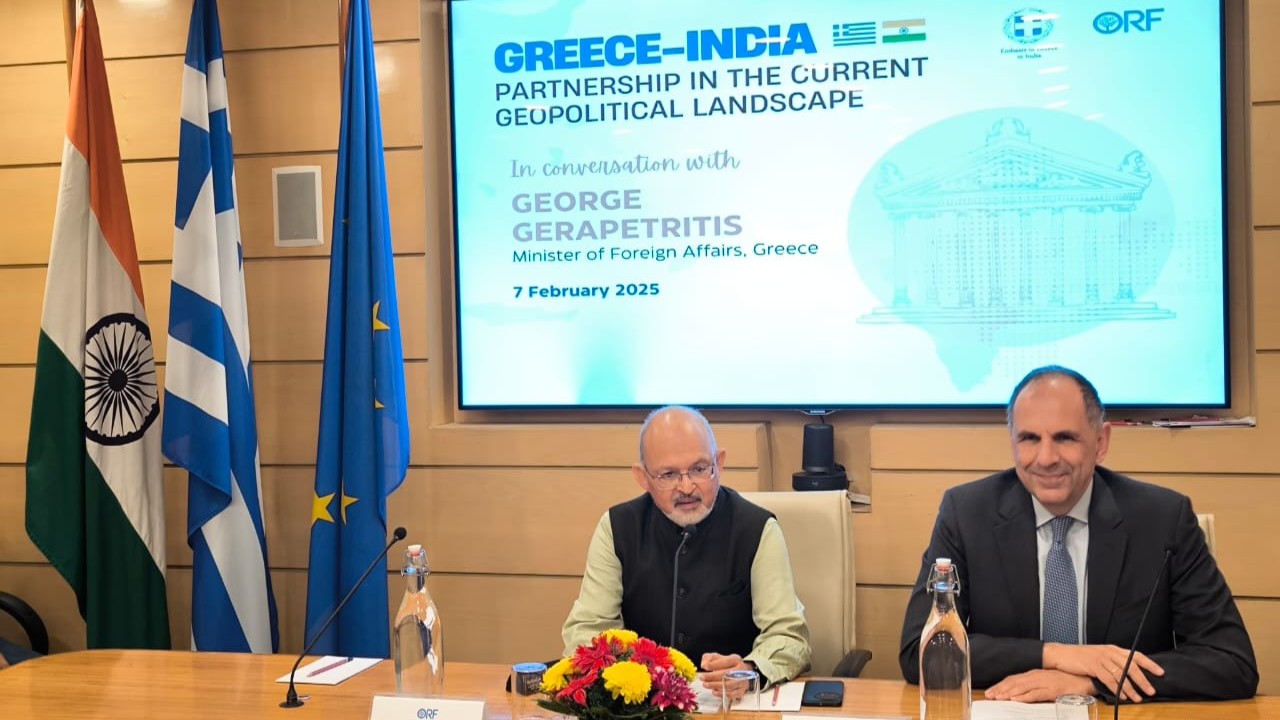
I think it is normal when you begin your speech in front of such an educated and knowledgeable audience to start by first thanking for the invitation. Indeed, I'm grateful for being here, after a series of visits, that are still ongoing, after Saudi Arabia and Qatar, Israel, the Palestinian Territories, Jordan, India. And there is more to come. I have to tell you that I feel the need to share my views, and I would like to also hear from you.
Because what is really missing, I think, in contemporary politics is, in a sense, testing the political ideas and policies, and just have some sort of interaction, a deliberative attitude towards things. Because on some occasions we are very strong on our opinions, we are opinionated. We are not as deliberative as we should be, and that leads us to extremes. Instead of building bridges, we just destroy the existing channels of communication. International communication is really a pre-requirement for peace and prosperity.
I am really grateful to the “Observer Research Foundation” and to its Chairman for the invitation. I take it that he's very popular, because I can see a lot of people in this room looking forward to hearing from him.
I have to say that since my last visit here many things have happened. To start with, our membership at the Security Council of the United Nations commenced as of January 1st, 2025, and for a term of two years. The current situation is the most difficult one to be a Minister of Foreign Affairs, and even more so a Minister of Foreign Affairs within the Security Council. I will explain why in a while. Then we also have two ceasefire agreements. We have the Lebanon ceasefire and the Gaza ceasefire. We have a new, rather surprising or at least unexpected development in Syria.
And we have the new US Administration and we are still trying to explore the scenarios ahead. And I think this is indeed a difficult task. The truth is that there's going to be some significant change in the perception of globality, of international affairs. So we need to be prepared for what is happening, and we need to solidify partnerships of like-minded states, of like-minded people.
But I will start by saying something very self-evident. That the world is in turmoil. I said it last year, I say it this year too. I can't say that we have made a lot of progress. We have some rather volatile ceasefire agreements in Lebanon and in Gaza. There are still huge pending issues in order to proceed with substantive peace in the region. We haven't settled important prerequisites in order to have sustainable tranquillity in the region, such as the security arrangements, the governance in Gaza the day after. But also the international common understanding required, in order to achieve a sustainable solution for turbulent regions such as the Middle East. We all agree that, at the end of the day, we need to achieve sustainable peace.
We almost all agree that we need to have a new Palestine state, a two-state solution, but we cannot agree on how to achieve this. The problem is not that we cannot solve complicated issues. The problem, I think, in the international security architecture is that we cannot find a common understanding, even in simple cases.
In the Security Council, a few weeks ago, we had a rather unpleasant experience. We had a draft Resolution initiated by the United Kingdom, concerning the humanitarian aid to Sudan. Sudan is probably the biggest “minefield” in the world, because there is a tremendous humanitarian crisis, with almost 15 to 20 million people displaced and on the verge of famine. The Resolution was essentially about unhindered humanitarian aid to flow to Sudan. I have to tell you that the Resolution was rejected because of the veto powers vested in the current members of the United Nations Security Council. So even for the simplest decisions in the international arena, we have to fight. And this is not something which is really optimistic about the day after in the international security architecture. It is obvious that for many states, the idea is that national interests prevail altogether over any sort of global approach that would entail protection of minorities, overall protection of human rights, protection of peace and stability. In view of all this, I think it's not unfair for someone to say that multilateralism, as we have known it after World War II, is in real danger. And I will elaborate further in a while.
If multilateralism is threatened and we need to just address the issue of how we concede national interest for the sake of global values, then what would the solution to a new international security architecture be? My idea is that the whole international security architecture was essentially based on two layers. First, a very strict geographic type of diplomacy and international relations. We would say what Thucydides – the ancient Greek historian – would say, that geography is destiny.
What we were trying to do was to actually bring our neighbourhood in a state of tranquillity, by building, let's say, regional alliances. On the other hand, we had a wide range of nationalistic tendencies in the United Nations or the League of Nations, which were the examples of that type of multilateralism. What was missing was the idea that we need to build further layers in between local regionalism and wide multilateralism. And this is exactly, I think, what we should place emphasis on.
The idea, for example, of IMEEC is exactly that. We need to abandon the idea of locally limited, restricted, narrow regionalism and proceed to an intermediate level of a new prospect of multilateralism.
And I think the India–Middle East–Europe Corridor is exactly this. We are all stakeholders of global challenges. We need to admit this. Unless we admit that there is not a single challenge which is located only in a region or even in a broader neighbourhood, we cannot proceed to any sort of meaningful solution for the future. There is not - I have to say this with huge emphasis - there is not a single challenge that does not have a global character.
That's the truth. I will give you an example, the pandemics. When we were discussing in the West how to treat the COVID pandemic, we were saying that we need to have at our disposal all types of medical treatment against the pandemic. There was a race in order to get the proper medication. Nobody really cared about how the pandemic would impact the underdeveloped world, such as Africa or in some countries in Latin America or even in the Pacific. And the situation was that the pandemic was still active, in spite of the fact that essentially all people of the Western developed world were able to get proper preventive medication. Because the mobility of people is of such an extent that you cannot prevent any pandemic from being circulated very widely.
This is a very narrow idea of how we treat global challenges. Another modern, let's say, challenge, is AI, artificial intelligence. I would say, it is just a small paradigm of misinformation and disinformation. Misinformation and disinformation could harm democracy. Democracies are very vulnerable today, exactly because there is abundant information just floating around without anyone being able to see what the accurate information is. Because proper democracy, functional democracy, really relies on full, proper and true information. But this is practically not achievable. Because there are so many means of “deep fake” models today. So, democracy is fully endangered. And you cannot say that because you are in India or in Greece, you can in some way solidify and protect your democracy from external actors trying to misinform or disinform citizens, because misinformation and disinformation can be rooted anywhere in the world. So, you cannot actually be protected from this. A long time ago, let's say 20, 30 years ago, we used to say that the only global challenge of the world, apart from aggression of one state against another, was the environment. Now, the environment is only a small part of the global challenges. You can see how volatile the situation is.
It only took a statement by President Trump to completely overturn the balance of the Paris Agreement and of global environmental protection policies. So, you see that now there's not a single challenge that doesn't have a global character. We need to start with this premise, and we need to build new international models of cooperation, of diplomacy, in order to reinvent the basics.
What should diplomacy be? This is the question. There are two ways, I think, to deal with this. The first option is to actually be based on the idea of national utilitarianism. You do what is proper and beneficial for the country. That means that it could be an ideology based on utilitarianism or an ideology based on transactionalism. But at the end of the day, that means that you need to have as your priority what is best for the country. The second option would be to employ a more, let's say, moral approach to international relations. I would say that we need to have a rules-based and principled international order. Not only an international legal order, but also an international social order, because it has to do with education, it has to do with various factors affecting the mentality of people.
There is a sort of rivalry here between transactionalism and principled diplomacy, and you can see the pros and cons of both. I have the feeling that in the last few months or few years, there is a clear shift towards transactionalism. And this cannot be the response to global challenges, because by definition, transactionalism entails two national interests, or entails national interests against the global common interest. So, this cannot be the response.
“Dharma”, you say in India, ethical moral principles in one’s in life. This should be the solution. We need to have moral principles established, because unless we have some moral principles in international relations, there is no way that we can establish a rules-based world. If we do not have a rules-based world, then any type of aggression can happen, not only conventional aggression. I have a feeling that conventional aggression is nowadays probably the less onerous threat. Why? Because it is very visible. There are so many threats worldwide that are almost invisible, which actually make the world absolutely unstable. Now, as we speak, we have 55 active conflicts around the world. Almost 25% of the whole world is in a state of conflict.
This is the volatile atmosphere that we encounter today around the world. We should be more on the side of moral principles when it comes to international relations.
Now, on the basis of this idea, which means rules-based principled foreign policy alongside with alliances built on a transnational and trans-regional level, I think the cooperation between India and Greece is a model, is an exemplary case of how states should cooperate. With India, we share a huge culture. We are both ancient civilizations that were deeply rooted in principles, such as democracy. In fact, India is the largest democracy in the world, whereas we are probably among the smallest democracies in terms of population.
Yet, we claim that we have invented the idea of democracy, so we have some rights of “intellectual property” in democracy. So, we do have something in common. But Greece has a lot of things to offer. And you can see why. Because first of all, its position is very strategic. We are essentially at the crossroads of three continents, four seas. We are strong members of the European Union, of NATO, of the United Nations. We are now an elected member of the UN Security Council.
We belong to the Balkans, which is a very volatile region as well. But above all, out of history, out of good luck, or out of competence, we have made it to be reliable interlocutors, with almost all stakeholders in our broader region. The mere fact that in my travels, I meet with Kings, Prime Ministers, Foreign Ministers who would have difficulty to even speak to each other, is a good indication, I think, of how we operate. I think, to be honest, that this is actually the good thing when you have a principled foreign policy, that you can be on an equal footing with everybody, and nobody has any sort of concern or objection. So, frankness and openness. I don't need to say why India is an invaluable partner. It is obvious why. It is a large country, a country with a huge diplomatic footprint, but also a country that could be the leading partner of an emerging world, of the Global South, of BRICS, of a new world which is now emerging. I clearly say, and I want to be very straightforward on this, that from our position as a member of the Security Council, we are going to work very hard in order to echo the voice of India within the Security Council.
And of course, I have to thank India for supporting our candidacy. We are going to unilaterally support India's candidacy for the Security Council for the 2028-2029 term. But to be honest, I don't know if it is proportionate or even politically ethical to have India contesting for this position. India should be at a much higher position. After all, I think within the next few years, we are going to revisit the structures and the governance of international organizations, including, among others, the United Nations. So, the question concerning the composition of the Security Council, the decision-making, the veto rights, will by all means be on the forefront of the discussion. So, we are going to be there.
Now, just a couple of words concerning our presence within the Security Council. You can interrupt me if I say too much, because I would like to also mention that we have a series of priorities during our term in the Security Council. Our priority will be the peaceful resolution of disputes. And to be exact revisiting the essence and the true meaning of the peaceful resolution of disputes. Because we have completely lost the spirit of the UN Charter when it comes to peaceful resolution. I recall the 55 conflicts around the world. Then we have women, peace and security, protection of children in armed conflicts, climate change, and maritime security.
Maritime security for us is a very critical aspect of peace and prosperity, not only because Greece is a very strong maritime nation and Greek ship owners essentially own more than 20% of the world’s merchant fleet, but also because I think maritime security is an issue of global concern. We see what is happening now with the Red Sea and the Gulf of Aden. We see what is happening with the Suez Canal, which threatens not only security concerning the transport of goods, but also has a huge impact on inflation and on national economies. For example, the economy of Egypt is now at stake, exactly because there is a tremendous disruption in the income from Suez. Because almost 75% of incomes have been lost because obviously now many prefer to go around Africa instead of going through the Suez Canal.
So, this is of utmost importance. I know that for India, this is a very critical factor. India has a vested interest in maritime security. We have discussed extensively with my colleague, Dr. Jaishankar, who is very enlightened when it comes to foreign policy and a very influential actor in the international scene. We have discussed extensively on how to coordinate in order to elevate the status of maritime security to the benefit of our two nations. And I think IMEEC is also very close to the idea of safety and security.
IMEEC is not only about data, or energy and transporting goods. I think it is a channel of peace for our neighbourhood and for the globe. I think it is important that it provides an alternative route among other routes, because it is important to have diversified routes when it comes to mobility.
Because you cannot heavily rely on single routes. The example of Russia, the overreliance of Europe on Russian natural gas is very pertinent I believe. I think IMEEC is going to be a landmark project for the future. It's about time that we start thinking about it seriously. We can't wait until the war ends in Gaza or Lebanon. We need to have a very strong alliance of like-minded states based on democratic values, on free flow of people and goods, but also free flow of information in order to develop that new route.
We are going to work very hard with India. We have a strong strategic relationship of mutual esteem. And I think this is the way to proceed. It is important to be ready to face the challenges in the next couple of years, when the whole doctrine of international relations will be dramatically changed because of new challenges, and hopefully because of the end of the two wars.
Yesterday I went to the Museum dedicated to Mahatma Gandhi. And I was in awe visiting the place where Mahatma Gandhi was assassinated. The symbol remains and transcends centuries. I would like to share one of his sayings with you and conclude with this: “I'm praying for the light that will dispel the darkness. Let those who have living faith in non-violence, join me in the prayer.”
Thank you so much.
February 7, 2025