


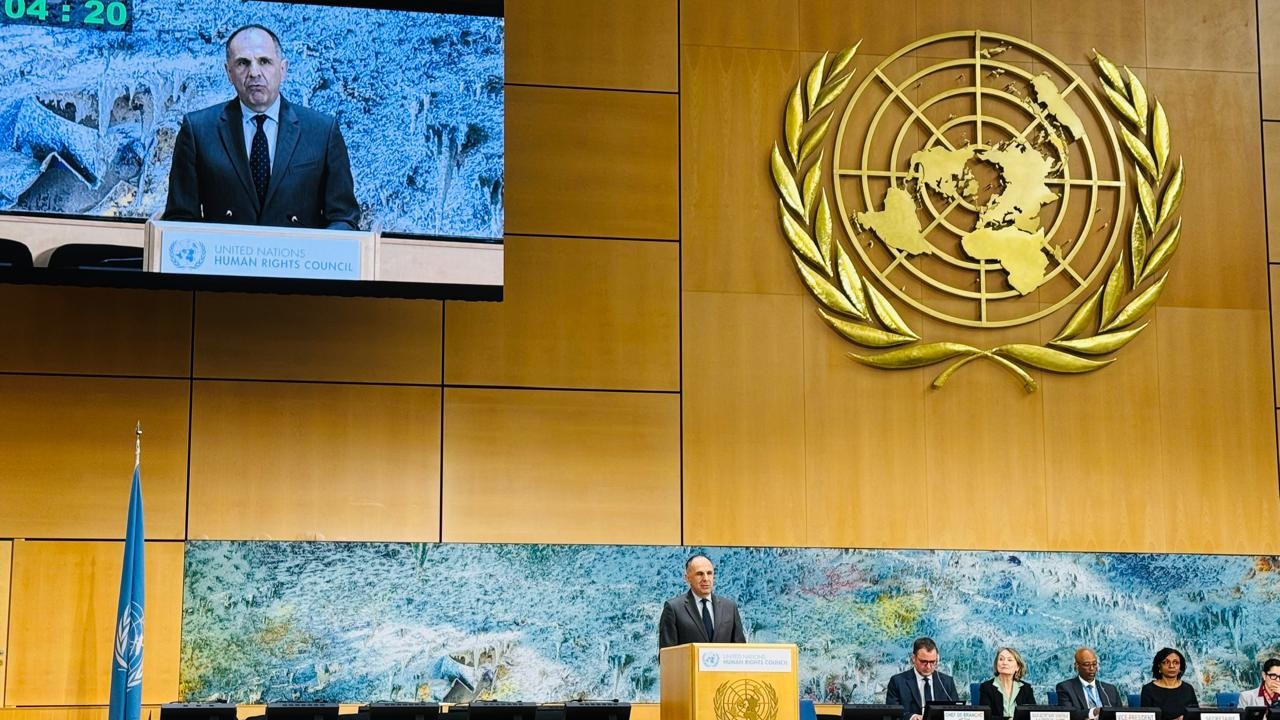
Secretary-General, High Commissioner, Mr President, Excellencies,
It is a distinct honor to address the High-Level Segment of the 61st Session.
We stand at a historic milestone today. Twenty years have passed since we established this Council to replace the Commission on Human Rights with a stronger, more credible body.
Looking back, we have reasons to be proud. We created the Universal Periodic Review, ensuring no state is immune from scrutiny. We expanded the Special Procedures, giving a voice to the voiceless.
However, anniversaries demand honesty. We mark this milestone in the shadow of a severe liquidity crisis. This is not merely a bureaucratic hurdle; it is an existential threat. We cannot protect rights on a budget deficit.
Greece's message is simple: We must match our rhetoric with resources.
We reaffirm our unwavering support for the Office of the High Commissioner. However, regarding the UN80 milestone, we must be honest about the challenges ahead. Yet, Greece encourages every effort to transform this system. We need a UN that addresses its weaknesses constructively. A UN that is cost-efficient, effective, and fully accountable. Only then can it fulfill its mission—in a balanced way—across all three of its pillars.
Mr. President,
Beyond this internal crisis, we face a geopolitical "polycrisis." The chain linking Peace, Development, and Human Rights is breaking.
In Europe, we mark four years of war in Ukraine. Four years of aggression and devastation. Greece stands firmly by Ukraine's sovereignty. This is a defence of democracy and International Law against revisionism.
While we welcome genuine efforts for peace, we must address the human cost. In the Russian-occupied territories, a human rights vacuum prevails.
But the darkest crime is clear: The forced deportation of Ukrainian children. Thousands have been stripped of their names. Stripped of their history. This attempt to steal a nation's future must stop.
Our concern extends to Syria. Stability requires inclusion. Syrians must decide their future free from foreign interference. Every ethnic and religious community—including Christians—needs a seat at the table. Greece stands ready to contribute to humanitarian aid and reconstruction.
Turning to our immediate neighborhood, the Middle East.
Greece welcomes the release of the hostages with profound relief. This is a triumph of diplomacy. It proves that dialogue saves lives.
But this was only the first step. We must urgently transition to a permanent truce.
However, silence alone is not enough. The humanitarian situation in Gaza remains catastrophic. We cannot look away. Greece is fully committed to the stabilization effort, but we must return to the only viable political horizon: The Two-State solution. Security for Israel. A sovereign state for the Palestinians. This is the only path.
Looking further south, Sudan faces the world's largest displacement crisis. Famine is stalking the land, and sexual violence is weaponised. We must focus on ensuring accountability.
In Iran, we have a moral obligation to stand by the people against violence targeting peaceful protesters.
And in Afghanistan, we confront systematic gender persecution. Women and girls are being erased from public life. We cannot, simply cannot, accept a world where half the population is invisible.
Mr. President,
How does Greece respond to this polycrisis?
First, as proud members of the European Union, we recognise the Union as the vital anchor preserving multilateralism in a fragmented world. We advocate for a Europe that meets global expectations, wielding its significant economic, regulatory and trade power to promote human rights and defend the rule of law.
Second, as a non-permanent member of the Security Council, our response is anchored in clear principles. We remain faithful to the UN Charter. Our compass is the universal application of International Law, serving as a bridge between divided worlds.
The Charter is not an à la carte menu. It is the monolithic foundation of our coexistence.
We operate on the triad of Dialogue, Democracy, and Diplomacy. We do not believe in a world of "might makes right." We believe in a world where rights define might.
To speak with authority abroad, one must act with integrity at home.
We are implementing in Greece a National Action Plan to eliminate racism. We are combating human trafficking. We are breaking glass ceilings to achieve gender equality. And we are implementing a comprehensive strategy to address juvenile delinquency and protect our youth.
Regarding migration, Greece has consistently done its utmost to save lives at sea and grant asylum to those entitled to protection. However, we place equal emphasis on combating smuggling networks and the instrumentalization of migration. We must prioritize effective returns and innovative solutions.
Excellencies,
Based on these principles, allow me to highlight Greece's candidacy for the Human Rights Council for the term 2028-2030.
Our vision rests on one significant pillar: Education.
We see hate speech rising. We see discrimination. Law provides a framework, but laws alone are not enough. What cannot be compromised is a citizen's conscience.
As the great philosopher Aristotle said:
"Educating the mind without educating the heart is no education at all."
This is our guide. Our goal is to foster a global "Human Rights Culture."
We must educate the next generation's hearts. We must teach empathy, not just rules. If a child learns that human dignity is sacred, that child will grow into a leader who respects peace. This is the only defence against chaos.
To this end, Greece looks forward to the launch of the Global Alliance for Human Rights, that was announced officially yesterday.
We need an initiative that brings together governments, the private sector, and civil society. We must place human rights back where they belong—at the centre of political life - much like the Helsinki Accords did for Europe in the 1970s.
Mr. President,
Twenty years ago, we built this Council. Now, we must protect it. We must fix the budget. We must stop the wars. We must educate our children, the future generations.
Greece is here to listen. We are here to cooperate. We are here to build bridges.
Thank you.
February 24, 2026