


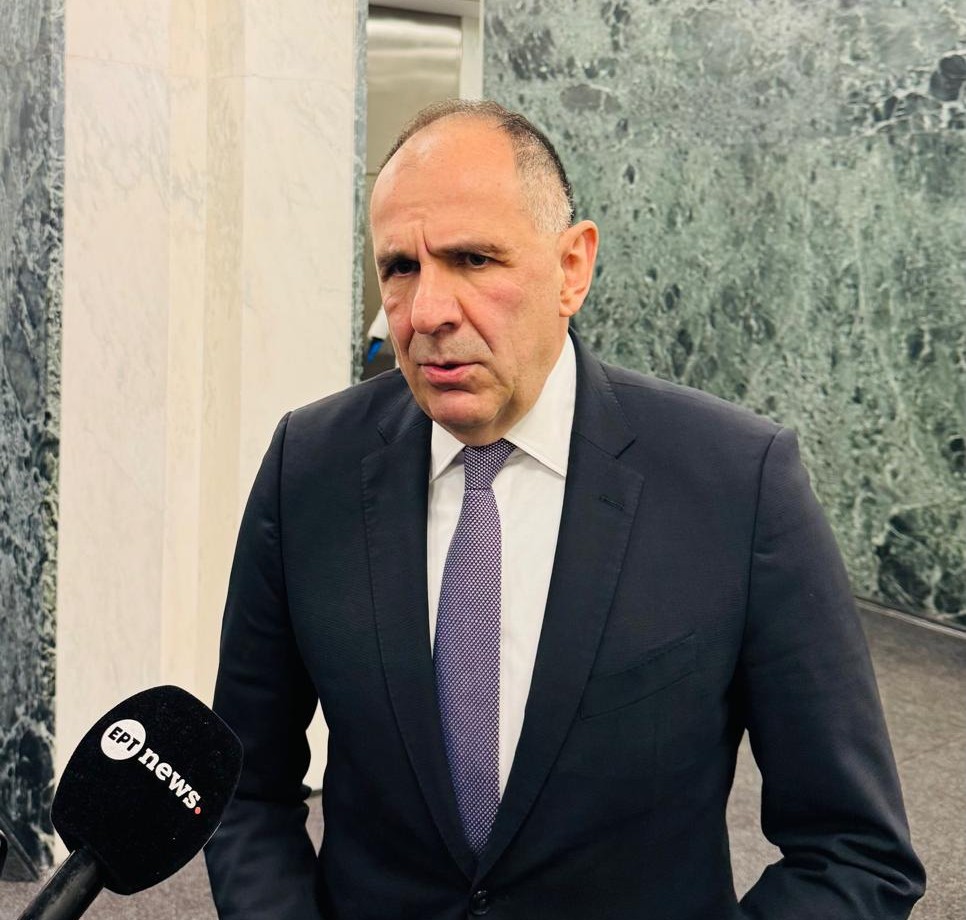
JOURNALIST: You met with the UN Secretary-General for a longer period compared to previous meetings. On which issues did you focus, and was the Cyprus issue at the center of attention?
G. GERAPETRITIS: We had the opportunity to have a long discussion in a bilateral meeting with the Secretary-General of the United Nations and in an expanded format with the delegations, covering a wide range of issues. First and foremost is the Cyprus issue, which constitutes the national priority of the Government’s policy and of the Greek State.
I had the opportunity to raise the issues with the Secretary-General. As you are aware, the Personal Envoy of the UN Secretary-General is currently in Cyprus, where she held discussions and a joint meeting with the two leaders regarding the Cyprus issue. The prospect is that, once conditions mature and tangible progress is achieved on the issues currently under discussion, particularly those relating to Confidence-Building Measures, a new expanded meeting will take place.
I would like to emphasize the importance of the UN Secretary-General's placing the Cyprus issue very high on his agenda. We believe a major development must occur. This is not merely a national issue. At a time of significant global turbulence, it is extremely important that the issue undermining international legitimacy be resolved for the benefit of Cyprus and international security.
We also had the opportunity to discuss a range of regional and international issues with the Secretary-General. We discussed Libya and Syria, Sub-Saharan Africa, and all major global hotspots. I presented Greece’s position on Syria, emphasizing the need for an inclusive political process ensuring the participation of all ethnic and religious communities. There must be as balanced a development as possible in Syria, free from foreign interventions and always in accordance with the principles of democracy and the rule of law.
Regarding Libya, we had the opportunity to discuss ongoing developments. As you know, I remain in contact with both sides in Libya. Discussions are currently underway toward a political solution in Libya, which is most welcome and would represent a significant development for peace in the broader Eastern Mediterranean region. I also raised with the Secretary-General issues related to the implementation of International Law, as well as matters raised by Libyan interlocutors, which I conveyed to him.
Together, we identified major hotspots that pose serious challenges to global stability, particularly in the Middle East, Ukraine, and Sub-Saharan Africa, where multiple armed conflicts are currently underway. There is an urgent need for a global alliance under the auspices of the United Nations to contain these armed conflicts and prevent them from becoming a major threat to international security.
Finally, we discussed matters relating to the international security architecture. I emphasized Greece’s firm view that international organizations, especially the United Nations, should remain at the forefront of efforts to uphold justice and international order.
The path we have followed, the path of International Law and international multilateralism, must remain strong. Historically, the United Nations has served as a cornerstone for medium-sized and smaller states and should remain so. It remains a source of hope for achieving sustainable global peace and prosperity.
January 29, 2026