


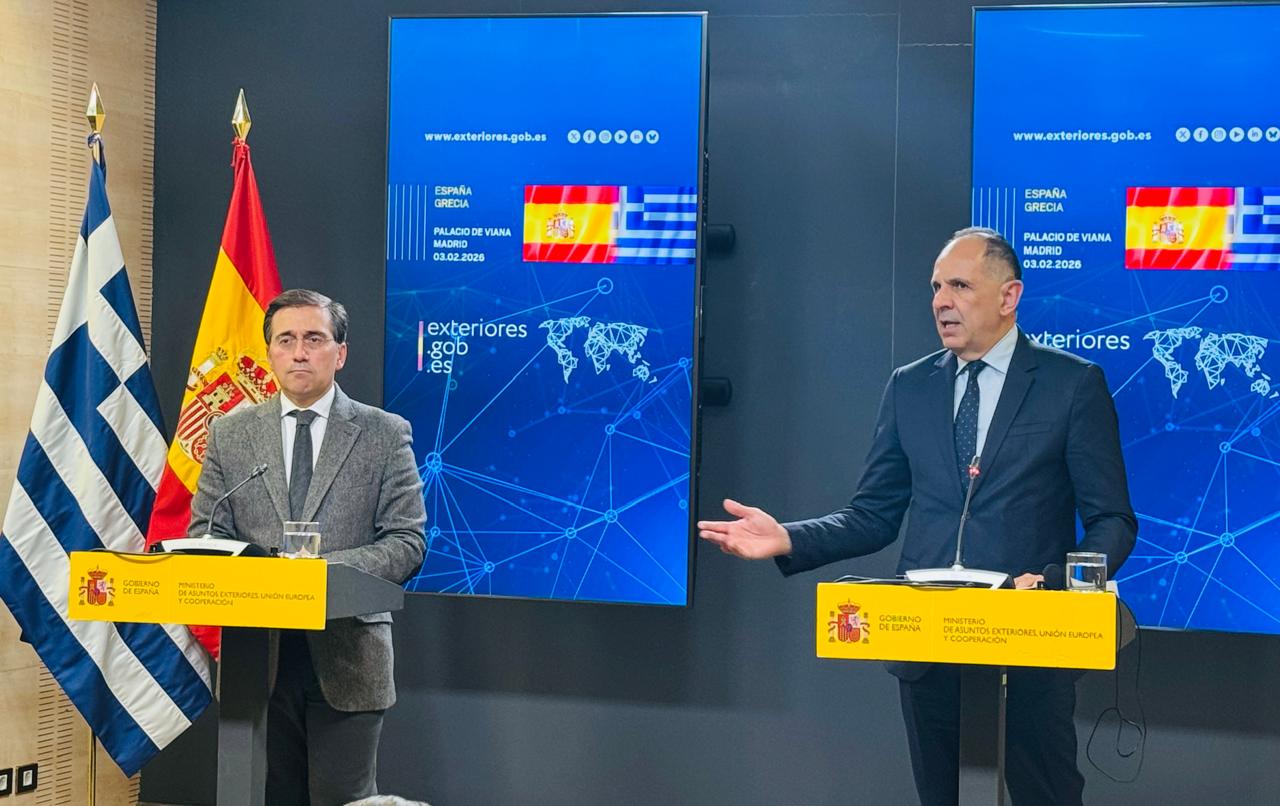
G. GERAPETRITIS: My dear José Manuel,
It is always a pleasure to visit Spain, and I am honored to be here today in Madrid—a city of remarkable beauty and cultural heritage.
Thank you so much for your warm welcome and hospitality. It has been a tremendous honor to work with you for the last few years because we share the same vision about Europe, about our countries and about our continent.
Allow me, at the outset, on behalf of the Greek Government, to express our deepest condolences for the tragic railway accidents. Greece stands in full solidarity with Spain and the Spanish people during this difficult time.
Greece and Spain share a common understanding of today’s global challenges and a strong foundation upon which to build our foreign relations.
Our geography plays a defining role in shaping our policies. As Mediterranean nations with extensive coastlines and deep maritime traditions, we face similar challenges across our wider neighborhood and share a responsibility for regional stability and cooperation.
We are also linked by a parallel historical journey. Both our countries were freed from dictatorships and transitioned to liberal democracies in the 1970s, and opted for a strategic path joining the European Union and the NATO Alliance.
Coming to Madrid shortly after I visited New York, where I held meetings at the United Nations and the Security Council, including with the UN Secretary-General, I am convinced—as my Spanish colleague is—that it is more crucial than ever to defend multilateralism, uphold International Law, and safeguard the principles of the UN Charter.
Our meeting today reflects the strong momentum in Greek–Spanish relations. It follows my Prime Minister’s visit to Spain and comes just eight months after you visited Athens. I had the honor to host you at the premises of the Ministry of Foreign Affairs. This clearly demonstrates our shared determination to deepen cooperation between like-minded partners and allies.
We discussed the future of the European Union at a historic juncture. We agreed on the need for a decisive leap towards strategic autonomy to address current challenges and reduce critical dependencies in energy, technology, and defense.
As Mediterranean countries in Europe's South, we share a common perspective. I would like to recall your Prime Minister’s statement regarding the vision of a “360-degree Europe”—one that looks with equal attention and strategic interest to all its regions, including the South.
As Mediterranean countries, also, we welcome the adoption of the Pact for the Mediterranean in Barcelona last November, an important milestone in EU engagement with its Southern Neighbors.
A stronger and more resilient European Union must also be a larger one. In this context, we strongly support accelerating the accession process of the Western Balkans. Looking ahead to the Greek Presidency of the Council of the EU in the second half of 2027, Greece intends to present concrete initiatives to advance the European perspective of our Western Balkan partners.
Together with my Spanish colleague, we also exchanged views on the war in Ukraine, the situation in the Middle East—particularly Gaza and Syria—as well as recent developments concerning Greenland and Venezuela.
Regarding Ukraine, Greece stands firmly in solidarity with Ukraine which is opposing revisionism. We support all efforts aimed at ending the hostilities. Ukraine must be part of all negotiations to ensure a durable peace, in full respect of her sovereignty and with credible security guarantees that deter any future aggression.
In the Middle East, Greece consistently supports initiatives that bring the region closer to lasting peace and stability.
Hence, we strongly supported the UN Security Council Resolution 2803 (2025). We welcome the progress achieved towards a sustained ceasefire and the implementation of the 20-point Gaza Peace Plan endorsed by the Council.
In this vein, the partial opening of the vital Rafah crossing marks, indeed, a positive step on this Peace Plan, yet not adequate. More practical steps should be taken to reunite families and provide humanitarian aid to all people needing it.
The return of the body of the last hostage to Israel also brings great relief and opens the way to Phase Two—a truly decisive moment.
Greece stands ready to contribute actively and responsibly to the day after in Gaza, in close cooperation with the Palestinian National Committee and the Palestinian Authority, which remains the only legitimate representative of the Palestinian people and must be empowered politically, financially, and institutionally.
On Syria, we welcome the agreement concluded between the Syrian transitional government and the Syrian Democratic Forces.
We stress the importance of its full implementation, strict adherence to the ceasefire, and the safeguarding of the rights of all Syrians, including the Kurdish population. This agreement constitutes a step toward a comprehensive and inclusive political transition. Syria’s true wealth lies in its diverse and pluralistic society. Syrians from all ethnic and religious backgrounds must be protected, and their rights respected at all times.
On Iran, we are closely monitoring developments in the country, including through our Embassy in Tehran. Greece reiterates the need for de-escalation, dialogue and peaceful resolution of the current crisis. Diplomacy should indeed prevail.
As NATO Allies, we also exchanged views on developments concerning Greenland.
Greece recognizes the growing importance of Arctic security for transatlantic stability. The future of Greenland lies with Denmark and Greenland itself, and any solution must safeguard unity and cohesion within the Alliance.
On Venezuela, as an elected member of the UN Security Council, Greece called for universal respect for International Law and the principles enshrined in the UN Charter. We have long made it clear that the people of Venezuela have the legitimate and inalienable right to decide on their future, with full respect for fundamental rights and democratic principles.
My dear colleague,
As frontline countries on the European Union’s external borders, Greece and Spain closely monitor developments in Sub-Saharan Africa, the Sahel, and Sudan, where severe humanitarian crises are driving large movements of innocent civilians.
Irregular migration, which we also address within the MED5 and MED9 frameworks, requires a comprehensive European response. While preparations for the implementation of the Pact on Migration and Asylum are advancing, we must remain focused on our core priorities in this respect:
Fair burden sharing, strengthening the protection of the EU’s external borders, increasing effective returns, and enhancing cooperation with key third countries.
Regarding our bilateral relations, we exchanged views on further strengthening our economic cooperation, particularly in trade, investment, and energy, building on the positive momentum generated by the business delegation held in Madrid last May.
Beyond economic ties, we are also committed to strengthening our soft power, culture, and education, as my dear friend just mentioned. This is evident in the Cervantes Institute's presence in Athens and the teaching of Greek at many universities across Spain.
My dear José Manuel,
I thank you once again for your hospitality. It has been an outstanding honor to be in Madrid and to exchange views with you.
Thank you.
JOURNALIST: I'm Pierros Tzanetakos from the Greek Public Television. I think it's a question for both Ministers. Based on Donald Trump's foreign policy, until today, do you believe that the European Union can and will find a modus vivendi, at least for the basic alliance needs with Washington. The second point, are you satisfied with the progress of the European Defense Autonomy Project? Thank you.
G. GERAPETRITIS: First of all, I have to say that the transatlantic security cooperation needs to maintain its momentum. We have to realize that the post-war world has been established on the basis of this transatlantic cooperation. It's important to keep it effective for peace and prosperity in the world. I am very hopeful and optimistic that this momentum will be maintained. What the new American administration provided us with, was the incentive to actually revisit some of our fundamental ideas about Europe and especially Europe's future and autonomy. When it comes to autonomy, we can only discuss about the strategic autonomy of having a joint deterrence mechanism. The idea that we need to further enlarge Europe in order to have a greater Europe. And of course, we need to see our common vision in Europe through a solid strategic development progress which will embrace not only the competitiveness of the European Union and of the European continent, but also issues relating to social cohesion and other factors which are global challenges at the moment, including the climate crisis and the food security crisis. Overall, I think we should be happy with the progress we are trying to make in Europe in order to become more resilient, more autonomous, while at the same time keeping the bridges with the United States, bridges which have been solid and need to be maintained in the future.
February 3, 2026