Griechenland in Deutschland


Minister of Foreign Affairs George Gerapetritis’ statements following his meeting with the Minister of Foreign Affairs of the Federal Republic of Germany, Johann Wadephul (Athens, 04.05.2026)
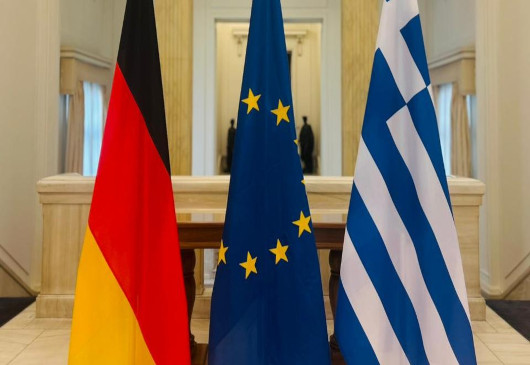
Joint Statement by the Ministers for Foreign Affairs of the Hellenic Republic and the Federal Republic of Germany on the establishment of a Partnership for Strategic Cooperation
Minister of Foreign Affairs, George Gerapetritis message on World Greek Language Day (09.02.2026)
Announcement by the Ministry of Foreign Affairs regarding the unanimous decision by UNESCO to proclaim February 9th as World Greek Language Day (Uzbekistan, 12.11.2025)


Aufforderung zur Angebotsgabe für die Reparatur des Aufzugs den Griechischen Botschaft in Berlin
Aufforderung zur Angebotsabgabe für die Lieferung, Installation und Wartung von 3 Druck- und Multifunktionssystemen ein
Wir informieren Sie, dass zur besseren Bearbeitung Ihrer Anliegen ab dem 1. Juli 2026 Dienstleistungen, die bisher bei der Konsularabteilung der Griechischen Botschaft ohne Termin angeboten wurden,...
Dear Compatriots,It is with profound emotion that we commemorate once again the anniversary of the Greek War of Independence, a defining historical milestone which led to the establishment of the...
Wir möchten Sie darüber informieren, dass am 10.01.2026 das neue Wehrpflichtgesetz 5265/2026 in Kraft getreten ist, das wesentliche Änderungen für im Ausland lebende Personen mit sich bringt,...
JOURNALIST: Minister, you recently referred to Greece’s readiness to refer the Greek-Turkish dispute to the International Court of Justice in The Hague. Do you consider that, at this juncture, the conditions are appropriate for negotiations to begin on the drafting of a special agreement? G. GERAPETRITIS: I have repeatedly stressed...
Good evening, Honourable Minister, dear Nasser. It is with great pleasure and honour that I welcome you to Athens today, at a time of particularly intense geopolitical challenges, both for the African continent and for global security. Your presence here today confirms the excellent level of our bilateral relations and...
JOURNALIST: We begin our broadcast with the Minister of Foreign Affairs, Mr. George Gerapetritis. Mr. Gerapetritis, welcome and thank you for honouring us with your presence every year by being here and starting together with us. G. GERAPETRITIS: I hope I bring you good luck. It seems that, as time...
At today’s Informal Meeting of European Union Foreign Affairs Ministers in Ireland, we will discuss pressing issues concerning the global security architecture, the Middle East, and instances where revisionism has become particularly acute. Greece has consistently stood by those defending themselves, by International Law, and in support of freedom of...
Regierung und Politik


State Symbols
The Flag
The national flag of Greece consists of four white and five blue alternating horizontal stripes, with a white cross on the upper left corner. Blue and white are the national colours of Greece, as blue symbolizes the sky and seas and white denotes the purity of the Greek independence struggle. The cross represents the Christian religion. The nine blue-and-white horizontal stripes of the flag stand for the nine syllables of the Greek motto Eleftheria i Thanatos (Greek for Freedom or Death).
The National Anthem
The Hymn to Liberty (or Hymn to Freedom) is a poem written by Dionysios Solomos (1823) and consists of 158 stanzas. It was set to music by Nikolaos Mantzaros, (1865) and it is the longest national anthem in the world by length of text. This anthem has been performed at every closing ceremony of the Olympic Games, to pay tribute to Greece as the birthplace of the ancient Olympics.
(English translation by Rudyard Kipling)
We know thee of old
Oh divinely restored,
By the light of thine eyes
And the light of thy sword.
From the graves of our slain
Shall the valor prevail
As we greet thee,
As we greet thee again,
Hail, Liberty! Oh, Hail!
The National Emblem
The national emblem of Greece, also known as the coat of arms of Greece, consists of a blue crest with a white cross totally surrounded by two laurel branches. The first Greek national emblem was provided for by the Constitution of Epidaurus of 1 January 1822.
The colours of the national emblem of the Hellenic Republic are blue and white. An additional design with golden laurel leaves appears on the caps of the military officers of the Hellenic Armed Forces as well as on the flag of the President of the Republic.