


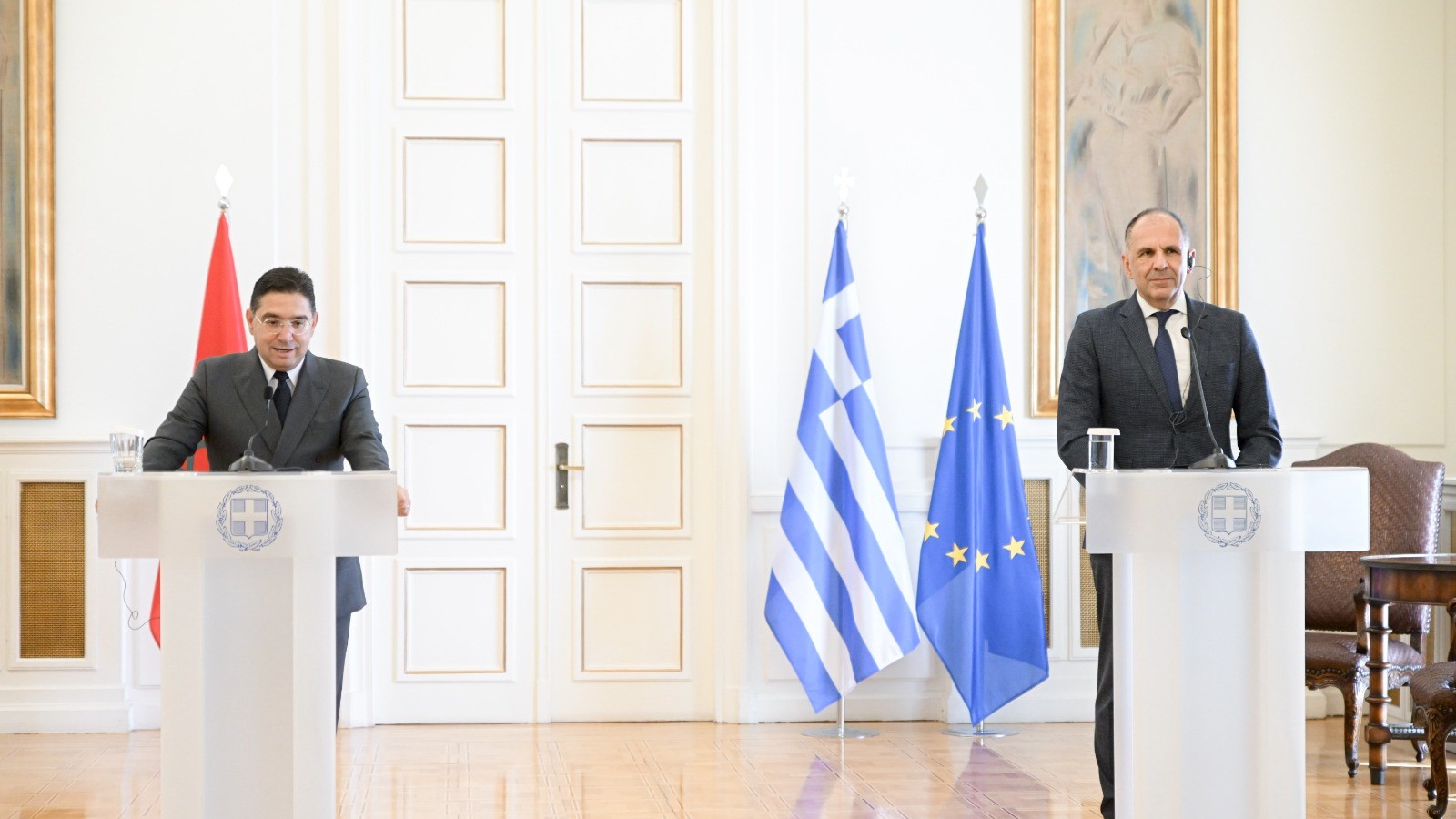
Good evening,
Honourable Minister, dear Nasser. It is with great pleasure and honour that I welcome you to Athens today, at a time of particularly intense geopolitical challenges, both for the African continent and for global security. Your presence here today confirms the excellent level of our bilateral relations and our shared desire to deepen them further.
Greece and Morocco are connected by longstanding ties of friendship, mutual esteem and trust. As Mediterranean countries, we share challenges and opportunities, as well as a deep cultural affinity. During our meeting today, we had an extensive and productive discussion on issues concerning our bilateral and regional interests.
We confirmed that our strategic convergence is grounded in International Law, respect for the territorial integrity of States and multilateral diplomacy. As an elected member of the United Nations Security Council, Greece acts in full respect of the Charter of the United Nations and International Law, including the International Law of the Sea. Our adherence to these principles enables us to act as a reliable interlocutor in the region, promoting the peaceful resolution of disputes.
Within the framework of our discussions, we placed particular emphasis on the major security challenges facing the wider Mediterranean and North Africa region. We exchanged views ahead of the upcoming consideration of the renewal of the mandate of the United Nations Mission for the Referendum in Western Sahara (MINURSO) whose mandate expires on October 31, 2026. I stressed that Greece firmly supports the political process for the settlement of the Western Sahara issue under the auspices of the United Nations. We welcome the adoption of Security Council Resolution 2797 (2025), which we helped shape last November, also thanks to our excellent contacts and channels of communication with all parties, through a series of constructive interventions.
Greece will once again contribute, in its capacity as President of the United Nations Security Council next month, to shaping the relevant resolution. Moreover, in line with with the common position of the European Union, we fully support the efforts undertaken by the Personal Envoy of the UN Secretary-General, Staffan de Mistura, to conduct negotiations based on Morocco’s Autonomy Proposal and with a view to finding a fair, lasting, and mutually acceptable solution.
We consider that the Autonomy Proposal constitutes a serious and credible contribution to the ongoing United Nations process and could constitute the most feasible solution. As provided for in Resolution 2797, the parties are called upon to participate in discussions without preconditions and to submit ideas that will contribute to achieving a final and mutually acceptable solution.
We also expressed our deep shared concern over the security challenges in the Mediterranean and North Africa, stressing that regional stability requires close cooperation. Greece deeply appreciates Morocco’s role as a pillar of stability in the wider region, as well as its active contribution to the development of the African continent.
At the same time, we discussed the importance of maritime security and maritime transport. Greece underscored the importance of maritime security as early as May 2025, during our Presidency of the United Nations Security Council, and also plays a leading role in Operation “EUNAVFOR ASPIDES”, currently under way in the Red Sea, with the aim of safeguarding freedom of navigation in the region.
As an EU Member State, Greece actively contributes to expanding channels of communication and further developing the strategic partnership between Morocco and the European Union. We also attach particular importance to the new Pact for the Mediterranean, which provides a framework for further deepening our cooperation in critical areas of common interest, such as migration, energy, the digital transition, and people-to-people contacts.
Recent developments along the Morocco-Spain border in the area of Ceuta demonstrate once again that migration management is a shared European and regional challenge and requires close cooperation, effective border protection and effective action against migrant-smuggling networks. We are convinced that this partnership between the European Union and Morocco, particularly in the areas of digital connectivity, green energy, and migration management, will contribute to effectively addressing common regional and international challenges.
In this context, the signing of the Green Partnership between the European Union and Morocco in October 2022 - the European Union’s first Green Partnership with a partner country - highlights the importance Morocco attaches to the green transition and environmental protection, areas which are also of particular interest to Greece.
Dear Minister, dear Nasser,
although our political and diplomatic relations are already at an excellent level, we recognise that there is considerable scope for further developing our bilateral economic and trade relations, so as to create additional opportunities for mutually beneficial cooperation.
We agreed to work towards expanding our trade flows. Greek exports to Morocco remain largely concentrated in petroleum products. Greece regards Morocco as an important gateway to the markets of Sub-Saharan Africa. On this basis, we explored the considerable potential for improving and developing our bilateral cooperation in specific areas of interest. We focused on infrastructure, where significant opportunities are emerging in view of the 2030 FIFA World Cup, which Morocco is co-hosting. We also discussed prospects for cooperation in the fields of green energy and water management, as well as port and maritime cooperation. Naturally, we attach particular importance to the agri-food sector, which is a key priority for both countries.
In order to effectively implement all these objectives, it is essential to further strengthen contacts between officials of our two countries. At the same time, these efforts should also extend to closer cooperation between our respective business communities. We believe that convening the 8th Session of the Joint Interministerial Committee will provide the appropriate institutional vehicle for deepening our economic cooperation and promoting new trade agreements.
Dear Minister,
I am convinced that your visit today gives fresh impetus to our cooperation, for the benefit of our peoples, as well as the stability of our wider region. I warmly thank you for being here today and hope that this visit will serve as a catalyst for an even closer and friendlier relationship between our peoples.
September 7, 2026