


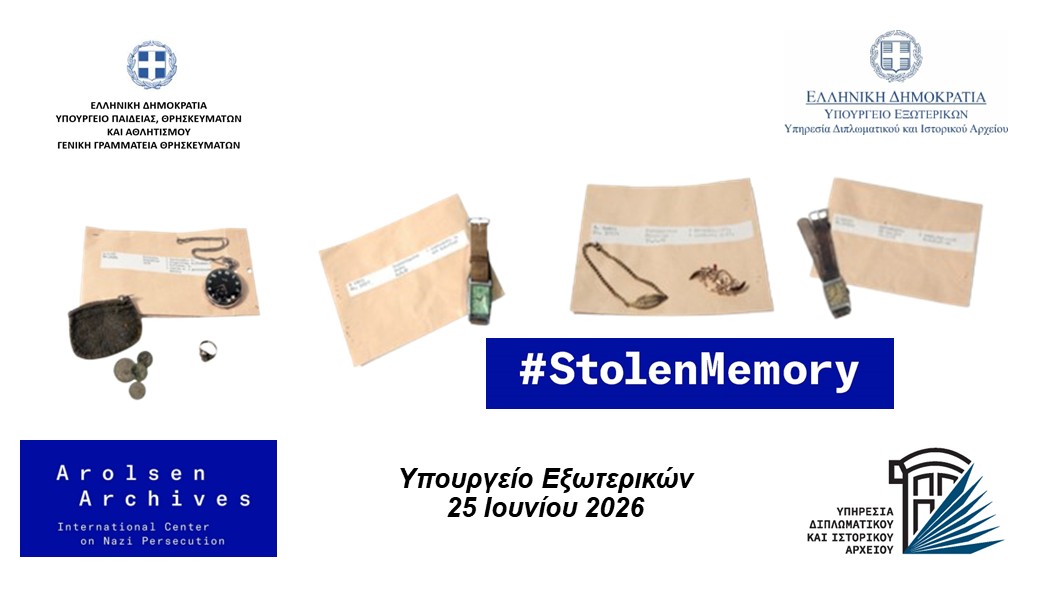
An event was held on Thursday 25 June 2026 at the “Yiannos Kranidiotis” Auditorium of the Ministry of Foreign Affairs, with the aim of returning personal belongings of four Greek victims of Nazi concentration and forced labor camps to their families, within the framework of the international campaign #StolenMemory of the Arolsen Archives, and the relevant program implemented in Greece by the General Secretariat for Religious Affairs of the Ministry of Education, Religious Affairs and Sports and the Service of Diplomatic and Historical Archives of the Greek Ministry of Foreign Affairs in collaboration with the Arolsen Archives.
The event marked the successful completion of the #StolenMemory campaign in Greece and is of particular interest, as the Greek case presents two unique features at an international level.
Firstly, this is the only case to date worldwide in which the participation of the student community in the process of identifying families of victims of Nazism was part of a centrally planned state initiative, which was implemented by the Ministry of Foreign Affairs and the Ministry of Education, Religious Affairs and Sports. Similar actions have been undertaken from time to time by individual school units in other countries, such as Poland, but without being part of a national program designed and implemented by central government agencies.
Secondly, Greece becomes the first country to have managed to identify the families of all of its nationals whose personal belongings were kept in the Arolsen Archives, completing a cycle of search and restoration of historical memory with particular symbolic and humanitarian significance.
The event was opened with a welcome address by the Secretary General of Religious Affairs, Mr. Georgios Kalantzis, who represented the Prime Minister, Mr. Kyriakos Mitsotakis. A greeting was delivered on behalf of the Minister of Foreign Affairs, Mr. George Gerapetritis, by Ambassador Ms. Chrysoula Aliferi, Special Envoy of the Ministry of Foreign Affairs of Greece for Combatting Antisemitism and for the Protection of Holocaust Remembrance. The Director of the Service of Diplomatic and Historical Archives, Expert Minister-Counsellor, Mr. Georgios Polydorakis, in his speech focused on the successful implementation of the international #StolenMemory campaign in Greece and the importance of its completion through the program of the Ministry of Education, Religious Affairs and Sports and the Ministry of Foreign Affairs. This was followed by a greeting from the Director of the Arolsen Archives, Mr. Moritz Wein.
The return of the objects to the families of the victims followed, alongside a presentation of the research undertaken by student groups from the Evening Vocational Lyceum of Evosmos, Thessaloniki, the 2nd General Lyceum of Koropi, Attica, the 7th Gymnasium of Nea Ionia, Attica and the 1st General Lyceum of Hymettus, to identify and locate the victims' families.
Each of the four families also received by Mr. Wein copies of the original documents regarding their relatives, which are kept in the Arolsen Archives.
The Arolsen Archives, which preserve the archival material of Nazi concentration and forced labor camps, constitute the largest institution for documentation of Nazi crimes worldwide, and possess over 30 million documents that form the basis for research and education of younger generations.
The Arolsen Archives’ #StolenMemory campaign aims to locate families of victims of Nazi persecution from around the world, whose personal belongings were found in Nazi concentration and forced labor camps after the end of World War II. The campaign has been launched since 2018, through a traveling exhibition in various European countries, which presents the objects in the possession of the Arolsen Archives in photographs, as well as through a special website. It has been quite successful so far, since the relatives/descendants of the legal owners of many of the approximately 4,500 objects kept in the Arolsen Archives were found. Subsequently these objects were returned to the relatives of their owners.
June 29, 2026