


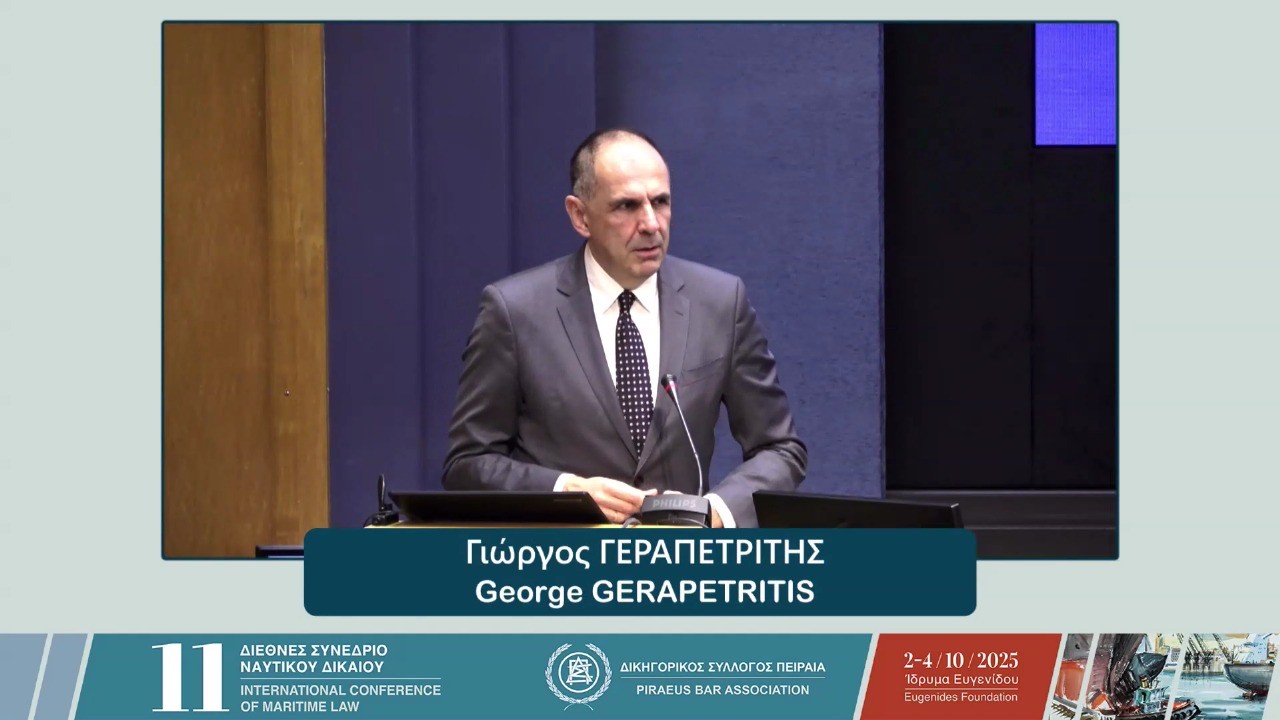
Ladies and Gentlemen, welcome to Piraeus. It is a great honor for us to host you here, at the center of maritime trade and in the heart of our seafaring tradition.
First of all, I would like to thank the President of the Piraeus Bar Association, who brings honor to our distinguished Association. Let me also express a small grievance, Mr. President, that the program refers to me solely in my political and academic capacity — and not in my professional one, as a lawyer and member of the Piraeus Bar. It is always a joy to drive down Syngrou Avenue from Athens - the air is different as one approaches Piraeus. The bottom line, therefore, is that we envy Minister Kikilias, who has a view of the port every day from his office. I would also like to thank Ms. Lia Athanasiou, not only for her kind, albeit exaggerated, words, but, above all, because she has succeeded in turning the International Conference of Maritime Law into a true institution, while also upgrading maritime law studies at the National and Kapodistrian University of Athens. It is with great pleasure that I see so many young faces here today - graduates of the postgraduate program in Maritime Law - most of whom are now excelling in their professional and academic careers. Above all, I would like to thank our distinguished guests who have traveled from all over the world to honor us with their presence.We are deeply grateful, and we hope their visit will be a rewarding one. The achievement of Ms. Athanasiou in turning the International Conference of Maritime Law into an institution is particularly important, since what we are experiencing nowadays is an erosion of the sense of predictability and stability, a collapse of certainties. We are witnessing the collapse of certainties.
Let me say candidly and from experience: this is, by far, the most difficult period since the Second World War to serve as Minister of Foreign Affairs. Every symmetry has been lost. Wars, which once seemed distant phenomena that do not affect us, now unfold in our neighborhood, and each new day seems to undo the previous one. I believe there are just two remaining certainties: International Maritime Law and the wakeful nights of the Minister of Foreign Affairs. As you can perhaps hear in my voice, last night was another sleepless one, due to the latest developments. We are all aware of the complexity surrounding the Global Sumud Flotilla, which has been sailing toward a conflict zone. The Ministry of Foreign Affairs had already, as a precaution, made formal demarches to the Israeli authorities - both in advance and again today - in order to ensure the safety of the Greek citizens on board of those vessels.
As you may have seen, yesterday we issued a joint declaration with the Minister of Foreign Affairs of Italy - whose citizens are also participating in the flotilla - to ensure that the Israeli side fully upholds all guarantees regarding freedom of navigation, the safety of our citizens, and the provision of consular assistance. According to the information we have received so far, 39 vessels of the flotilla are sailing toward the port of Ashdod. All passengers are in good health and no violence has been used against them. The exact circumstances under which the vessels were escorted to Israel are not yet fully clarified. What is certain, however, is that in coordination with the other countries whose nationals are participating in the mission, we will do everything in our power to guarantee their safety. We have already taken the necessary measures to that effect. Following this brief introduction on the latest developments, let me now turn to the subject of today’s conference.
Greece and the sea - the connection is so self-evident that I hardly need to elaborate on the profound bond between the Greek people and the sea, or on the importance of maritime security and seamanship as a national priority.
Greece is the only country whose Constitution includes a special provision devoted to shipping, a fact that is far from accidental. Society and institutions have always evolved along converging lines and as a State, we also have a strong international presence in matters relating to maritime affairs. As you may recall, last year Greece hosted the 9th “Our Ocean” Conference, the largest global event dedicated to the environmental protection of the oceans, with over 120 delegations participating. We had 469 commitments approaching 11.5 billion US dollars. Greece itself undertook 21 commitments amounting to 800 million dollars. It was the most successful conference of its kind to date, held right across from us, at the Stavros Niarchos Foundation Cultural Center. Greece is also present in most international missions, contributing vessels of the Hellenic Navy in the Indian Ocean with Operation ATALANTA, in the Red Sea with Operation ASPIDES, and in the Mediterranean with Operation IRINI. The presence of the Hellenic Navy underscores the vital need to safeguard the freedom of navigation, a freedom that is increasingly under threat. For this reason, we have chosen maritime security as one of our key thematic priorities during Greece’s tenure on the United Nations Security Council for the 2025–2026 term.
Our Signature Event last May, during Greece’s Presidency of the UN Security Council, was dedicated precisely to maritime security. I wish to share with you that the level of concern regarding global maritime safety is extremely high. Maritime security is a vital issue. It concerns not only the academic community but, above all, politics, as we all understand the necessity of safeguarding navigation at all levels.
Eighty percent of the world’s trade volume is transported by sea. This implies supply chains and national economies. One only needs to look at what happened to Egypt’s national economy, due to the drop in Suez Canal revenues, where transits have fallen by more than 60% because of the incidents in the Red Sea. This sequence of events, the fact that the supply chain relies almost entirely on the sea, means that even landlocked states have a major interest in maritime security. Therefore, this is not an issue that only concerns states with strong ties to the sea, but one that concerns all states alike.
Above all, however, comes the safety of seafarers. Too often we focus on the macro-level aspects of shipping, such as its economic or social impact, and forget the people themselves. Ambitious, emblematic goals are always served by people who are the true driving force behind them. These people are our seafarers, whose safety we must guarantee. You all know the threats. Allow me to highlight two that are particularly relevant today.
The first concerns hybrid threats, especially those targeting undersea infrastructure. As we all understand, connectivity is of paramount importance in our era. However, energy pipelines and electrical interconnections are highly vulnerable. We have seen what occurred in the North Sea. They have become one of the principal targets of hybrid attacks and threats, due to their extreme vulnerability. It is exceedingly difficult to safeguard the integrity of underwater infrastructures that are critical to multiple states. This phenomenon is, therefore, linked to broader geopolitical developments. Wars as we knew them up to the Second World War no longer exist. Conflict today takes new forms. We see what happens in Ukraine, in the Middle East, and in other parts of the world, such as in the sub-Saharan Africa, where non-traditional means are being used in armed conflicts.
The second issue concerns the so-called shadow fleets, a matter of particular relevance to us. Shadow fleets are essentially vessels used to undermine maritime security and the lawful and regulated movement of ships. Shadow fleets not only undermine global maritime safety but also global prosperity and peace. This is, therefore, an issue of major priority also for the European Union. It was brought especially to the forefront after Russia’s invasion of Ukraine and it remains one of the EU’s key priorities today.
Let me move on to the maritime spatial planning. By “planning”, I mean the way each State and the international community structures its maritime zones. It is evident that maritime planning constitutes an almost novel field. Traditionally, what societies regarded as essential was the terrestrial spatial planning, meaning, the urban planning through which land rights could be granted, uses allocated, and legal certainty ensured in transactions. Today, however, from a geopolitical perspective, value increasingly lies in the maritime spatial planning.
There are four dimensions corresponding to the values highlighted by the maritime spatial planning. The first and most important, since it concerns sustainability and the future generations, is the environmental dimension. At this point, I would like to highlight the importance of international courts assuming a more active role in matters concerning the environmental protection of the oceans. In the past two years, we had two very important advisory opinions. In 2024, the International Tribunal for the Law of the Sea issued an advisory opinion regarding the responsibility of States to reduce carbon dioxide emissions, as well as the sanctions applicable in cases of non-compliance.
Today, we will have the privilege of listening to President Heidar, speaking about this advisory opinion, as well as about the most recent one, delivered this year by the International Court of Justice in The Hague, again on the legal obligations of States concerning the protection of the climate and the environment. It took decades since the United Nations first underlined the need for the marine environmental protection of the oceans for the International Court of Justice to take action.
The second major dimension is the energy dimension. It is evident that energy is transferred and will continue to be transferred primarily by sea. Interconnections constitute the largest and most critical link in the energy chain. One only needs to look at the map of submarine energy infrastructure in the Mediterranean to appreciate this fully. In Greece, two major energy interconnection projects are already under way: the Greece–Cyprus–Israel Electricity Interconnection, and the Greece–Egypt Interconnection, the GREGY Project. The latter is of great importance and represents a vital component of energy supply, as a cable with bi-directional power transmission capacity that will bring green energy to Europe and, in the future, possibly hydrogen, which is expected to become one of the main energy sources of the coming generations.
The third dimension is the geopolitical dimension of the maritime spatial planning. By “geopolitical” I mean, above all, the avoidance of conflicts between States. A few decades ago, no one could have imagined that the allocation of maritime zones suitable for economic exploitation would become a source of tension, crisis, or even conflict. Nowadays, it has become the primary cause of such disputes. The Mediterranean Sea borders twenty-one States. All of them seek to secure the maximum possible maritime space through maritime zones, namely, their Exclusive Economic Zone (EEZ) and the continental shelf. This sometimes gives rise to maximalist claims. Yet the application of the Law of the Sea, through the United Nations Convention on the Law of the Sea (UNCLOS) adopted at Montego Bay, which has already been in force for a very long time - 43 years is remarkably long for an international convention. Despite tectonic shifts in geopolitical realities and in the importance of maritime spatial planning, this Convention remains the cornerstone of maritime order, which sets both the procedures and the substantive criteria for the maritime special planning. The geopolitical dimension of such a planning is immense, because it prevents crises. It must therefore be viewed as an instrument for achieving peace.
The idea that the exercise of rights relating to the Exclusive Economic Zone should be subject to negotiation, settlement, or ultimately referral to international jurisdiction, reflects a sensible approach. There must be a rational basis for distribution, and the most rational basis is the deliberative one. Nevertheless, as the importance of each State’s energy self-sufficiency increases, so does the value of every meter of maritime space. Therefore, we realize the extent to which the geopolitical value is multiplied.
Finally, there is the social dimension of the maritime spatial planning. We often talk about the economic value of the sea, but there is also a value that goes beyond economics. It is of paramount importance to be able to integrate these ecosystems into a central plan that is inclusive and does not exclude these sensitive ecosystems and island groups. Because today the most critical, the most important thing, is inclusion. And because inequalities are unfortunately lurking and increasing, being able to form a framework of convergence through the sea in terms of regions or peoples is extremely important.
Those of you who are currently in Greece will have certainly seen this. It is the map of the country's Maritime Spatial Planning. Greece, in the context of implementing EU legislation, has introduced its Maritime Spatial Planning. For the first time, a few months ago, Greece clearly recorded how it understands Maritime Spatial Planning itself. A plan that is based purely and exclusively on International Law. First and foremost, it expresses our Exclusive Economic Zone, reflecting the agreements that have been made with neighboring countries, Italy and Egypt, but also of course - where there is no agreement with neighboring countries yet - the outermost limits of the potential continental shelf and Exclusive Economic Zone. A Maritime Spatial Planning, which opens a new era for Greece, shapes the framework of social activities that can be carried out at sea and, first and foremost, highlights Greece as a pillar of stability and geopolitics in the international arena.
What are the main features? As mentioned, it is an implementation of Directive 89/2014. What does it include? What is the added value of this Maritime Spatial Planning? It establishes in a very clear way a plan, which is characterized as holistic, because it includes all the objectives that must be set for the regulation of the marine space. Climate resilience, sustainable tourism development (tourism is a cure, but it can also be a poison. We all understand that sustainable tourism for a country with multiple sensitive ecosystems can become a major problem and therefore, what we must do is to demonstrate prudence and respect for the sustainability of sensitive ecosystems), protection of cultural heritage, improvement and protection of maritime transport, fish farming, energy resources and of course strengthening cross-border projects of common interest. The human activities that can be developed within the maritime space are clearly recorded. A solid plan. The next steps will follow, which concern the completion of this ambitious project of the Maritime Spatial Planning. However, Greece, for the first time, records in a single text, which is part of the European acquis, its maritime zones, either those that have already been completed by agreement with neighboring states, or the outer limits. Greece is now on the geopolitical map and has a very clear position regarding its rights.
This is the second dimension. One could say that, beyond the Maritime Spatial Planning, that Greece has introduced a second major plan, which is the first phase of the National Marine Parks. The National Marine Parks that you see, on the left is the South Aegean Marine Park - the first phase, other marine parks in the Aegean will follow - and the one you see on the right is the Ionian National Marine Park. They are the first two National Marine Parks. We also have the Sporades Marine Park, but what is particularly important today is that based on purely environmental criteria, Greece has now established, as a unified entity, its first marine parks. These criteria were set by a special committee of scientists. The characteristics have to do first and foremost with the most vulnerable marine ecosystems. We started from the South Aegean, because precisely there, due to the large number of islands and islets, the systems are much more sensitive, and there is also a large movement of commercial ships. Navigation, in general, is an issue that is always linked to environmental protection. Therefore, the first phase starts from these two very important marine parks. More than 35% of the country's territorial waters, that is, more than 1/3 of the national territorial waters, now constitute marine parks.
This project is of enormous importance. It is a project that I feel should be one of the few that makes us very proud of for future generations. We have taken on a real burden to carry the marine parks, but it is our duty and debt to future generations, because the overconsumption of capital, which we have done for decades, not only in Greece, but also everywhere in the West, obliges us today to take measures, that in some cases may be harsh. Why? Because activities that take place within the National Marine Parks will indeed be significantly reduced. The added value of National Marine Parks compared to simple Natura 2000 areas is significant, not only because they limit human activity, but precisely because they create a continuity in these parks, a marine unit within which special rules concerning the conservation of biodiversity, the protection of habitats and awareness-raising regarding the marine environment now apply. Greece, in yet another field, as in others, such as renewable energy sources, is achieving European goals well ahead of the European ones. The European goal, which has been set for 2030, has already been fulfilled by our country in terms of the protection of the marine environment through the National Marine Parks.
Let's take a look at our conclusions. I started by saying how difficult the international situation is. And I'm not saying this to arouse the audience's sympathy, because I have to manage these issues that arise, but primarily, because the international situation is such that it requires you to undertake major initiatives with prudence and seriousness. Seriousness is the key point. Many times, I hear those who, with empty talk or with words that do not correspond, not only to justice, but not even to reality, ask for the moon. The answer is very serious. In asymmetrical times, what we all have to do is respect International Law and above all, exercise our policy with seriousness and responsibility, without shouting, and above all, keep in mind that today's responsibility may be tomorrow's danger. That is why we take action.
In my opinion, there are four points on which we should emphasize in relation to maritime security and more generally in relation to the maritime environment. The first is the strengthening of international cooperation. This is not a simple matter and again comes down to unfavorable conditions. We all see how much international multilateralism is in decline. The foundation on which the post-war world was built, which was the collective action of international actors, primarily the United Nations, but also the European Union and other regional organizations, seems to be receding today. There was a clear inability on the part of the major organizations to manage issues, which were very important, resulting in the creation of space, not just for individual states, but also for combinations of states that could create other data.
So, at a time when international organizations are retreating, we must insist on international cooperation. Because the challenges of our times are neither national nor regional There is no crisis that does not have a global character. A few years ago, one might have said, “Why should our country care about what’s happening in Sub-Saharan Africa?” Well, it's simple. Right now, there are 15 million people in Sudan who are effectively displaced, because 2.5 million Sudanese are currently in neighboring countries, and their main hope - their basic human hope for survival - is to be able to leave and reach Europe. So, the issue of migration is here to stay.
The climate crisis, which now seems to be here to stay, cannot be seen as a regional issue. The developed world may have higher carbon dioxide emissions, but that disperses everywhere. Solidarity, which theoretically exists, has not been proven in practice. We can look at health conditions. The Minister of Maritime Affairs present here, in his previous capacity, had to manage a crisis that was unprecedented by our standards. However, we understand how much now every issue has a global reach. No issue, no challenge, is limited to just one country or region.
The second point is the tightening of national laws and the full respect for International Law. I start with respect for International Law because I often hear people say, “Why do we in Greece or the Ministry of Foreign Affairs or the Ministry of Justice - which demonstrates great respect for the principles of the rule of law under the present Minister - need to be so attached to International Law and not adopt, in such an asymmetric world, a more transactional approach? What do we want - if I may speak plainly, in terms of the topic of our conference - by establishing marine parks that limit human activity and ultimately may even shrink the economy itself, instead of trying to have as expansive and utilitarian an approach to things as possible?” This approach is not simply careless; it is dangerous for the country, and I say this with full awareness. Anyone in Greece or anywhere in the world who tries to undermine the implementation of the international rules of the security architecture system established in the postwar international world, assumes a huge responsibility toward their country and future generations.
We can see, for example, what applies with regard to fishing, which is an issue that is of serious concern for both myself and the Minister (of Maritime Affairs). We understand that there is a complex set of rules, which is quite layered. In the Aegean Sea, rules of European Union Law are applied, rules of purely International Law are applied, and rules of national law are applied as well. In most cases, it is interesting to note that in most cases, the rules of national law - in this case Greek law - regarding sustainable fishing are stricter than the EU and international rules. The result is that we can protect our seas in our maritime territory with much greater and more beneficial effect. But where we cannot exercise jurisdiction, such as the open sea or international waters, rules of lesser protective value apply, creating unequal conditions in competition and economic development and, most importantly, failing to protect the marine environment effectively. Uniform rules everywhere and absolute respect for International Law should apply.
The third point is the synergy between the public and private sectors. The private sector plays a very important role in matters concerning the management and protection of maritime space. Greece, within the framework of its active policy - which involves respect for International Law and the exercise of its sovereign rights - has announced the exploitation, research, and development of deposits south of Crete, covering two blocks. This would be pointless if there were no interest on the part of energy giants to come and create the framework for exploration and extraction to become a reality. We often say that there is a huge tug-of-war over how to allocate maritime space. But the allocation of maritime space is only valuable when it is implemented. That is why it is extremely critical. I truly consider the interest shown by American energy giants, with geopolitical significance, in the Greek blocks south of Crete very important. It constitutes a confirmation regarding the exercise of our rights because, at the end of the day, the market itself is what confirms this.
Another important example is our shipping industry. The transition to green shipping, Minister, is a goal in which Greece should take the lead. We have discussed this many times, and you have taken important initiatives. Regarding the green transition, Greece must be at the forefront. I am confident that there will be complete agreement on this with the Union of Greek Shipowners, which represents the private sector, the major capital of the Greek economy. We must proceed together. And finally, the utilization of new technologies is very important, especially for the protection of ecosystems. Part of the National Marine Parks primarily concerns the monitoring of the strict rules established for ecosystem protection. This monitoring is not easy with conventional methods. Nevertheless, there is an overall plan to carry out this monitoring using modern means, which will include unmanned aerial vehicles, as well as other tools and navigators, so that we have a real-time image of where human activity is located in these areas. Therefore, the use of modern technologies is sine qua non in order to implement these stringent public policies that, in reality, guarantee peace and prosperity in the seas.
I would like to conclude by saying that Greece was the contractor and name-giver of the oceans, from the mythological Oceanus, and I believe this reference should not remain only in Greek antiquity. For us, the protection of shipping, maritime space and marine biodiversity constitute not just a major policy, but a horizontal policy. Everything we do is done with the awareness that for us, the sea is the most precious thing we have. For this reason, it forms part of our policy and a commitment to our citizens and future generations that Greece will remain at the forefront of ocean protection.
Thank you very much.
October 2, 2025