


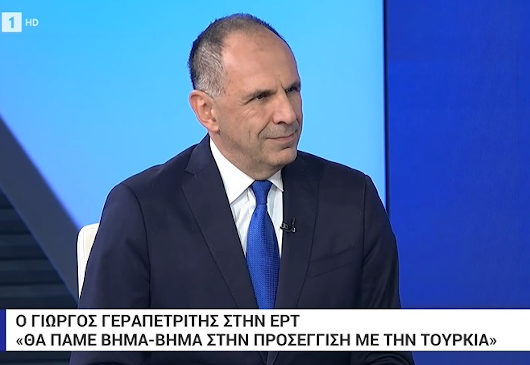
 JOURNALIST: Minister, thank you for coming directly from the airport where you escorted President Erdoğan to his departure. First of all, everyone, both in the international media and here, is talking about a “new page” today. So, I would like to ask you what exactly has happened. Has Erdoğan changed? Have the conditions changed? Have we changed? What exactly has occured?
G. GERAPETRITIS: I believe, Mr. Kouvaras, that the time has come for us to adopt a different understanding. This understanding is related to the fact that we are located next to each other, that we are neighboring countries. Thus, geography unites us. For this reason, it is our duty to seek solutions, to set aside the existing differences, and focus on what unites us: on our positive agenda, on the need to have closer relations as peoples, on the need for better economic relations and, of course, on the need to avoid the tension we have experienced. Our goal, Mr. Kouvaras, is that any disagreements that arise, and they inevitably will, do not lead to crises. That would be a great legacy.
JOURNALIST: Which means that this important step taken in Athens today could pave the way for the next crucial step, namely the resolving of the issue of the continental shelf and the Exclusive Economic Zone (EEZ). That’s what appeared to be pursued by the Greek government, as evidenced by the Prime Minister’s remarks today. Therefore, one issue is that the differences do not produce crises, and the other is that the differences, or better say the sole dispute according to us, Greeks, be resolved. Is that the case?
G. GERAPETRITIS: You used the word "step" twice in your comment, so let me combine these two: we will take it step by step. And the truth is, Mr. Kouvaras, that we have had a period of truly calm waters for the past ten months or so. It is something that I believe has been consolidated. After today I honestly feel that there is a genuine willingness by both countries to advance our relations, to stabilize our ties, and to proceed to the next step when conditions mature. We all realize that our major dispute, the sole dispute that can be brought before international jurisdiction, is the delimitation of the Exclusive Economic Zone and the continental shelf. It is a dispute that goes back decades. I believe that when the conditions mature, we will be able to address this dispute as well.
JOURNALIST: You know, you are talking about taking things step by step, which I hear and understand. There have been leaps in the past, but they have always taken us backwards, rather than forwards. In light of the leaps that have taken us backwards in the past, couldn’t the last 10 months be deemed as a significant step forward? I don't want to call it a leap, but what we saw today bears no resemblance to what we were experiencing 10 months ago when all started with the earthquakes. Do you believe we can move faster or is this not a goal of the Greek Government?
G. GERAPETRITIS: I must confess that my true intention, as well as the Prime Minister's instructions, was for us to proceed with prudence and diligence, in a situation where we can truly build, brick by brick, a sincere relationship. I believe we have accomplished that. Today is a historic day, in the sense that, if I may say so, we signed the Athens Declaration on Friendly Relations and Good Neighborliness. This Declaration precisely highlights what unites us. In other words, it emphasizes the importance of friendly relations between two neighboring countries, as well as the need to find a way to defuse disagreements so that they do not divide us or create dangerous situations, and of course, to achieve a level of cooperation that is mutually beneficial. It is a Declaration which I believe marks the beginning of the next day. And if you ask me, yes, I believe we have reached a point where we can truly move forward at a faster pace.
JOURNALIST: That is very interesting. It appeared today that the visit, diplomatically speaking, had been well-prepared. Nevertheless, was the Prime Minister's second intervention with his references to the Muslim minority and the Treaty of Lausanne, planned, or was it spontaneously caused by Erdoğan’s remarks?
G. GERAPETRITIS: Mr. Kouvaras, you are a very experienced journalist. You realize, and I believe all your colleagues do as well, that this particular visit was minutely prepared with assiduous work, professionalism, prudence, and diligence. It is my conviction that the seriousness with which we have handled the Greek-Turkish relations over the past few months was manifested today in the most tangible way. It was evident even, if you want, in the body language of the two leaders and the images we saw in the bilateral meetings between the Ministers. Because, Mr. Kouvaras, leadership is undoubtedly important, but so is how we perceive the level of ministerial relations. And we witnessed truly sincere relations in the Ministry of Foreign Affairs, where we hosted all the inter-ministerial meetings, which is what we desire.
So, I would like to tell you that everything was indeed very well-prepared and if you will allow me to say, this is largely due to the good work that the Government has done. I would like to take this opportunity to congratulate all the Ministers who helped produce the agreements and of course, especially the staff of the Ministry of Foreign Affairs, who worked with great enthusiasm.
JOURNALIST: You didn’t tell me though, whether Mitsotakis' response was planned or prompted from Erdoğan’s remarks about the Muslim minority and the Treaty of Lausanne.
G. GERAPETRITIS: I won't be evasive. Let me simply say that Greek diplomacy is prepared for all eventualities. I have been saying this a lot lately: we are prepared and ready for anything. You know what? On this particular issue, the issue of minorities, we know there is a difference in approach, just as there is a difference on the Middle East, as well as on the Cyprus issue.
JOURNALIST: Yes.
G. GERAPETRITIS: These differences should become the subject of discussion. We should discuss our differences. You know, Mr. Kouvaras, I am a proponent of discussion, a supporter of deliberative democracy. I believe that when people meet and have a rational approach, principles and values, they can always find a solution.
JOURNALIST: I think today...
G. GERAPETRITIS: I believe it was evident today that we were honest. We said that we have differences and that was stated by many sides. We didn't hide it. However, what became clear is that both sides sought for a constructive discussion.
JOURNALIST: Could you tell me something else now? Personally, what is your relationship with Erdoğan and Fidan? And I'm asking this for an additional reason, because there has been an issue today and you have seen it yourself. I mean the way you greeted Erdoğan at some point, the fact that you made a slight "bow". There has been a lot of fuss about it.
G. GERAPETRITIS: First, let me say that by nature, I can only be honest with my interlocutors and act based on principles and values. I believe that this is appreciated by the other side as well. And I want to emphasize that I feel the same applies on the part of the Turkish Minister of Foreign Affairs. I want to tell you, Mr. Kouvaras, that there have been many instances during the last ten months when there were many potential tensions, which we managed to decompress through discussion at the highest level. Thus, a good interpersonal relationship has indeed been developed between the Foreign Ministers that helps us keep a better pace. As for President Erdoğan, we have the formal relationship that a Minister of Foreign Affairs has with a Head of State. Regarding the issue you mentioned, I want to tell you that I understand, the Prime Minister said it too, that there are voices within Greece that are opposed to the rapprochement we are trying to establish with Türkiye. I can accept every opinion. However, I do not understand the way in which someone will try to cast any shadow on this visit, which is particularly productive for the country. I want to emphasize this. I will always demonstrate the due respect to our Head of State, as I did when I saw her on Saturday, as I did today, and will always do. I will always do this to the Head of my state. After all, I had seen Erdoğan, as you know, earlier this morning. I welcomed him and I believe those images can speak for themselves.
JOURNALIST: Certainly. I would like to pose one final question. K. Mitsotakis will travel to Ankara in the spring. What do you expect from the Greek-Turkish relations by then? Because you just informed me, and I admit I didn't know it, that there were times during the last 10 months when things were about to go off track on a diplomatic level as well, and you and Fidan prevented this from occurring, to put it simply. So, what are your expectations for the next few months, until the Mitsotakis-Erdogan meeting in the spring? Should we take it step by step?
G. GERAPETRITIS: The more a relationship is built, Mr. Kouvaras, the more difficult it becomes to disrupt that relationship. I believe we have laid down a solid foundation to build upon. Today, Mr. Kouvaras, we adopted 15 agreements and joint statements: economic agreements, trade exchanges, strengthening exports and investments.
Agreements that have a social aspect. Agreements on the mutual recognition of technical qualifications, on the protection of people with disabilities. Very significant agreements that, in my opinion, assist to bring peoples closer together. We have already ensured that there is a significant flow of university student exchanges as well as student exchanges. I would like to tell you, Mr. Kouvaras, that after today, I feel a little bit stronger to manage any tension, both as a member of the government and as a government collectively under the instructions of our Prime Minister. There is no possibility that two countries living next to each other and having between them the Aegean Sea, our sea, do not have tensions. But I want to say that with good intentions, demonstrated on the ground, with reason and principles in our politics, these tensions will not be enough to stop the course to better and productive relations.
JOURNALIST: Mr. Gerapetritis, I have one more question. Will you inform the opposition more specifically and in what manner? Or will it be informed in a discussion to be held in Parliament? Will there be any meetings following the High-Level Cooperation Council?
G. GERAPETRITIS: I'm glad you asked. As you are aware, I maintain a steadfast conviction that there should be complete briefing of the political system. As you are aware, I briefed the political leaders last week ahead of today's meeting, and I have already asked to brief the Parliamentary Standing Committee on National Defence and Foreign Affairs in the coming days, so that the political parties know where we stand and what the next steps are. The next steps, which include a series of meetings on all three pillars, namely the political dialogue, the Positive Agenda and the Confidence Building Measures and, of course, the meetings that the two leaders will have in the immediate future.
JOURNALIST: Are you planning to travel to Ankara soon?
G. GERAPETRITIS: I will be meeting with the Minister of Foreign Affairs on several occasions. We have already scheduled a timeline of contacts until next summer. Both leaders will meet as well. Already, a meeting of the Prime Minister is being organized for the spring. Prime Minister Mitsotakis will visit Ankara. I want to assure you and assure the Greek people that all the upcoming steps are planned with seriousness, diligence, and professionalism.
JOURNALIST: Thank you very much, Mr. Gerapetritis.
G. GERAPETRITIS: I warmly thank you for the honor.
December 7, 2023