


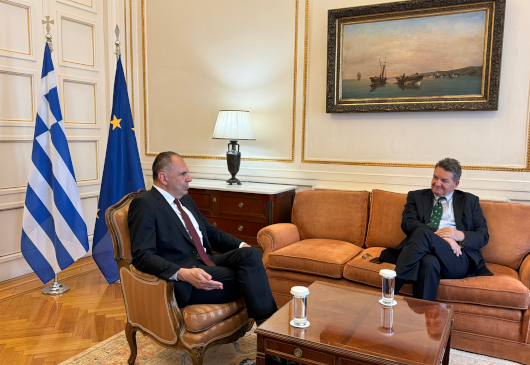
 JOURNALIST: You just concluded a meeting with Ms. Holguín. During your visit to Ankara did you discover any potential to overcome the Turkish intransigence regarding the position of two states on the Cyprus issue?
G. GERAPETRITIS: The Cyprus issue remains a top priority for Greek foreign policy. We are actively working to bring the President of Cyprus and the leader of the Turkish Cypriots to the dialogue table. I maintain excellent relations with both the UN Secretary-General's Personal Envoy and the Secretary-General himself. We communicate and meet regularly to activate the dialogue mechanism between the two sides. We are aligned with the Cypriot government in the belief that improving Greek-Turkish relations can positively impact the initiation of dialogue on the Cyprus issue. We, indeed, discussed the Cyprus issue in Ankara. The Greek position is clear. The two sides should discuss the basis of the UN Security Council resolutions for a Bi-zonal, Bi-communal Federation. The dialogue should be initiated and there should be a productive discussion, which will lead us to a viable and beneficial solution of the Cyprus issue within the framework of the resolutions. I believe that the Turkish side recognizes the importance of dialogue. After all, it is in this dialogue that we also invest as regards Greek-Turkish relations. I hope and wish for a positive development to the Cyprus issue in the near future.
JOURNALIST: Following your visit to Ankara, what is the timeline for the next meetings?
G. GERAPETRITIS: The next milestone is September in New York, at the UN General Assembly, where a meeting between the two leaders will take place. The leaders will also attend the NATO Summit in Washington. If deemed appropriate, they will meet there as well. The next milestone is the High-Level Cooperation Council. The two leaders agreed yesterday to convene the Council towards the end of the year in Ankara. In the meantime, until September, there will be a new round of political dialogue, positive agenda, and Confidence Building Measures, so that we have more positive and tangible results. It is particularly important that normalization is emerging in our relationship with Türkiye: We meet on a regular basis. These meetings do not necessarily have to yield a very specific, major result; we can now even disagree without this necessarily creating tension.
JOURNALIST: Since the express visa measure has been very successful, are you considering expanding it to other islands as well?
G. GERAPETRITIS: First, let me point out that this was an initiative of the Greek Ministry of Foreign Affairs and serves the idea that any approach by governments can only exist through a people-to-people approach. For this reason, I believe it has been extremely important not only for the economy of our islands but also for establishing foundations of friendship and good neighborliness. We coordinated with the European Commission to adopt this measure, given that it constitutes a deviation from the Schengen rules. Our intention was to activate the measure for islands hosting refugee structures, as well as those with direct ferry lines. Considering that it is a deviation from the Schengen rules, it is difficult to expand it. Hopefully, we will have the opportunity for other measures that will bring the two peoples closer together.
JOURNALIST: You have stated that you are likely to lead the discussion on the delimitation of maritime zones. As far as we are aware, this issue was not raised in Ankara. Do you see any willingness on the part of Türkiye to discuss this? Is there an intent on their part to refer it to The Hague?
G. GERAPETRITIS: The issue of delimitation of the continental shelf and the EEZ is a complex technical matter with significant historical weight. It is noteworthy that it has been the subject of 64 rounds of exploratory contacts, without substantial results. Although it has an intrinsic value to be able to enjoy a period of calm in the Aegean without violations of our national airspace and without significant migration flows, a definitive resolution of the continental shelf and EEZ issue would be extremely important for long-term and sustainable peace in our region. Our intention is to discuss these issues when conditions are suitable. An environment of sincerity and mutual understanding should be firmly established, particularly through the consolidation and full implementation of the positive agenda agreements. We stated from the beginning that we would proceed step-by-step in the Greek-Turkish dialogue. We are doing so prudently so as to build primarily upon what unites us. Certainly, differing views on fundamental issues have not disappeared. The timing depends on the mandate given by the two leaders to the Foreign Ministers to initiate and monitor the relevant dialogue. It would be ideal if we could reach a joint agreement on the delimitation. In any case, the path of a special agreement to refer this difference to international jurisdiction always remains.
JOURNALIST: In Ankara, we observed a generally positive atmosphere, but there were also significant disagreements on various specific issues, such as the Monastery of Chora and the minority. How do you assess the visit?
G. GERAPETRITIS: My overall assessment is positive. The atmosphere was sincere, and both sides demonstrated a deliberative spirit. I do not consider it as negative that we recorded our disagreements. And this is because to be able to discuss even those points we disagree on without generating tension and crisis is essential for any dialogue process. Moreover, it would have been impossible to achieve complete convergence, especially since both states carry huge historical burdens. Our intention is to be able to place the emphasis on what unites us and discuss those issues on which we disagree without tension. This is how a normal inter-state relationship, a productive normality, should function.
JOURNALIST: The statements by North Macedonia's new President, Ms. Siljanovska, constitute a breach of the Prespa Agreement. You have reacted by emphasizing that North Macedonia's European perspective depends on the faithful implementation of the agreement. Are you considering initiatives at the NATO level as well?
G. GERAPETRITIS: Let me first point out that in my view, the Greek side's response was swift, multidimensional, and effective. In addition to the announcements by the Prime Minister and the Foreign Ministry, we had statements from the President of the European Council, the President of the European Commission, and the EU High Representative, as well as from Spokespersons of the Foreign Ministries of other states, who were informed and mobilized at the initiative of the Greek Ministry of Foreign Affairs. The truth is that today's political leadership of North Macedonia is already under internal pressure. The country's Ministry of Foreign Affairs issued a statement that there must be full compliance with the Prespa Agreement and the constitutional name of the state, while the Ministry of Justice characterized the oath-taking as null and void. I am convinced that the citizens of North Macedonia would not want to jeopardize their relationship with Greece and the European perspective of their country. It is obvious that we raise issues of compliance with the Prespa Agreement in all international fora and demand its bona fide implementation.
JOURNALIST: The opposition is calling on you to ratify the memoranda. You have stated that this will happen within this year. Has anything changed regarding this?
G. GERAPETRITIS: I believe that developments have vindicated the policy we have been following. We will bring the memoranda for ratification at an appropriate political time; their ratification depends on the bona fide and full implementation of the Prespa Agreement. Because, apart from the issue of the constitutional name, there are other substantial pending issues. I really do not understand the opposition’s stance: on the one hand, it accuses us of not having ratified the memoranda and, on the other, it sees risks to the implementation of the Agreement from the behaviour of the new political leadership of North Macedonia. The reality is that we want to bring the memoranda up for ratification because we, too, agree in principle with the European course of North Macedonia. However, this cannot be done unless there is full and tangible compliance with the Prespa Agreement. Let's not forget that the implementation of the Agreement is explicitly a prerequisite for the accession process of North Macedonia.
JOURNALIST: Regarding the Beleri case, do you believe that the Albanians are deliberately delaying the accession process, so that by the time the first package of chapters gets assessed, his legal ordeal would be over, he would be declared deposed, and a Greek veto would be meaningless?
G. GERAPETRITIS: I would not like to interpret the intentions of the Albanian government. Τhe Greek side has from the very beginning positioned itself very strictly and on the basis of rules. What we have been saying all along is that issues concerning democracy, the rule of law, minority rights, and the political rights of all citizens constitute European stakes rather than a bilateral dispute. We continue to believe this. And certainly, it was not Greece that sparked the Belleri case. After all, the first chapter of the accession negotiations specifically concerns these fundamental issues. It is obvious that when this chapter opens, how justice has functioned in Albania, and whether Mr. Belleri was provided with the guarantees that should be offered to every citizen, especially members of national minorities, will be substantively evaluated. We remain firmly in favor of the accession of all Western Balkan states to the European family, as this would substantially contribute to peace and prosperity in a highly fragile corner of Europe. On the other hand, we all understand that concessions on European acquis are not acceptable. Greece will ensure that any existing problems in relation to this are appropriately highlighted.
May 19, 2024