


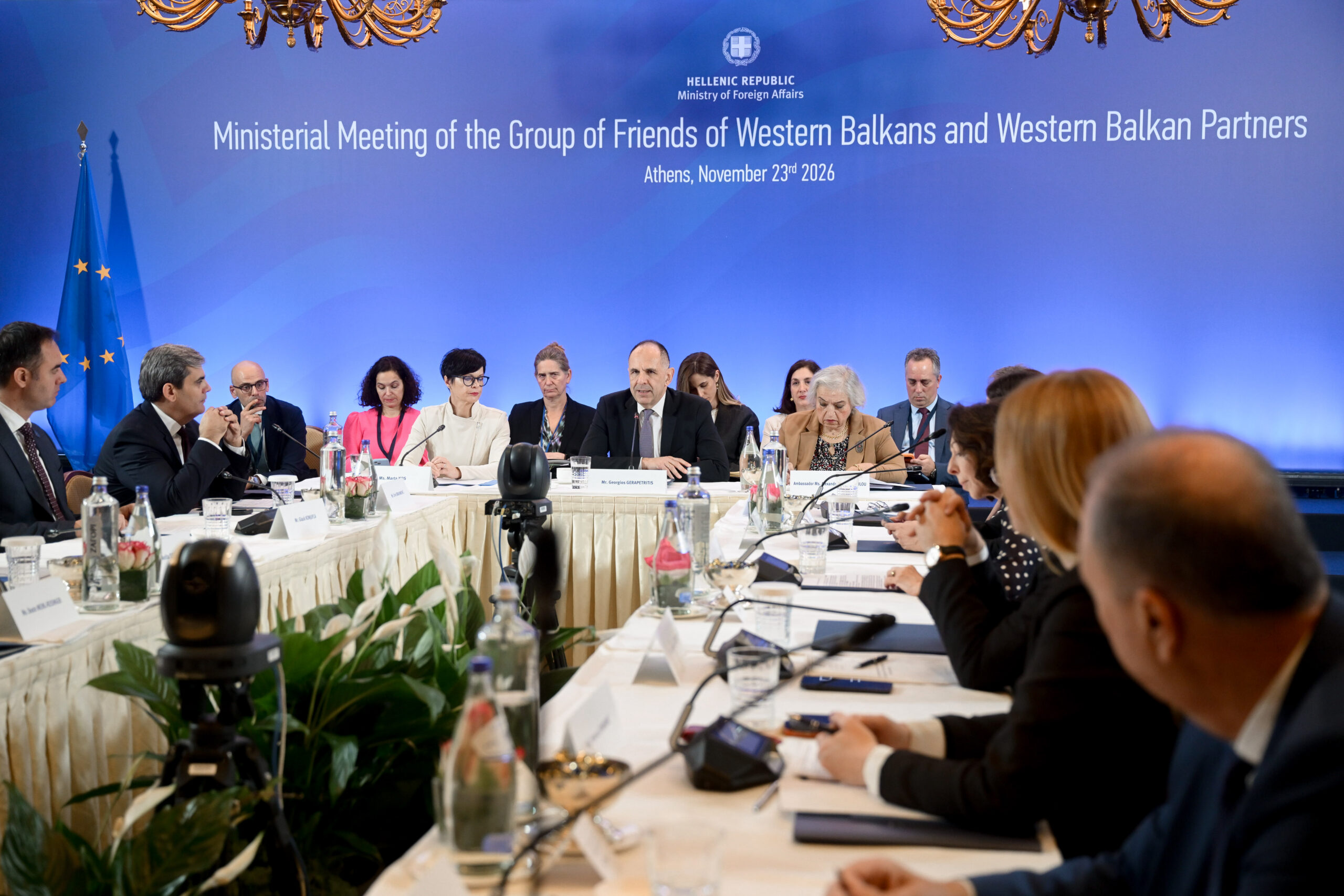
First of all, I would like to welcome you all to Athens. It's truly an exceptional honour to host you here. And we are particularly rejoiced with the strong attendance of this meeting and its popularity. We had the opportunity yesterday to interact in a more informal way, which is always the most enjoyable way. But we need to do some serious work now because the issue in question, namely the accession of the Western Balkans and how we sustain its momentum is truly critical because times are volatile and we need to actually make some meaningful progress when it comes to the enlargement process. For us, it is a recognition, that you are all here, of our continuous efforts as the Group of Friends of the Western Balkans, to support our Western Balkans partners' EU aspirations, that I believe will gain a renewed impetus in view of our Presidency of the Council of the European Union, in the second semester of 2027.
Building on the Thessaloniki Agenda of 2003, already 23 years ago, I had the pleasure of hosting you and my colleagues from the Western Balkans at the Delphi Economic Forum back in May. Following a very interesting exchange of views, we adopted the Delphi Declaration on the European Integration of the Western Balkans, essentially reiterating our shared conviction that the future of the Western Balkans lies within the European Union and our shared commitment to achieving this goal.
Now I have the pleasure and honour to host you here in Athens, in the cradle of democracy. This morning's session is Enlargement: Sustaining the Momentum. And there is a momentum to start with, as proven by the intensive ongoing discussions ahead of the next enlargement. A momentum focusing on the institutional arrangements needed and the ways to further support the European course of our partners.
Aristotle said— I keep on saying this, I like this quotation— that the whole is greater than its parts. And this is exactly how we describe the importance of enlargement for both the European Union and the Western Balkan partners. Sometimes we forget that it is equally important for the European Union to actually echo the enlargement process because it reflects the willingness of the people who are at the door of the European Union to actually become part of our family. The accession of the Western Balkans to the European Union, as we all recognize, is an investment in peace, security, and prosperity. The region will benefit from the transformative nature of this accession. At the same time, once integrated in the European Union, I think it will play an important role in strengthening the Union, situated at a very sensitive crossroad, strategically placed between Eastern Europe and the Eastern Mediterranean, two hotspots of international crisis, unfortunately. The Western Balkans are necessary for completing the political unity of our continent and the geographical continuity of the European Union.
As far as all of us are concerned, the Western Balkans are our immediate neighbours with whom we share challenges and a common future. This is why the momentum must be sustained and enhanced today. Two days before the EU-Western Balkans Summit in Brussels and following the contribution of the Commission with preparing for a wider Union— thank you so much for this, my dear Marta— and the 2026 Enlargement Package, we are here to see how we can seize the opportunity and have a free exchange of views on the progress achieved, the current challenges and the best ways forward. We have to recognize that much progress has indeed been achieved.
Montenegro truly emerges as a success story of the European Union enlargement policy, showing that Western Balkans getting closer to full EU membership is indeed feasible when the relevant conditions are fulfilled.
Albania has already also opened the chapters within a year and has already closed four chapters with five more under discussion. Congratulations, my dear Ferit, for this.
North Macedonia has already made significant progress in a number of areas, notably digital transformation, foreign and security policy alignment, and aspects of public administrative reform. Congratulations, my dear Timčo.
Serbia has adopted a series of reform measures regarding the rule of law, including in relation to the functioning of the judiciary, the fight against corruption, electronic media, and the electoral framework, which is a very critical condition for democratic processes. We are looking forward to cooperating with the new governments with a view to stepping up the accession efforts.
Bosnia and Herzegovina has taken steps to fight corruption and the financing of terrorism. We look forward to working with the new government in order to resume efforts and concentrate on advancing the country's EU path. Congratulations, Dino, and thank you for being here.
We also welcome Kosovo's efforts in the fight against organized crime and the improvement on the major challenges concerning the business environment. And of course, at the same time, we understand that challenges remain. In particular, when it comes to the fundamentals cluster and the need to deliver and effectively implement substantial reforms we should not overlook the fact that the fundamentals are essentially the key to Europe because this is what truly unites us. Our shared commitment, our historic commitment to the fundamentals of democracy and of the rule of law. Democratic governance, respect for human rights, and the fight against corruption are not just preconditions for accession. They are the key to the transformation of the region to the benefit, first of all, of its own citizens, and that is why they matter.
Allow me also to highlight the importance of good neighborly relations and respect for international law, which constitute an essential part of the accession process and a fundamental precondition for the stability and prosperity of the whole region. They are, of course, equally important in order to build the trust required among Member States in the larger Union. Having said this, the right way forward is not, of course, lowering the bar, but keeping it high and supporting and encouraging all partners to reach this bar. And this is absolutely feasible to maintain, and we are confident that they will certainly do so in the very near future.
As the oldest EU member state in the region, Greece will spare no effort to support the Western Balkans' European aspirations. In particular, ahead of our Presidency of the Council of the European Union in 2027, we should ensure that we will have a Union of equals with all rights and obligations stemming therefrom. I will leave it at that, and I'm eager to hear your views. Once again, a very warm welcome to Athens, and it's an exceptional honor for me to host you here.
Thank you so much. Now we have to do some serious work.
November 23, 2026