


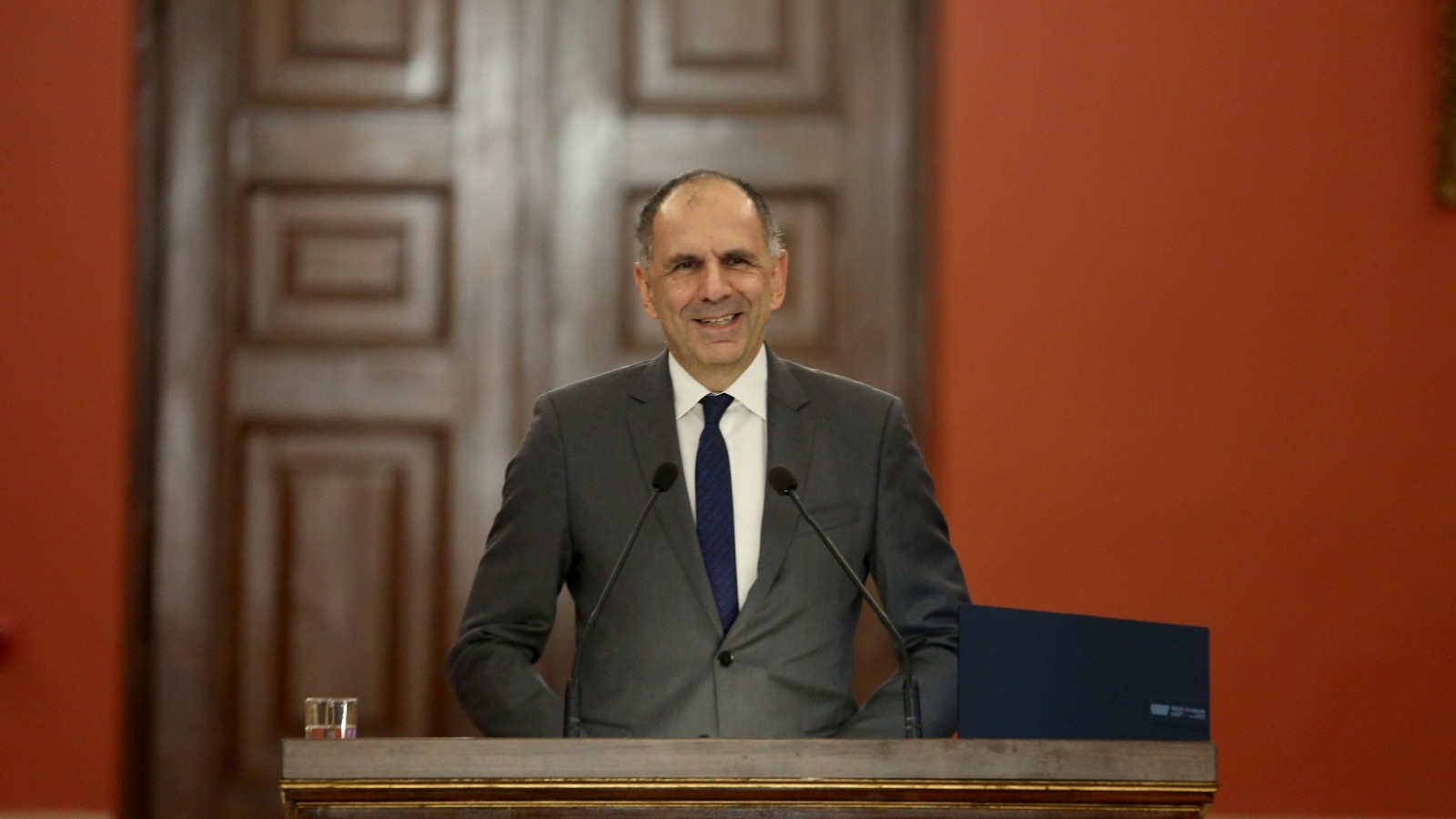
INTRODUCTORY REMARKS
Dear friends, dear students,
This is a very important moment for me today. And I must confess that it is a difficult moment. It is difficult to return home as a guest. And that makes my emotion and anxiety even greater regarding what we will discuss today. But it also heightens my admiration and gratitude toward our students, toward the School of Law, which, for more than twenty years, has been and remains my home. I would like to thank, from the bottom of my heart, the Student Association of Public and International Law for its honorable invitation, as well as my dear colleagues who honor me with their presence today, the Dean, the former Dean and also President of the European Court of Human Rights, whose presence here today and whose observations - which I hope will be moderate rather than sharp - honor me exceedingly.
I would like to make clear from the outset how difficult it is to move from academia to politics. And that is because, from the moment one does so, one abandons a fundamental premise: the discussion based on rational discourse.
The self-evident assumptions we can share within the framework of academic deliberation are often absent from political dialogue. Especially nowadays, when populism abounds, information is transmitted uncritically and without verification, and no one feels the need to consult primary sources. Everything is communicated at great speed, and unfortunately, the quality and integrity of information are sacrificed on the altar of speed or of easily consumable content.
Therefore, I urge you not to fall into the trap of evaluating me solely as Minister. The main problem of division that has arisen is that, in political life, I am perceived as an academic, while here at the University, you now perceive me as a politician. It is really important - and this is my advice to all of you - to serve the public good. The goal each of us should have, not only as a duty to our country but also as a personal debt in gratitude for what our homeland has bestowed upon us, is to serve it from whatever position we are given, in whatever way we find most effective. Returning today to the School of Law and particularly to an academic forum on international law, I recall the first-year lecture in Constitutional Law, when we discussed the basis of sovereignty and how the national and international legal orders overlap.
And, as any public affairs scholar who takes himself seriously, I too used to question the value of International Law - even its very existence and classification as a distinct branch of law - based on two main arguments that we all understand.
The first is that one cannot call “Law” something that derives from the might of the powerful. Therefore, it lacks the essential characteristic required to define a field as legal science - namely, inductive reasoning. The second is that, in many cases, International Law lacks the effectiveness conferred by sovereignty: accountability and enforceability. Any law must be enforceable.
What will my main topic be today? As I often do, I will give you the conclusion first and then try to support it with arguments. My basic position is based on three assumptions.
The first assumption is that we are experiencing a changing world full of paradoxes. The second assumption is that these paradoxes create insurmountable challenges. The third assumption, which is also the conclusion, is that these challenges lead us to radical doubt - not only about the validity and applicability of International Law, but also about the very values upon which the Western liberal world has been built.
But what does a “changing world” mean? What we are experiencing today is truly unprecedented, both in Europe and globally. Realities that held true for decades - such as the belief that Europe is impregnable, that it is shielded - have now disappeared. At the heart of Europe, there is now a large and bloody war, while the European Union itself is under attack. It is being challenged both from within and by its own peoples, who now openly question the Union’s strength and credibility - arguing that it struggles to make decisions and, above all, fails to mitigate the crises surrounding us. The fundamental principle that Europe is secure, and that borders cannot be changed by force, is now a thing of the past, after Russia’s invasion of Ukraine. Within this environment, a series of paradoxes are shaping a new perception of the international security architecture.
The first paradox is that, while all contemporary challenges are global, transnational, and universal in nature, the international multilateralism that forms the basis of the post-war world order appears to be in retreat.
All the crises we are experiencing today have a distinctly international footprint. The notion of a “regional crisis” no longer exists, whether it is a conventional war, a health crisis, a climate crisis, or any other hybrid crisis. Crises know no borders.
One would expect that, precisely because crises transcend borders, international multilateralism should be strengthened, along with international organizations which are the prime supporters of crisis management at the multinational level. However, this is not what happens. In fact, as crises multiply and take on a global character, international organizations seem increasingly incapable of responding. Perhaps the most striking example is the United Nations, which was founded to prevent wars in their conventional form at the time and later to manage all types of crises.
Consider that today, there are 61 armed conflicts recorded worldwide, the highest number ever, 11 of which cause more than 1,000 deaths per year, and are thus classified as major wars. A situation that calls for the strengthening of international organizations and multilateralism. Nevertheless, international multilateralism seems to be receding and giving way to smaller formations or even to interventions by powerful states alone.
The second paradox, closely related to the first, is this: everyone invokes International Law -especially states like Greece, which have a long-standing tradition of adhering to it. Because Greece is situated in a difficult neighborhood and possesses the size and relative power it does, International Law constitutes a powerful instrument for confronting external threats. Nevertheless, despite the fact that International Law is being invoked more than ever, international politics seems to be shifting toward a transactional approach. To use legal terminology - since I am addressing a specialized audience - one would expect that, when we refer to International Law as a means for the peaceful resolution of disputes (as required by the UN Charter), we would first identify the rule and then seek to apply it to the facts. In reality, what happens is the reverse: we first have the solution, and then we search for the legal basis to justify it. A purely utilitarian approach, where International Law not only retreats - which would be the relatively better outcome - but even becomes a legitimizing pretext for decisions that undermine the persuasiveness of law itself. And most of all, such an approach harms the weak.
And the third paradox is that while there is an international perception that democracy around the world is becoming stronger and democracies are multiplying - therefore authoritarian regimes are diminishing - in reality the exact opposite is true. Democracies around the world are declining, authoritarianism is becoming more and more visible. The law of the powerful is being imposed and is turning democracies into de facto authoritarian regimes. The Economist's Democracy Index for 2024, lists 74 democracies - and 74 are full democracies, but also democracies that are deficient -, while 93 states are not classified as democracies. You can imagine where this index would be if the reference were not to democracy, which is a much more procedural phenomenon of our world, but to the rule of law, which is characterized by an enhanced substantive aspect.
Let us now look at the issues of the problems that arise from these international paradoxes: the retreat of international multilateralism, the pretentious invocation of International Law, the decline of democracy.
The problems that I identify are of two kinds. They are the problem of values and the structural problem. What do I characterize as a problem of values? It is the basic reference to liberal democracy and its principles. To the values that have shaped the post-war world, particularly democracy, the rule of law and human rights. The fact that values constitute the basis of the post-war world, the basis of the international security architecture, can be seen by everyone not only in the Charter of the United Nations, but mainly in the Treaty on European Union. It is very interesting to look at the Article 2 of this Treaty, which explicitly refers to the values that govern the European family. Values that refer precisely to democracy, the rule of law, independent justice, mainly in the area of inclusiveness, tolerance, equality. A much more substantial version of the values of the Western world. The European vision was built on these values in the 1950s, and this had multiple benefits. It created what Professor von Bogdandy refers to as a European society through law.
But it also had an element of security. We created a safe area, as Karl Deutsch would say. Security, of course, is today dynamically declining. It is declining because we no longer have the self-evident fact of the inviolability of borders, where revisionism exists in practice, however much it may be condemned. But values are the structural feature that gave birth to Europe, beyond international coexistence within the framework of the United Nations. And in fact, the Treaty of the European Union itself, as it has been interpreted - very recently in the Polisario ruling of 2021 of the European Court of Justice - states that these values should also govern the external action of the European Union. When Europe presents itself to the world, it should do so primarily on the basis of these values.
Of course, values also have their limits. Because, Article 2 - which I mentioned to you a moment ago - may be the most fundamental, in my opinion, in the entire European acquis, in the institutional architecture of the European Union, however, the drafters of the Treaties made provisions to weaken its actual application, the substantial added value that it could have.
Because what is the real sanction if a Member State of the European Union does not follow the values that form the basis of the European edifice? This is already provided for in Article 7 of the Treaty and there is a sequence of steps that can even lead to severe sanctions. For example, a state that has been found not to respect European values could be deprived of its voting rights.
And indeed, in two cases this happened. It happened with Poland and it happened with Hungary. The case of Hungary is interesting. In both cases, it involved government interference in the judicial system or in independent authorities. With Hungary, the process is still ongoing. Despite this - and this is interesting in terms of how much values are receding as the basis of the European structure and liberal democracy - the values and the resulting annulment process did not prevent Hungary from holding the Presidency of the European Council in the second half of 2024. Although there was a large academic movement, which argued with legal arguments, that in the context of these sanctions, a country that is not inspired by the values of the European Union, should not take over the Presidency, the values are more about appearance than substance.
The second problem is perhaps even greater. It is the structural problem, which has to do with the organization and operation of international organizations. This problem starts emanates from the fact that international organizations attempt to simultaneously serve two purposes simultaneously, which in many cases may be conflicting.
The first purpose is to serve the values that are characterized as European or international, universal. The values that govern each international organization. But it also has a second purpose: maintaining a nucleus of sovereignty of the member states that make up each international organization. That is, each international organization tries to simultaneously serve the purpose of the community, while preserving a beneficial, substantive content in the traditional sovereignty of each member state. This largely counterproductive dynamic that can be applied has led to what a very distinguished professor, Dapo Akande of the University of Oxford, has characterized as “the problem of consent.” What is “the problem of consent”? To put it simply, it is the problem of the veto. The veto, that is, the right of each member state to block decisions that are crucial within the international organization, is precisely the procedural vehicle through which national rights are safeguarded. That is, sovereignty and national interest, as each state perceives it.
We see the “problem of consent” in international organizations every day. Take, for example, the three major organizations that are considered to serve the Western-style international security architecture. In the United Nations, the Security Council has been unable to make a Decision, to issue a Resolution, regarding Russia’s attack on Ukraine for more than three years. Why can’t it do so? It’s very simple. Because one of the members that has the right to veto, one of the permanent members of the Security Council, is the aggressor. We can have at the same time a universal decision of the General Assembly of the United Nations condemning a country and the next moment the Security Council, which is the executive body and which should precisely implement the decisions of the international community, is blocked precisely because of the mechanics that give the right of veto to the five permanent members of the Security Council.
But we don't have to go far. We can also go to Europe. In Europe, when unanimity is required, for example in the cases of decisions taken within the framework of the Common Foreign and Security Policy, the CFSP - in order to take this decision, because nowadays interests do not coincide, it should be necessary, to put it elegantly, for any member who disagrees, to leave for a coffee break. The decision should actually be taken during the coffee break, so that there is the required unanimity. And again, within the framework of the right of veto, which is used as it is used.
But let's also look at NATO. What happened to NATO? In order for the new members to join, for which there was an agreement in principle among all NATO members, they would have to go through an administrative filter of the other states, where some states put forward conditions that were in no way related to the issues involved in the state's accession to NATO.
Based on the above, we understand how vulnerable the system of International Law and international politics is today. I fear three things. I fear, first, that Europe, but also the international system, may suffer the fate of ancient Athens, the “Athens syndrome”. Athens was a much more powerful regime in all respects than Sparta. But why did it fall? Because it succumbed to the populism of demagogues, as presented by Thucydides. And because today populism is the last resort used by those who are in the wrong or those who wish to have illegitimate access to power, the great danger is always within us. And for Europe, this danger is primarily internal. The second danger is the danger of a “Macedonian Empire”-style fall, that is, the lack of leadership or the lack of resilient institutions. Unfortunately, today, we are witnessing the lack of resilient institutions, the general decline of institutions, as well as the lack of leadership on several occasions in international fora.
In order for peace and prosperity to survive, institutions are needed. Where there are institutional gaps, they are certain to be filled by those who scheme to undermine them. All of us should therefore not forget the importance of building resilient institutions.
And of course, the third danger is the fall of the “ancien régime”, the old regime, which in reality was overthrown by rival ideologies. Ideologies, which appear and in fact are transmitted with lightning speed everywhere, can act as a psychological lever to undermine the value of institutions. This ideological battle can lead to major problems for those who rely on values.
I did not give a very optimistic picture of international politics. I know that. You might ask me, why do we, here in Greece, if this is the case, continue to support the persuasion and power of International Law? Because International Law is the basis on which international order can be built. Order today has more value than anything else. But order without values cannot exist. For us, what is paramount in such a disorderly world, full of civilizational challenges, is a threefold goal. And I think, if you consider the steps that we have taken in our diplomacy, in Greek diplomacy, you will recognize many of what I have just mentioned to you.
The first is to be able to create conditions of peace in our neighborhood and in the world. Having conditions of peace is necessary, not only for the obvious reason that tensions and crises are not produced. Having conditions of peace gives you the opportunity to be able to build what is useful. To build international alliances and to be able to create arguments that will help you. But above all, peace is necessary, because in the modern world, where there is tension and crisis, this can also be interpreted as a call to third parties to become more actively involved.
For me, for the Ministry of Foreign Affairs, for the entire Greek State, I think no one can deny the fact that peace in our neighborhood is a necessary goal. And at the same time, we must be able to build so that we can have those negotiating arguments, which will put us in a position of strength or at least on equal terms. The truth is that, today, we have many more arguments than we had before. They are those arguments that, on the initiative of Greece, have been incorporated in the European acquis, have been placed in international politics and are now part of this diplomatic game. My point of view is that in times like these, being in a state of passive inaction is the greatest danger for the country. Greece must take initiatives, it must support its own national position and be ready at any time to assume the leading role it can play.
Reference was made to the major forms of power, whether they are hard or soft. The hard form of power today, perhaps the greatest that could exist after economic stability, is energy security and diversification. Greece has managed in recent years to develop a level of energy security that makes it not only self-sufficient, but necessary for many countries. All the corridors that have been opened allow us today to be able to provide an energy mix to all the countries of the wider region and to have become an exporting rather than an importing country. For the first time, we have managed to have more than 50% of our own energy mix come from renewable sources, which gives us the ability to face all risks with absolute self-sufficiency.
But also, our sources of soft power. One source of our soft power is certainly the Greek Diaspora, it is public diplomacy. These are the factors that make the country strong. And above all, it is the international capital that people give us. The fact that Greece has ambassadors everywhere - and by ambassadors, I mean all the Greeks of Greek origin and Greek conviction who are currently around the world - is a capital that is not found anywhere. And I can absolutely confirm this to you. Because wherever I am abroad on an official visit, I see the Greeks of the Diaspora. And I can tell you with certainty that this is an asset that is so powerful that it can give our homeland much greater value than any conventional diplomatic mission.
And it is my wish - and I have always said it as a Professor at this School - that the young people find their way, travel, discover new worlds, not be afraid of uphill climbs, become ambassadors of the School, the city and Greece around the world. I will conclude.
I conclude with the elephant in the room, which I did not mention. I have spoken at length about the values, which must be our basis. And we must defend them since a country like Greece cannot adopt a transactional logic, but must adhere to International Law and the rules of the international legal order. Are there really common values of what we call Western civilization today? Are there any more values of liberal democracy today, which are taken for granted and not challenged? The question is not so simple. Let me put it another way. If today we had countries in the process of joining the European Union, which are currently at the core of the European Union, could they pass the criteria set by the Treaty on European Union in Article 19 and the Copenhagen criteria? Within the European Union, are we all of one mind regarding what the values that should inspire our community are?
The answer is obviously not easy. The truth is that the collapse of values actually goes against the very existence of the European Union. And because the European Union is our homeland, I want to believe something that I have always believed. That the power that is generated by the Law of the European Union and by the European family is not what we all think. That is, that we should all become homogeneous, be in a state of uniformity, because in this way we multiply our power. The added value of Europe, for us, is the principles that Europe represents. And a strong Europe is in fact a guarantee for the international system, a guarantee of peace and prosperity.
However, I want to be very clear in concluding. Whatever challenges we may face in relation to International Law, today more than ever it is necessary to stand by it and strengthen it. And we must consistently invoke it. The selective application of International Law does not simply lead to the weakening of its rules. It essentially leads to the nullification of the international legal order. And it is unknown what results this nullification could have. And especially for countries that are in difficult neighborhoods, such as Greece, with the size and problems that our country has had over time.
For this reason, I call on you all to serve the rules, to serve the law, to view all peoples and all states with respect, without intolerance, to serve our national interest. Because Greece has a strength that will never end.
Thank you.
SECOND INTERVENTION
My colleague, a distinguished expert in International Law and international affairs, has raised a number of important issues. I will try to be as concise and clear as possible.
With regard to the Security Council, Greece was elected with an unprecedented percentage of votes. Ninety-seven percent of the countries voted in our favor. Those that did not, simply do not vote for any country. This demonstrates that Greece possesses a unique quality not shared by all nations: Greece possesses diplomatic capital. Why is that? Because Greece’s stance is based on principles and rules, not on transactions. Greece is able to engage in dialogue with everyone, even with parties who do not speak to each other. We are a strategic interlocutor of Israel, while maintaining excellent relations with the entire Arab world and the Palestinian Authority. We are a privileged interlocutor of the Palestinian Authority. Just a few hours after the Sharm El-Sheikh Peace Summit in Egypt, I had the opportunity to welcome the Palestinian Minister of Foreign Affairs, a visit of high symbolic importance.
Greece bridges the North with the South, the East with the West. This is the essence of our presence on the UN Security Council. We have outlined a series of priorities focused on the peaceful resolution of disputes, something that is, regrettably, too often neglected in today’s world, such as the protection of women and children in armed conflict, and maritime security.
During our Presidency last May, Greece organized a series of events and undertook multiple initiatives. I had the great honor of delivering, at the United Nations, the Joint stakeout on behalf of 80 delegations on the protection of the most vulnerable in armed conflict, particularly in Gaza. It is of great importance that there are countries such as ours, capable of bridging differences. What has been lost - and I say this with genuine regret, as I have always been a highly devoted advocate of this principle - is the spirit of deliberation, both in Greece and internationally.
I have always maintained in lecture halls - and I try to do so in Parliament as well, though it is not always easy - that we must all be ready to change our opinions when reason persuades us that another view is more valid and stronger. This, I believe, is the greatest privilege anyone can have. We cannot remain trapped in sterile dogmatism, which will inevitably lead to intolerance and authoritarianism. For Greece, membership on the Security Council is both a powerful diplomatic instrument and a profound responsibility. It is a diplomatic instrument because, within the framework of the Security Council, I engage in dialogue with every country in the world.
It is remarkable how significant one becomes, by virtue of the decision-making structure of the United Nations, when one serves as an elected member of the Security Council. Even today, I have spoken with several Ministers, as tomorrow we are likely to have a very important vote on a Resolution regarding a very difficult issue concerning Western Sahara. It may seem distant, but in truth, no issue is ever too distant to affect us in times of crisis. None. At the same time, one should take into account the great capital we acquire by becoming an interlocutor of all these states who are seeking to make their voices heard through us. This builds a great diplomatic capital for our country and I believe we are making the most of it.
As regards our initiatives. I believe I have tried to be as diplomatic as possible, although, I must admit, that is not always my style. I have stated that, in my view, there can be no logic of inertia when it comes to our country’s foreign policy. Foreign policy is like a bicycle: you either keep pedaling, or you fall. It is my deeply held conviction, in alignment with the government’s policy, that Greece should assume a leading role on multiple levels. I often hear criticism regarding the initiatives we undertake. Naturally, there will always be criticism. When one takes initiatives, it is inevitable that some may be displeased. But the fact that some may be displeased can never be a deterrent to undertaking initiatives.
I can say - and I do so with pride - that Greece today advances arguments it has never advanced before. A Maritime Spatial Planning, outlining the outer potential limits of the Greek continental shelf and Exclusive Economic Zone, did not exist. Today, it is part of the European acquis. The marine parks within areas of national sovereignty are of great importance, as they neutralize arguments that have been used against Greece for decades. The fact that major American corporations are investing and participating in Greece’s projects for the exploration for hydrocarbons is a tangible proof that our sovereign rights are recognized. All these are initiatives, as is the Prime Minister’s proposal to convene an international conference of the Eastern Mediterranean with all adjacent coastal states, which positions Greece in a leading role, places it at the forefront, and allows it to take ownership of the policies. I say that sincerely. We are not driven by a logic of reaction but by a logic of action. Only through action can one succeed in today’s complex world.
Western Balkans. Indeed, I have come here almost directly from the airport. I was tempted to apologize in advance if I showed signs of fatigue, but thought that would sound somewhat insincere before such a distinguished audience. The truth is that the Western Balkans are not merely our natural neighborhood. They currently are at the center of international attention for several reasons.
The first and most important is that we are witnessing the resurgence of the persistent virus of nationalism in the region. There is no greater threat than latent nationalism resurfacing in a politically explosive environment. For that reason, the Western Balkans must be treated as an absolute priority.
There is only one path, the one leading toward the European family. That is the second reason why the Western Balkans must remain firmly on our radar. At present, as in many other parts of the world, the region has become an arena where states compete for influence, and not always legitimate influence. We are observing interventions even in electoral processes. The hybrid threat through the use of artificial intelligence is changing the rules of the game. Citizens must now be able to avoid anything that does not correspond to truth, they must think critically and not stay on the surface of matters. Otherwise, democracy itself will be shaken.
Today, Africa, the Western Balkans, parts of Asia, and Latin America are all regions experiencing substantial foreign interference. Such interference undermines democracy and, obviously, erodes the rules of International Law. It also creates an imbalance that ultimately damages our values as a whole.
Allow me to conclude. It was mentioned earlier how important the provisions of our Constitution are, and my position on this is well-known. I always refer to the Constitution. Today, I was resolved not to do so but I could not resist, so I will end with a reference to it. There is a provision that is perhaps the most neglected in the entire Constitution. I sometimes hear the argument: “Why must we always adhere so strictly to International Law? Why not to bargain for a supposedly better outcome?” My answer is clear. Most of the students present here today have regrettably not had me as a teacher. Whenever I ask an almost rhetorical question like this, there is only one answer: “Because the Constitution says so.” Indeed, the Constitution says so, in Article 2, paragraph 2. Greece, adhering to the generally recognized rules of International Law, pursues the strengthening of peace and of justice in its region and throughout the world. That is why we stand with International Law.
Thank you.
October 23, 2025