


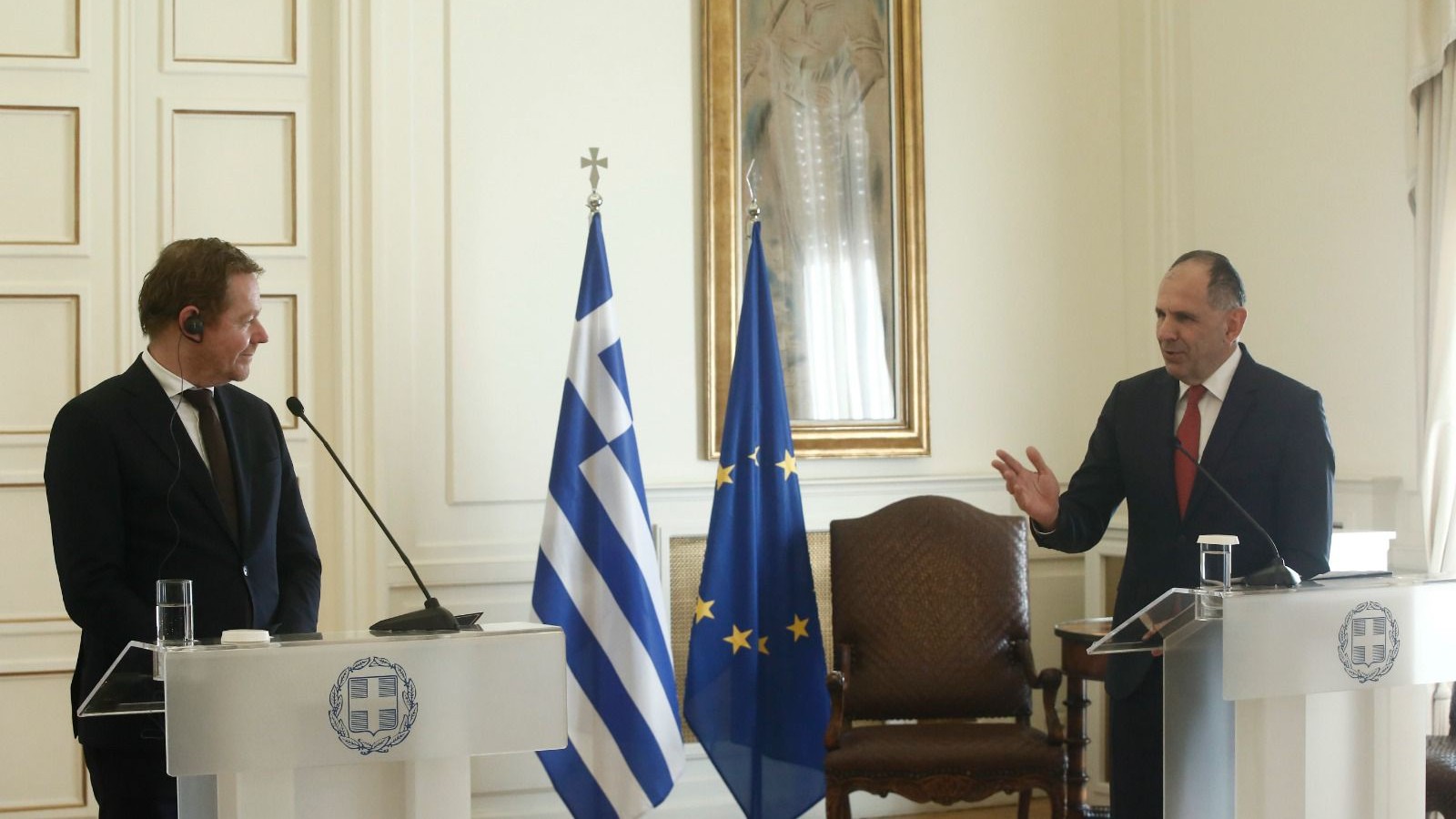
I am pleased to welcome to Greece and Athens the Minister of Asylum and Migration and Minister of Foreign Affairs of the Netherlands, Mr. David van Weel.
Greece and the Netherlands, EU partners and NATO allies, share common principles and values, which underpin our bilateral relations.
The challenges of our time are multiplying and growing increasingly complex. On most of these challenges, Greece and the Netherlands share a common understanding. In the current fragile geopolitical juncture, we must act collectively and responsibly.
Against this backdrop, we discussed the role that the European Union must assume. We believe that a larger, strategically autonomous and competitive Europe will act as a force multiplier, both for the Union itself and for each Member State.
We spoke about NATO, the need to preserve the cohesion of the Alliance, to underscore the importance of the collective security system, and to further deepen cooperation between the Alliance and the European Union.
The erosion of international multilateralism contributes to heightened global insecurity. As an elected member of the UN Security Council, we believe that the United Nations is the appropriate international forum for taking the necessary decisions aimed at achieving international peace.
The rules of International Law and the principles enshrined in the UN Charter — in particular respect for sovereignty and territorial integrity — constitute non-negotiable pillars of a peaceful international legal order.
As maritime nations, we place particular emphasis on the full implementation of the International Law of the Sea and on safeguarding freedom of navigation. In this context, we condemn attacks against merchant vessels of Greek interests which are not subject to the sanctions regime and which serve the secure supply chain within the European Union. I have already raised this issue with the European authorities and with our European partners.
With my esteemed colleague, we discussed the situation in the wider Middle East and developments in Iran.
Fundamental rights, including freedom of expression and freedom of assembly, must be respected by all. Any form of violence, all the more so when it results in the loss of human life, is abhorrent and absolutely condemnable.
We call upon the Iranian regime to refrain from the imposition and execution of sentences against citizens who are demonstrating in favor of freedom. The death penalty imposed on young persons, as a consequence of the exercise of a universal right, constitutes an intolerable disgrace to the international community. We call for absolute restraint from any such action.
We also addressed the war in Ukraine. Greece could not but stand by the side of Ukraine, to the side of the party acting in self-defense, opposing any form of revisionism. We will continue to support the sovereignty and territorial integrity of Ukraine.
We also exchanged views on the situation in the Mediterranean, and I had the opportunity to brief my counterpart on the visit of the Prime Minister and the Greek delegation to Jerusalem and Ramallah.
Greece enjoys the comparative advantage of traditionally maintaining excellent relations with the Arab world and having a strategic relationship with Israel. The consolidation of the ceasefire, the alleviation of the suffering of the civilian population through the unhindered flow of humanitarian aid, and the immediate transition to the second phase of the peace plan, will constitute the essential conditions for sustainable peace in this long-suffering region.
Honorable Minister,
As a frontline country on the external borders of the European Union, Greece experiences particularly acutely the consequences of instability in our neighborhood. Let us consider what is happening in Africa, and in particular in the Sub-Saharan Africa, in the Sahel region, in Sudan.
One such consequence is irregular migration. We attach particular importance to the implementation of the Pact on Migration and Asylum, to the principle of solidarity and fair burden-sharing, as well as to the need to strengthen cooperation among partners, as well as with third countries.
The esteemed Minister, who also holds the migration and asylum portfolio, has already taken important steps towards the effective management of this issue, which we also discussed during our contact.
As regards our bilateral relations, they are at an excellent level, at their highest level to date. Today, we discussed the prospects for further strengthening our relations in the fields of economy, trade, investment, education and culture.
We also place great value on our cooperation in these two areas, culture and education, on the promotion of the Greek language through officially recognized Departments of Greek Language, and, of course, on the promotion of Greek culture and history through Dutch universities and their Departments of Classical Studies.
I could not fail to refer to the human bridge between Greece and the Netherlands: The Dutch citizens who visit Greece, numbering close to one million, as well as the approximately 40,000 Greeks residing in the Netherlands. People are always the best ambassadors of our countries.
Dear Minister, I thank you for today’s discussion, I welcome you to Athens and the Ministry of Foreign Affairs and I assure you of the excellent relations we seek to maintain with our friend the Netherlands.
January 14, 2026