


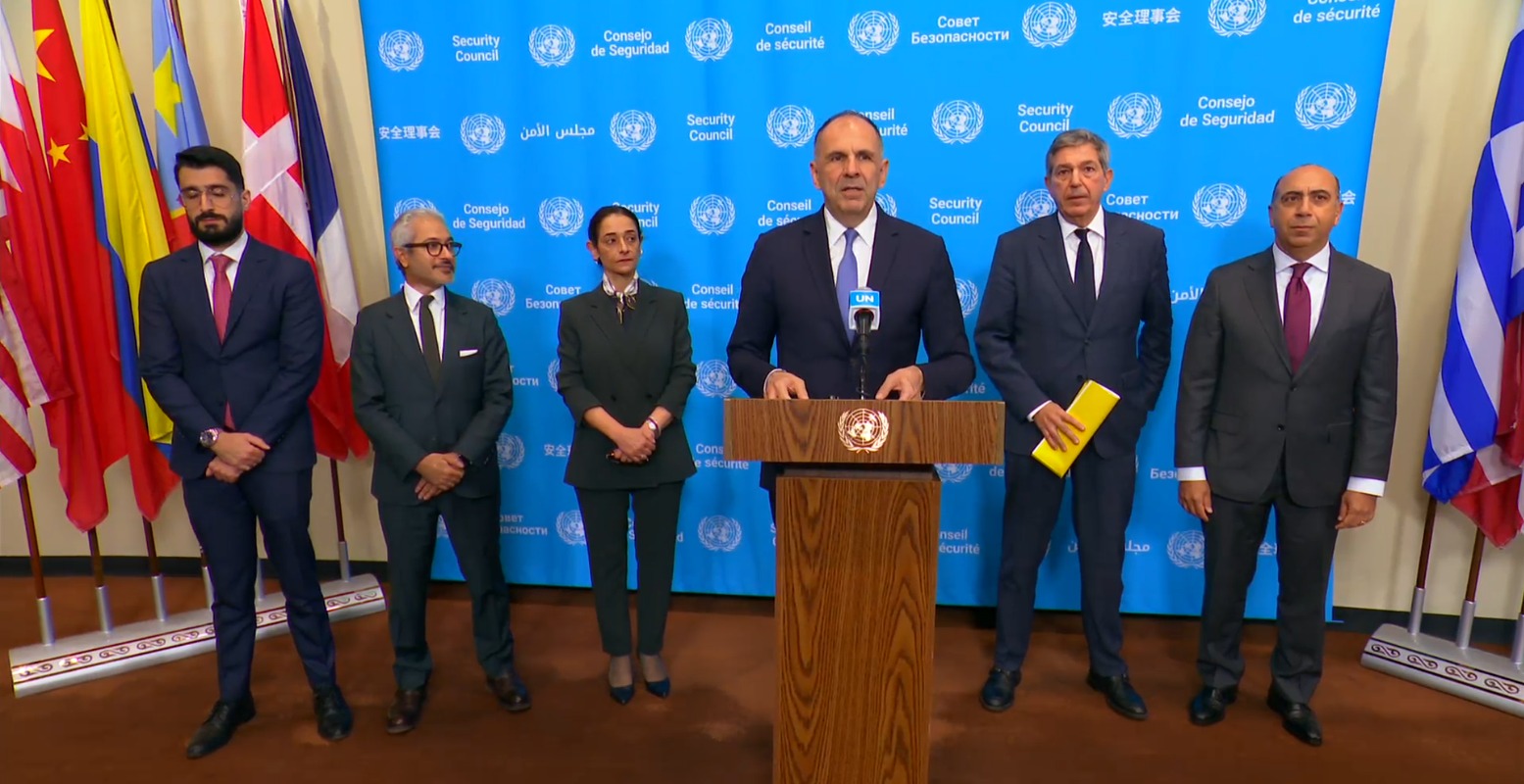
I am delivering this statement on behalf of Bahrain, Cyprus, Egypt, the United Arab Emirates, the European Union and my own country Greece.
The recent decision of the Libyan House of Representatives to approve the 2019 so-called “Turkish-Libyan Memorandum of Understanding on the delimitation of maritime jurisdictions in the Mediterranean Sea” raises serious concerns for regional security and stability. It also highlights a broader challenge to the international legal order: ensuring that arbitrary bilateral arrangements do not undermine established rules of international law or prejudice the rights of other States.
International law, and in particular the United Nations Convention on the Law of the Sea (UNCLOS) and customary international law, provide the legal framework for the delimitation of maritime zones. These rules are essential to ensuring predictability, legal certainty and peaceful relations between States. Accepting bilateral arrangements that disregard the applicable rules and principles of international law would set a dangerous precedent, undermining the international legal order and the principles underpinning the peaceful resolution of disputes.
The so-called Turkish-Libyan Memorandum is incompatible with these fundamental principles. It disregards geographical realities and the maritime entitlements of all relevant coastal States, including the maritime entitlements of islands under UNCLOS. The subsequent decision of the Libyan House of Representatives does not alter this legal reality. The Memorandum remains null and void, contrary to international law and cannot serve as a lawful basis for maritime delimitation or produce legal consequences for third States.
We remain committed to the reunification of Libya’s institutions and to a united and prosperous Libya. A stable Libya, actively engaged in regional cooperation, is essential to peace and security across the Mediterranean. Libya’s political transition and its relations with neighbouring countries must be guided by respect for international law and good-neighbourly relations.
As members of the United Nations, we have consistently advocated for the peaceful settlement of disputes through dialogue and in accordance with international law. It is in this spirit that Greece has pursued bilateral talks with Libya on maritime delimitation in good faith and in accordance with international law, and stands ready to continue these efforts.
Respect for international law is essential to regional stability and a rules-based international order.
October 26, 2026