


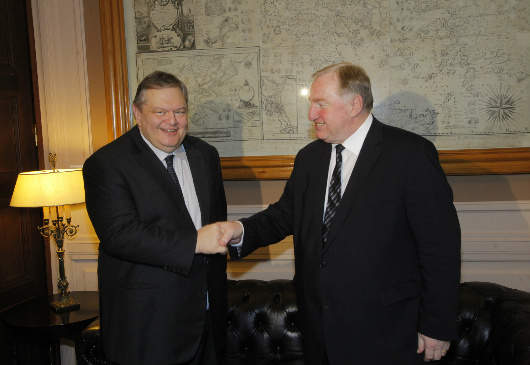
 E. VENIZELOS: It is with great pleasure that I welcome here today, to the Foreign Ministry, my dear friend Mr. Lambertz, who is the President of the German-speaking Community of Belgium, a very important institutional component of this friendly country.
But he is also the head of the Socialists, the socialist majority, in the EU Committee of the Regions. The Committee of the Regions is a very important institutional organ with which we will be collaborating very closely during the six months of the Greek Presidency. The Committee of the Regions, thanks to the efforts of my dear friend the President, will be organizing, together with the Attica administrative region and its governor, Yiannis Sgouros, a major event here in the spring, within the framework of the Greek Presidency.
Our goals, which are linked mainly with maritime policy, with Mediterranean policy, also include the establishment to the Adriatic-Ionian macroregion. President Lambertz experience with this is very important, because he is passing on to us know-how that we can use during our Presidency to promote our goals.
I took the opportunity of our meeting to brief him on the state of play in the implementation of the Hellenic Programme, because the European institutions need to know exactly what is happening in Greece. Because, as you know, the functioning of the troika is often not within the logic, the institutional logic, of the EU; in accordance with the Lisbon Treaty.
I thank him very much for his presence here.
K. H. LAMBERTZ: Unfortunately, I don’t speak Greek, though I did learn Ancient Greek at school. We were young then, and now I have aged somewhat. But that is not why I am here today.
With the Committee of the Regions, we will organize a Summit Meeting of the Regions and Municipalities of Europe, on 7 and 8 March, here in Athens, during the Greek Presidency. And it is in that context that I am carrying out my visit here today. I wanted to see the state the Communities and Regions are in, and that is why I have been here for the past two days.
It is a great honor to have been received by the Foreign Minister, who asked that the Committee of the Regions carry out an in-depth discussion regarding specific issues during the Greek Presidency. It is very important to us that we have effective responses on these issues.
In General, the European Union is in a difficult state, but it continues to be an important perspective for all the countries of Europe at the beginning of the 21st century. We will not be able to resolve any major issue without the adoption of a European approach. And now we must succeed in promoting European policy in such a way as to give this Europe renewed prospects of hope. This is what people need: Hope. Not utopian hopes, but tangible hopes.
So we will have to do what is necessary in order for there to be renewed prospects for employment and growth, and for there also to be proper solidarity in Europe – solidarity that is, after all, in everyone’s interests. Europe will not be able to move ahead in the mid-term if there is not progress throughout Europe. And this is the main reason I came here today, because I want to be thoroughly apprised of the real situation in Greece.
November 22, 2013