


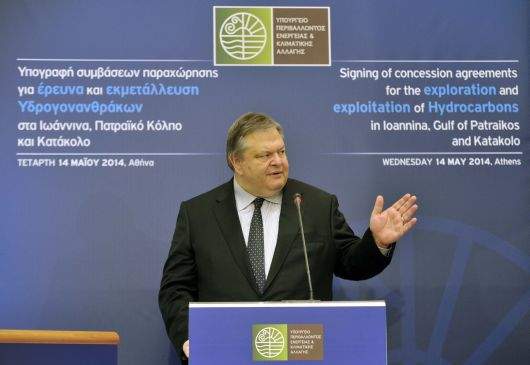
 E. VENIZELOS: Mr. Edward Davey, Secretary of State for Energy and Climate Change for the United Kingdom, Ambassadors, my dear Yiannis Maniatis, Makis Papageorgiou, Kostis Hatzidakis, ladies and gentlemen, I am truly glad that, in the capacity of Deputy Prime Minister and of Foreign Minister, I am here today to celebrate with all of you – and particularly together with Yiannis Maniatis and the whole team at the Environment, Energy & Climate Change Ministry – a great moment: the signing of the concession contracts for these three specific fields.
But I also want to congratulate the companies, the concessionaires and signatories with the Greek Public Sector, because they are making a very, very good and visionary choice. Because exploration for and utilization of hydrocarbon resources – both onshore and offshore – is a kind of dynamic public-private synergy.
The private sector’s role is extremely important – we are counting on it – as a factor for the country’s growth, the creation of job deposits through hydrocarbon deposits. We are pleased because we have already formulated the legislative framework that links the Greek Public Sector’s revenues from the exploitation of hydrocarbons with our social security system and its sustainability; that is, in reality, with a form of solidarity and justice for the generations.
And I am happy that the Public Sector is participating in his process as an honest and reliable partner, but first and foremost because it is exercising its national sovereignty and its national sovereign rights, within the framework of international law. In this sense, today we have a triple act. An act of economic growth, an act of social solidarity, and an act that, in the field of international law, is an act of the statement and exercising of national sovereignty and national sovereign rights.
We always act based on international and, naturally, national legality. Our priority is the delimitation and, as such, the utilization of maritime zones, the continental shelf and EEZ with all neighbouring countries.
In good faith, within the framework of good neighbourly relations, as provided for by the UN Convention on the Law of the Sea, the talks we have been in for years now with our neighbour Turkey, the agreement we have with Italy, our talks that have progressed with Egypt, our signed agreement with Albania, our older talks with Libya – for the course of which we hope for the best – are shaping an environment that enables us to utilize the Mediterranean basin and, naturally, our onshore territory and the territory of our state, which naturally includes our national waters.
As Mr. Maniatis started his speech with an experience, I would like to tell you that, many years ago, about 15 years ago, in the course of my long and multifaceted political career, I served as Development and Energy Minister then, and I had the opportunity to keep active and open the only place where there is real exploitation of Greek hydrocarbons: Prinos.
And we did this through a configuration that was original and quite risky for the time, given that we essentially entrusted it to the employees themselves, and thanks to that move, Prinos is still alive; we now have the potential to use the old and utilized deposits as storage space.
And I am pleased because a few weeks ago I saw one of the largest petroleum companies in the world contract with Prinos for what is extracted from Prinos.
As my British colleague said a short while ago, the crisis in Ukraine, the crisis in the EU’s relations with the Russian Federation, the crisis of the West in general with Russia – which we hope will be overcome, and we are making a great effort to overcome it, with respect for international law and through political and diplomatic means – brought the energy issue, once again, forcefully to center stage, as a parameter of foreign and security policy in the EU and everywhere.
I am pleased that there are positive byproducts of the crisis. I think it has been understood how important it is for there to be a single, unified negotiation on many issues, on behalf of the 28 member states, via the European Commission, because we are often the victims of covert or overt energy dumping within the European Union, to the detriment of the countries of the south, of the European Periphery.
Differences in energy prices and in the interest rates at which enterprises borrow are the two major inequalities being suffered by Greece and other countries of the European south, as compared to our partners. And this is something we don’t forget. Greece, of course, is becoming what my British colleague said: it is becoming a hub, because it has very strong geographical advantages.
The new pipeline, the Trans Adriatic Pipeline and its interconnections; the potential for us to very easily and cheaply realize the central corridor from the Aegean to the Baltic; and Revithoussa – which is emerging as an advantage not only for Greece, but for the whole of Southeastern and Central Europe – are shaping a map, together with the prospect of immediate construction of new LNG or CNG terminals in Alexandroupoli and in Kavala.
Of course, things aren’t easy. These are central talks on the level of Foreign Ministers as well. At the trilateral meeting we had last week, in Thessaloniki, with my Romanian and Bulgarian colleagues, we pointed up the importance of an integrated regional energy market. At the Ministerial Conference of the EU-28 and the six countries of the Western Balkans, connectivity in the energy and transport sectors was a central theme, because this lends a perspective to the unification of the continent.
The Western Balkans is a gap that must be bridged. So it is of very great importance that we emphasize this sector and convince the world, convince the international market, that we mean what we say, and that investments and, thus, synergy with the private sector in this field is truly a priority for us. And this is our policy.
So, it is with these thoughts that I want to congratulate, once again, the Minister and political leadership of the Ministry of the Environment, Energy & Climate Change and the companies, and I want to wish them every success and good results, to their mutual benefit and, above all, allow me to say – because I am speaking as a representative of the Greek people – to the benefit of the Greek people. Thank you very much.
May 14, 2014