


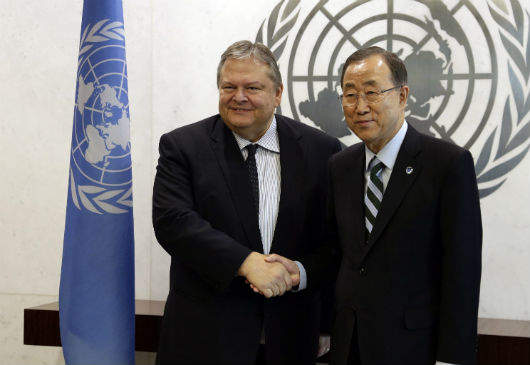
 E. VENIZELOS: My meeting with the UN Secretary General gave me the opportunity to talk to him about the whole range of our national issues – primarily the Cyprus issue, and the FYROM name issue, of course, but also the whole range of the major pending international crises, as the Secretary General is interested in the Greek position and in the European stance, and attaches great importance to our contribution to shaping a clear and active European policy on these issues.
With regard to our major, pending issues, which are chapters in the UN agenda, our position is very, very clear. We support the initiatives of President Anastasiades. We believe that the appointment of the Secretary General’s new Special Adviser, Mr. Eide, is a very good choice and can help things along, but we want a solution that is within the framework of the UN Security Council resolutions; a solution that is viable, just; a solution that is in accordance with the European acquis; and, primarily, a solution that can be accepted by the Cypriot people, the two communities, via a referendum.
This is a major acquis of democratic self-determination, and it is of very great importance that we make creative use of this acquis in favor of national interests, because the Republic of Cyprus is a member state of the UN and a member state of the European Union, and we cannot compromise this acquis of international legal personality. Any development must comply with the guarantees I mentioned, and provided it is accepted by the Cypriot people themselves via their vote.
Regarding the name issue, I had the opportunity a few weeks ago to talk extensively with Mr. Nimetz, in Athens. We are prepared to participate in the next meetings. We support this process, but we have taken major steps, creative steps. Our stance is very clear. Our national stance is in favor of a compound name with a geographical qualifier, for use in relation to everyone, domestically and abroad, erga omnes. So we are waiting for the other side to take corresponding steps that are in good faith and productive.
JOURNALIST: A question on something else, on an issue that will be discussed at this Assembly: the terrorism issue. In the last 48 hours there have been a number of reports in newspapers and on television channels to the effect that the Greek authorities received data from the CIA and other services, according to which 7 persons of Greek origin are involved with the jihadists, and other reports that jihadists were trained on Greek territory. What is the government’s position?
E. VENIZELOS: Greece is participating in the international mobilization against the so-called Islamic State. Greece respects and carries out the resolutions of the Security Council, the EU, NATO on these issues. We don’t have a problem of jihadist fighters in Greece, but there is such a problem in our wider region. So we are participating in the international cooperation on exchange of information in order to protect our countries, because this is now an issue of internal security. Greece does not have an immediate problem, but we are very interested in our neighbouring countries and the wider region. With Mr. Ban Ki-moon we talked about all the other issues: Ebola, climate change, and, naturally, the broad range of pending, active crises both east and south of Europe.
JOURNALIST: Did the Americans inform you, though, that there are seven persons?
E. VENIZELOS: No we have had no such specific notification. We are in very close cooperation with the American administration and with all of our allied countries.
Thank you very much.
September 22, 2014