


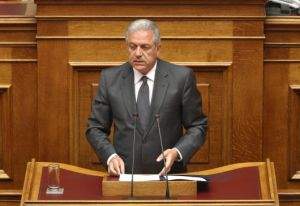
D. AVRAMOPOULOS: Thank you, Mr. Speaker.
First of all, I would like to thank our colleague Mr. Loverdos for this question, and I’ll start by saying that I fully share his concerns.
It is well known that the situation of the minorities in Syria, and particularly of our fellow Christians, is a matter of longstanding and constant interest to us.
From the beginning of the Syrian crisis, the Greek Embassy in Damascus had an open line of ongoing communication with the Patriarchate of Antioch, the metropolises and priests of the Throne and, naturally, the parishioners themselves, in order to keep abreast of the situation, and we of course proceeded immediately to the provision of the necessary assistance wherever it was needed.
Based on the information from our Embassy in Damascus, the Foreign Ministry issued repeated oral and written notifications to our European partners, raising their awareness of the situation of Christians in Syria, who in their great majority do not want to involve themselves in the crisis that has plagued Syria for the past year and a half.
As a result of our actions and coordination – and I always emphasize this because it is important how we move in the region with other partners who share our concerns – the EU Foreign Affairs Council has always included in its Conclusions the need to build rule of law in a Syria that respects the rights of all its citizens, regardless of ethnic or religious origins.
This need is addressed in particular to the organizations of the Syrian opposition, which, in all their official declarations – including the Charter adopted on 3 June in Cairo -- make a commitment in this direction.
It is to be noted that Syrians from all 19 ethnic and religious communities – including Christians – participate in the various opposition organizations.
At the recent External Affairs Council held on 23 June in Brussels – at which I asked Deputy Foreign Minister Kourkoulas to represent me because, if you remember, Mr. Clinton was here – there was a detailed discussion of the situation in Syria, and we referred in detail to the need to protect the Christian minorities and briefed the Council on the particular importance to us, to Orthodoxy, of the Patriarchate of Antioch.
For months, our Embassy was in constant contact with the Greek citizens in Syria, keeping them abreast of the security situation in the country, urging them to get their travel documents in order, to obtain the necessary entry visas from countries in the region in case it should be decided that they should leave Syria in haste.
Up until the last moment – even under particularly erratic security conditions – the Embassy staff saw that passports were issued to all those who submitted the relevant applications.
The Embassy also issued instructions to our honorary Consulates to deal with cases of lost or expired travel documents, and we did in fact have such cases.
A few days ago, due to the dramatic deterioration in the security situation in Syria, which was endangering the lives of the staff and severely limiting their movement outside the city of Damascus, we decided to suspend the operation of the Embassy.
However, Greece’s Honorary Consulates in Aleppo, Latakia and Tartus remain in operation, with instructions to provide all possible assistance to our fellow Greeks who have chosen to remain in Syria.
Moreover, the four EU member-state Embassies remaining in operation in Syria will provide consular assistance to Greek citizens, in accordance with the EU Treaties.
I would like to note that the Greek Embassy was one of the last diplomatic missions to leave the country, as the vast majority of our partners withdrew, for security reasons, during the months of February and March.
The Greek government will continue to carefully monitor all the developments in the security situation in Syria, with a view to protecting the security of our fellow Greeks. And let me note something here that I think is of particular importance: our whole policy is determined by one basic principle, which is that Syria must take the path of democratization. The current regime’s time has come to a close and it needs to withdraw as soon an possible.
At the same time, we will continue to push for the protection of the rights of the minorities – and in particular of the Christians of Syria – within the unstable and hazardous environment prevailing in Syria today.
Greece will continue to support and proclaim that the solution in Syria can be none other than a political solution.
The continuation of clashes solves no problem, but creates a larger and larger number of civilian victims.
This needs to stop immediately, and the international community needs to support a political transition process carried out by the Syrian people themselves, with whom, I remind you, the Greeks maintain traditional ties of friendship and respect.
[Second response]
D. AVRAMOPOULOS: Thank you Mr. Chairman.
First of all I would like to tell our colleague Mr. Loverdos that his proposal for the convening of the Defence and Foreign Affairs Committee on the topic of the crisis in the region, and not just in Syria – because, as you know, a lot is going on right now in the wider area of the Eastern Mediterranean, and for that reason, as soon as Parliament opens, we will take this initiative, and I thank you.
Mr. Minister, you said something very important, and allow me to confirm it: the economic crisis has unfortunately turned Greece in on itself, weakening our political and diplomatic presence in the wider region and around the world. And we all bear responsibility for this.
Despite the crisis, Greece has not ceased to be a factor for stability in the region, with a strong presence and say that is linked to history and the current state of affairs. I would like to believe that no government forfeited this potential and this right, but the economic crisis has certainly done a lot of damage to the country’s international presence, hurting Greece’s international standing.
And I would like to take the opportunity of this observation to say that a circular was issued yesterday to all our diplomatic missions round the world, to reactivate them in the endeavor to promote our country in every corner of the world. We are aware that the economic state of affairs and our financial obligations have hit at the heart of the Greek diplomatic service, as well. Nevertheless, what is most important at this moment is to again project an image of our country’s standing, and this battle will be fought by the Foreign Ministry, with Greek diplomats on the front lines.
Now, with regard to the other parameter of your observations. In fact, I, too, had the opportunity to ascertain during my visit to the Patriarchate of Antioch, in a previous capacity, the longstanding frustration one senses at the Patriarchate. What you noted is positive, and we will capitalize on it: that in synergy with the Church of Greece, all this can be got past and remedied. The fact that at this time Greece is standing by our fellow Christians in Syria, standing by the Patriarchate of Antioch, as I had the chance to say earlier, is a first sign of the profound respect and appreciation, as well as the support, that the Patriarch enjoys from our country, and we will continue in this direction.
Everything you noted today, Mr. Loverdos, reflects the reality of the situation we are called upon to deal with. On the other hand, however, a further conclusion can be drawn: the time has come for a new policy to come out of this crisis; a policy covering the whole world, so that our homeland can once again take its rightful position with standing, dignity and self-confidence.
We have huge potential. We have not exploited our true diplomatic reserves. And when I have the opportunity I will again brief the Corps on the initiatives we are undertaking as of 20 August, when an action plan will be launched with the aim of revitalizing our presence in the world, strengthening our international standing and re-establishing us as a factor for stability throughout our region.
With regard to the peacekeeping and humanitarian missions, regardless of what may happen in the wider Middle East region, Greece will continue to offer its services to the UN and related international organs, always pointing up our strong presence in the region and utilizing the advantage we have – a privilege that is our historical heritage – of being an equal and respected collocutor for all the countries in the region.
This serves Greek foreign policy in parallel with its basic obligation to fully ensure and defend our national rights. But an internationally oriented Greece is re-emerging, and this will gradually open a new era. In parallel with the effort all of the political forces are making to help Greece find its footing and orientation again in the midst of this broader crisis – a particularly profound and painful crisis for the Greek people – we will again see the Greece of pride and dignity.
Thank you, Mr. Minister.
August 2, 2012