


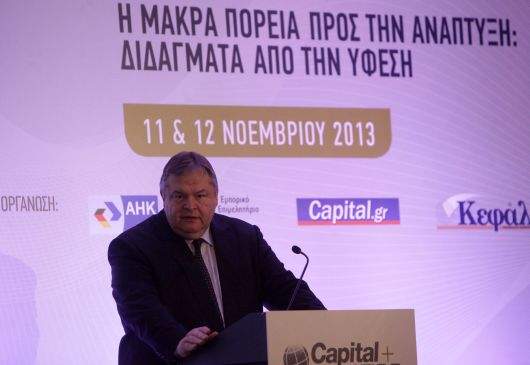
 • The monetary union endeavor was, from the outset, a voluntary endeavor, an endeavor more political than it should have been, an endeavor of unquestionable historic dimensions, but one that was, from an economic standpoint, organized to function under normal circumstances. It did not make provision for the eventuality of a crisis like the one the global economy faced from 2007 on.
• The Greek adaptation programme has two discrete pillars. The pillar of fiscal adjustment – that is, of drastic reduction of the deficits (fiscal and balance of payments) that had mushroomed. The fast fiscal adjustment model, which began in late spring of 2010, was a model that we did not choose, but it was the only solution that would avert a disorderly default.
• The other pillar is that of so-called structural adaptation, the pillar of structural changes, which is linked to the country’s productive configuration, with the mobilization of healthy domestic creative forces.
• The fact that, from a certain point on, and under the worst possible conditions, we were forced to move concurrently in both these directions created a number of problems. A society suffering the consequences of a fast, harsh fiscal adjustment – a society that, due to the measures being taken, sees the recession deepening and unemployment growing – is a society that is much less open to the need for structural changes.
• The prospects are bright for the upcoming Greek Presidency, which coincides with the six months of the great political debate that must be carried out – a debate during which the adjustment programmes must be evaluated.
• We can now argue, supported by the necessary fiscal data, that we have achieved very significant results on the first pillar – that of fiscal adjustment – and at the same time we have regained a significant portion of our competitiveness on the second pillar: structural adaptation. We succeeded in achieving the largest nominal reduction in global economic history with the PSI and with the debt buyback, freeing coming generations of Greeks from a very high debt of over 60% of GDP.
• It is true that we continue to be trapped in a debate over the notorious fiscal gap and the notorious funding gap, with regard to the targets and projections concerning the sustainability of the Greek public debt. But we want to have political collocutors, on a European and international level, who are capable of a true and in-depth understanding of the scientific and technical data. Our problem is not a political negotiation. What we want is to have before us responsible leaders whose decisions bear in mind all the facts with scientific proficiency as well as the necessary vision.
• We cannot talk only of a unified supervisory mechanism or a unified bank-bailout mechanism if we are not also talking about, for example, a unified deposit guarantee mechanism.
• There is a risk of the six-month period that is opening up before us – which is also the six months of the run-up to European elections and the six months of the Greek Presidency – rather than being the six months of the institutional debate on the future of Europe, being the six months during which Euroscepticism and economic nationalism prevail, which will mean the prevalence of an approach that will propagate inequalities, to the detriment, in the end, of the whole endeavor of European integration.
• What is happening in the Eurozone and the Eurogroup has nothing whatsoever to do with the legal description of the manner in which the European institutions should function on the level of the European Union. It is something completely different. It is something so realistic as to be cynical.
• The conditions for jumpstarting the real economy are, first, the international conditions: that our institutional partners understand the situation and understand the dynamics of the economy and the limits of the political and social stress that can be borne. The second condition is the action of the international private sector.
• Regarding domestic conditions – public and private – they include, first of all, a return to institutional health; that is, that we reaffirm the stability of the government, the country’s political and social stability. The public conditions are also social conditions. So it is of very great importance that we invest in measures for reducing unemployment, so as not to leave a large portion of the population without health coverage and social security.
• It is in our domestic resources – our land and our people – that we will find the solution, and there are truly health forces. We are fully aware of the difficulties being faced by the Greek entrepreneur on all levels and in all sectors.
• This effort requires the more active participation of the private sector. In reality, what is needed is a great joint venture between the public and private sectors, so that we can jumpstart Greece’s real economy, and so that Greek society and the Greek people can gain the sense of security and potential that they deserve after weathering this crisis.
November 12, 2013