


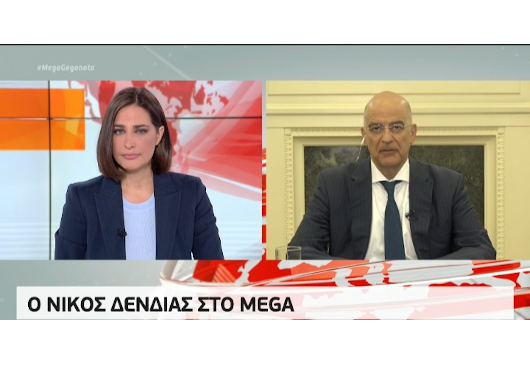
 D. ANAGNOSTOPOULOU: Minister, welcome to the MEGA evening news.
MINISTER: Good evening to you and your viewers.
D. ANAGNOSTOPOULOU: We’re in a difficult state of affairs, with escalating aggressive moves on the part of Turkey, and I’d like you to tell us whether the crisis is over, whether we’re seeing de-escalation.
MINISTER: I think we’re seeing a gradual de-escalation from the Turkish side, with the return – as the Defence Ministry informs us – of the Turkish vessels to their ports and naval stations, but that doesn’t mean that all of this tension created in recent days is gone for good.
D. ANAGNOSTOPOULOU: Minister, is what we’re experiencing a war of nerves that Turkey is trying to mount, or do you think Erdogan is determined – at some point, if not right now – to move ahead with drilling on the Greek continental shelf?
MINISTER: I can't predict what Turkey will do in the future. And what’s more, the way I and Greece in general, along with the European countries, see the actions that must be taken differs significantly from the way Turkey operates and acts.
D. ANAGNOSTOPOULOU: Do you think Erdogan is unpredictable? Because a lot has been said about whether he is unpredictable or acts according to a plan.
MINISTER: You know, I wouldn’t make this personally about Erdogan. I would say that Turkey has gradually adopted a mindset that diverges from the mindset of countries that act based on International Law and the International Law of the Sea, and in my view this is very damaging to Turkey itself.
D. ANAGNOSTOPOULOU: You are the head of Greek diplomacy. I ask you plainly – and I also expect a clear answer – has it been made clear, Minister, in the United States, in Germany, in Brussels, that Greece will respond militarily if its sovereign rights are violated, if an attempt is made to drill on its continental shelf?
MINISTER: First of all, allow me to say that there is an inherent issue with the way you pose the question.
D. ANAGNOSTOPOULOU: Meaning?
MINISTER: The inherent issue lies in this: the current government, the current Prime Minister and all the past governments of the Hellenic Republic had and continue to have a constitutional duty to defend the country’s sovereignty and its sovereign rights, and they have always made this absolutely clear to everyone. I have repeatedly said that these obligations derive from the country's Constitution, and no one can fail to uphold this duty. So, even if we wanted to, we couldn’t do otherwise.
D. ANAGNOSTOPOULOU: I ask you, Minister, because it was reported in recent days that Merkel told Erdogan that Greece isn’t kidding. Is that true?
MINISTER: I can’t confirm or deny what was said between Chancellor Merkel and President Erdogan. What I must say is that it is obvious that our country cannot back down at all on the matter of its sovereign rights and its sovereignty. It is an absolute given based on the country’s Constitution. And I want to say it in the right tone so no one takes it as a threat. It is our duty. We have absolutely no option; we can’t back down. We’ll do what we have to do, just as any past Greek Prime Minister or Greek Government or Minister of Foreign Affairs would have done.
D. ANAGNOSTOPOULOU: So, you’re saying that it has been made clear to our partners and to Turkey that Greece is determined to act if our sovereign rights are violated. But I’d like to talk a little about Germany’s role and how decisive it was in the end. Did Angela Merkel avert a clash between Greece and Turkey, as reported in Bild? We know the talks took place. No side has denied or confirmed it, essentially.
MINISTER: I’ll tell you. I can’t dramatise any communication or any intervention, especially that of a large country like Germany, which, I note, currently holds the Presidency of the European Union.
D. ANAGNOSTOPOULOU: Exactly. Maybe that’s why it wants to avoid further tensions.
MINISTER: It also has an institutional obligation to protect the countries of the European Union. Each Presidency has a specific role – a role given to it by the European Union. As a result, if Germany carried out the obligations deriving from its role, this is completely compatible.
D. ANAGNOSTOPOULOU: It's very interesting, because there was a secret meeting in Berlin, which we found out about from Mr. Cavusoglu, and I wanted to ask you if meetings like that are useful and effective.
MINISTER: I’ll tell you.
D. ANAGNOSTOPOULOU: Whether Turkey uses them to burnish its image, to appear open to dialogue.
MINISTER: I’ll be honest. They’re not secret. A meeting that isn’t announced is another thing. It’s obvious that all of the meetings on a specific level – diplomats, in this case – aren’t necessarily announced. This doesn't make them secret. It is a necessary condition for each side to be able to talk freely without the burden of publicity.
D. ANAGNOSTOPOULOU: It’s just that the timing was interesting, Minister, two days after the announcement of Hagia Sophia’s conversion into a mosque.
MINISTER: Yes, you are absolutely right. But excuse me, I have taken a very clear position on the issue of Hagia Sophia, and Mrs. Mendoni and I will soon be announcing a number of very specific actions to keep global attention on the protection of the monument. But we have also repeatedly said that Hagia Sophia is not and must not be made a Greek-Turkish dispute. We have repeatedly said that this is a trap that Turkey would very much like to lure Greece into. We mustn’t do that. Hagia Sophia, the protection of the monument, is an international issue.
D. ANAGNOSTOPOULOU: Is the matter of sanctions still open, Minister? Sources in the Ministry said a few days ago that Turkey will be paralysed if the European Union imposes sanctions. Will this hurt Erdogan?
MINISTER: We asked our European partners for the High Representative, Mr. Borrell – whom I talked to again today, following the visit from my Bulgarian colleague – to be given a mandate to prepare a list of sanctions. Not to impose sanctions. A list of sanctions, which, however, will concern key sectors of the Turkish economy.
D. ANAGNOSTOPOULOU: So, if these sanctions are imposed, will the Turkish economy be paralysed?
MINISTER: Let me say this: I’m not going to phrase things in a way that might increase tensions. We don’t want a poor or isolated Turkey. But the European Union needs to have an arsenal ready so it can show Turkey where its interest lies – Turkish society’s interest.
D. ANAGNOSTOPOULOU: A heated diplomatic game is in progress in the Eastern Mediterranean, Minister. How close are we to an agreement with Egypt on delimitation of EEZs? An agreement that would ‘break’ the Turkey-Libya memorandum.
MINISTER: First of all, you are right to ask. I thank you for that. But to us, the Turkey-Libya agreement is absolutely non-existent, null and void. I have repeatedly called it a violation of common sense ...
D. ANAGNOSTOPOULOU: But it does have legal effect.
MINISTER: No, in our judgement it does not have any legal effect, due to its inherent absurdity and illegality. In contrast, we are negotiating with Egypt in the framework of International Law and the Law of the Sea. Consequently, if we reach an agreement with Egypt – we’ve made progress. I’m not prepared to say that we are on the threshold, but we have made progress. I think this is real, and it is well known that we have been negotiating with Egypt for months now. But this will be a real agreement that will have legal effect in the framework of International Law. In contrast, I repeat, with the Turkey-Libya Memoranda. Because we have to remember that, apart from the issue of the so-called maritime zones, Turkey has persuaded the government in Tripoli to sign a Memorandum on defence cooperation, security cooperation, which provides an umbrella for illegal transport of weapons by Turkey into Libya.
D. ANAGNOSTOPOULOU: Minister, do you think the possibility of an application to The Hague is far off or getting closer, based on developments in our relations?
MINISTER: You’re referring to our relations with Turkey, of course.
D. ANAGNOSTOPOULOU: Exactly.
MINISTER: I want to be frank: we haven’t even begun to really talk with Turkey. This is a shame. It is a shame for two neighbouring countries, but we aren’t responsible for this. As a result, it wouldn’t be true if I told you that we might be able to see, on the horizon, a way to resolve the dispute through a judicial procedure. For that to happen, Turkey has to realise that it has to discuss things so we can resolve our disputes in the framework of International Law. Initially through talks, and if those talks lead to an impasse – this is sometimes possible due to the two sides’ positions – so that we can refer the issues to the international ...
D. ANAGNOSTOPOULOU: So, you’re in favour of dialogue, provided the tension abates.
MINISTER: Right. But to be clear: dialogue on the real disputes, not imaginary disputes. Our disputes with Turkey are very specific. They concern the continental shelf and the maritime zone over it. They’re not about just anything.
D. ANAGNOSTOPOULOU: Right. We thank the Minister of Foreign Affairs very much for the interview.
MINISTER: Thank you very much.
July 27, 2020