


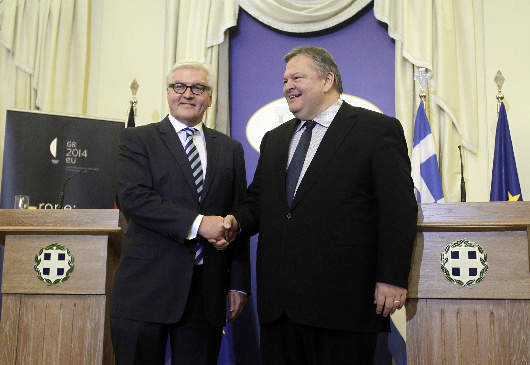
 E. VENIZELOS: It is a great pleasure to welcome to Athens, to the Foreign Ministry, my German counterpart and good friend Frank-Walter Steinmeier, the new federal Foreign Minister, who took up his duties just a few weeks ago.
This is an opportunity for me to wish him every success in the framework of the new Federal German coalition government, in which SPD is participating, given that Mr. Steinmeier played a very critical political and institutional role in recent years as the President of the SPD Parliamentary Group in the Bundestag.
I also want to thank Mr. Steinmeier, because he is the first Foreign Minister to visit Greece, to visit Athens, immediately following yesterday’s official inauguration of the Hellenic Presidency of the Council of the European Union.
My German counterpart and good friend Mr. Steinmeier’s visit is a positive omen for the Hellenic Presidency, as well as for Greek-German bilateral relations, to which we attach very great importance.
Because we see how critical Germany’s role is – the role of the largest economy in the European Union and the Eurozone – in the course of all European policies and in the course of European integration in general.
We had the opportunity for a one-on-one discussion of a wide range of issues: the priorities of the Hellenic Presidency, which my colleague knows very well; the situation in the Greek economy; the achievements of the Greek people, thanks to whose sacrifices we can now present fiscal equilibrium, a primary surplus in our budget, which is the best in Europe and one of the best in the world, in terms of both nominal primary surplus and cyclically adjusted and structural primary surplus.
The primary surplus is not just a number. It is a fiscal achievement. It is proof that we are very close to completing the Greek economy’s adjustment programme.
At the same time, we had the opportunity to discuss the steps that have been taken in the sector of structural changes and how important it is to internationally promote the image of a Greece that shows the success of the joint European efforts to overcome the crisis.
We also had the opportunity to talk about our region, EU enlargement policy, the European perspective of the Western Balkans. And, mainly, we both had the opportunity to stress the two countries’ and the two governments’ shared desire to deepen our relations, to capitalize on our cooperation, our friendship, our strategic partnership, not only within the framework of the EU and bilaterally, but also internationally, on the level of the UN and other international organizations.
We are well aware of how critical Germany’s role has been and is at this time; at this extremely difficult time of the crisis and the hardships the Greek people are facing; at this difficult time for the Greek economy, Greek society. And my message is that, for Greece’s part, our people, our enterprises, our workers know what they have to do in order for our country – with the national pride that it is its right to have – to again become a truly equal member of the European family, to once again stand on its own feet within Europe and within the Eurozone.
With these words I again welcome my dear friend and colleague Mr. Steinmeier.
FRANK-WALTER STEINMEIER: My dear colleague, dear Evangelos, first of all I would like to thank you very much for your wishes for my new, as well as old, office. Wishes that I have real need of due to the condition in which our common Europe finds itself, and in a Europe where we have a lot of work to do in order to achieve what we want.
I would also like to express my thanks for the warm welcome I had here in Athens, from you, here at the Ministry. I am pleased to have the opportunity to talk with you, to talk with representatives of the government. But I will not limit myself to taking to representatives of the government. I will talk with businesspeople, with MPs, with students during my day and a half here in Athens.
I hope that I manage within this day and a half to form an picture. To dust of the image I have of Greece, which has become less clear over the years. You will surely remember that it has been over six years, perhaps seven years, since we met the last time here in Athens.
And this was an additional reason why it was so important to me to come to Greece very soon. That wasn’t the only reason.
I am also pleased, on the other hand, that my arranging to come here so soon and visit your country has to do with Greece’s taking up the duties of the Presidency of the Council of the European Union, because it is important to me to bear in mind, within the framework of this Presidency, to support you, because you have many challenges to face – and I would like, from the outset, from the very first day, to support you. And I see that we can be led, in the end, even through disagreement, to very important compromises, as, for example, regarding the European Union, regarding the European Parliament, regarding the Banking Union, etc. And this is important, because if we don’t do this, if we don’t arrive at some compromises, we will lose time, and there won’t be the potential, within the framework of this European Parliament, for compromise solutions.
I refer to one example with this, in order to say that we need a Europe and a Presidency that is in a position to take responsibilities and take actions. And that is why my immediate visit here is a message of support for the Hellenic Presidency. And, in the end, naturally not just that.
I came to Greece because I know that Greece has traveled down a long road to emerge from this economic difficulty and stand on its feet again economically. And I am here because I want to stress that we Germans have great respect for and acknowledge Greece on this first part of the road, which has already been covered. We know that it takes a very strong backbone for one to succeed in overcoming such a difficult economic situation, and we know how difficult it is to recover from this situation.
I know this from personal experience. We had a crisis of an economic nature in Germany ten years ago, with very high unemployment rates, with recession, etc. I am well aware of what it means to live through such a situation and to impose the necessary measures and steps on the people.
And thus I have great respect for the Greek government, because I know how much weight you have shouldered recently, but I am fully convinced that this government will complete the journey down this road successfully – a journey that it started – and will use its term to do whatever is possible and necessary to succeed. Such a demanding reform agenda, which you set, and from which, for the first time, results are becoming apparent – results from these efforts, from these hardships and sacrifices.
Mr. Foreign Minister, Evangelos, you said precisely this, that you are succeeding in showing a primary surplus for the first time. And I am certain that the European institutions will assess this result very positively, and I am convinced that the economic successes, in the tourism sector, for example, which are visible now – because you had an exceptionally successful tourism season – will lead to new and even more visitors, precisely because what Greece is offering is so attractive, and that it is possible for there to be continuity in this direction and on this road.
So when one follows this road and tries to stay on it, one finds success.
So I came, despite the fact that I know that Greece has not yet been able to get out of these difficulties, but I was happy to come and convey this message of support and say how much we respect everything Greece has achieved. And we want to support you so that you can finish this journey.
Thanks again.
C. POULIDOU (ATHENS NEWS AGENCY): A question for Mr. Steinmeier: Some statements of yours came out in today’s SPIEGEL – statements encouraging to the Greeks. But yesterday, the same magazine, on the first day of the opening of the Hellenic Presidency, it had an article with chastening references to Greece. I would like to ask you, if you were Greek, how would you interpret this message from a magazine that is an “opinion leader” in European society?
And a question for Mr. Venizelos: I would like to ask you, since we are at the beginning of the Hellenic Presidency – if we could jump ahead to June, would you say that the Hellenic Presidency had been a success if … – I’d like one thing.
FRANK-WALTER STEINMEIER: I’ll start. First, I am glad that German newspapers are read so carefully in Greece. And, second, I of course understand the fact that not every piece of news finds such a positive response, but, as you can understand, the German newspapers, the German news media, are independent, and the government can exert neither pressure nor influence.
What I am doing is ascertaining first-hand what path Greece has travelled in order to get where it is, and I am benefitting from the talks I had with the Foreign Ministers of the other partners, to see what the reactions were to the reforms imposed.
So I am pleased, not only to be here myself, today, but also at the fact that I was accompanied by so many journalists, who are awaiting these talks with similar interest.
E. VENIZELOS: I too would like to respond to Ms. Poulidou’s questions: If I were to choose a basic goal of the Hellenic Presidency, I would say that, as the Hellenic Presidency, we would be very satisfied at the end of June 2014 if, in the European elections in May, the European idea – the great historical goal of European integration – were reaffirmed.
If, that is, between now and the elections in May, the European Union, with its institutions, were able to put forward a comprehensive, dynamic narrative for the future of Europe. A narrative that is convincing to the peoples and citizens of the European Union, and particularly to those European societies experiencing the major problem of unemployment – and youth unemployment in particular – if we were able to respond to the various objections of Euroscepticism regarding the future of Europe.
But for Greece, as the European Presidency, to be satisfied at the end of these six months, we will also have to have achieved the major national goal. And the major national goal is for Greece to turn definitively towards exiting the crisis and return to the status of an ordinary member state of the European Union.
We are very close to this goal. We need the invaluable support of our partners, because without our European partners, we would be at the absolute impasse of a disorderly default – not just economic, but societal and institutional as well. But it is very important now, when we have reached the threshold of the end, that we really reach the end. There are a few basic things that have to happen and will happen, because this is our historical obligation.
JOURNALIST: A question for Mr. Steinmeier: Mr. Minister, Greece’s debt is very, very high – too high, according to some politicians, analysts and economists. Is there a proposal to reduce this debt, for the debt to be lightened? Mr. Venizelos referred to this in an interview in the German press.
FRANK-WALTER STEINMEIER: There is no such stance, but it was noted in the talks we had earlier. My colleague Mr. Venizelos told me that it is important for Greece, now, that a message be sent: that through these reforms Greece has achieved things and is on the right path, and that, essentially, it was able to achieve a surplus. And that it is not just a surplus. It may turn out here that we have to do with a sustainable and long-term return to fiscal health. So this is the important issue. The other issues weren’t important in our talks – we didn’t discuss a third, fourth or fifth support package.
E. VENIZELOS: You will allow me to take the opportunity of the question posed to Mr. Steinmeier to make an observation. We are implementing an adjustment programme of the Greek economy, which was agreed on definitively at the end of February 2012. One fundamental goal of this programme is the sustainability of the Greek public debt.
According to the European Council and Eurogroup decision in effect, as soon as Greece manages to show a primary surplus, the Eurogroup will confirm the sustainability of the Greek public debt, which we mustn’t see just as a percentage of GDP – we also have to look at its internal structuring, which is very, very positive.
Because we have a debt that is long-term, average duration of 30 years. We have a debt that requires very limited annual cost of servicing. We have a debt that takes into account expiration of bonds and loan installments, which are placed so that they can be serviced relatively easily, and, moreover, we have a debt on which the long-term average interest rate is just 2.1%.
This means that, based on the joint effort we have made with our partners throughout this time, the prerequisites have already been shaped for the confirmation of the sustainability of the debt.
But we are now awaiting something that is a European necessity – a necessity in accordance with the European processes in force, which we fully respect. In the first months of 2014, Eurostat has to confirm the fiscal data for 2013; confirm, that is, that Greece achieved a primary surplus, and, moreover, that Greece has achieved a fiscal deficit this year that will be under the pan-European ceiling of 3%.
So as soon as we have this confirmation from the European institutions, we will follow the procedure provided for by the programme in force and the decision of the European institutions that is in force.
A. ATHANASOPOULOS (TO VIMA): A question for the German Foreign Minister. I would like to ask you this: Of late, there has been a major debate on the future of the troika and the potential role the European Parliament might play with regard to a possible inquiry into the troika.
I would like to ask you whether the new German Government sees the possibility of the troika’s being done away with as positive or negative – the troika as we know it today – with its role being taken on by purely European institutions. Thank you very much.
FRANK-WALTER STEINMEIER: No. Here I must say very clearly that I have a very personal view on this, and I didn’t need to change this view of mine due to my now being part of the government.
So I am of the view that the right institutions are represented in the troika, and, even if there isn’t full agreement on this everywhere, I am of the view that the International Monetary Fund’s participation in the troika is not a decision warranting criticism.
So I believe that, despite the criticism being leveled by Greece and by other member states with regard to the legitimization of the troika, we should sat that the troika is, if nothing else, a very important organ.
Naturally, there are decisions and assessments like those of the troika, which are just as important, such as the decisions of the European Commission or other institutions on the European level. However, the troika is responsible for evaluations and assessments of the progress that has been made by member states with regard to the reform policy.
The decisions are made by the European institutions, by Finance Ministers, by National Parliaments, etc., and there is no issue of the legitimacy of these institutions.
I don’t think we should base our criticism on the democratic legitimacy of the troika – wasting time on that – because the democratically legitimized decisions, based on the troika’s assessments, are taken by the democratically legitimized Ministers or corresponding National Parliaments.
E. VENIZELOS: Let me give my view on this issue as well: We respect all the European institutions. Consequently, we fully respect the institutional role of the European Commission and the institutional role of the European Central Bank, which are two of the three components of the troika. And, obviously, we see and recognize the critical role of the International Monetary Fund, which hastened to assist Greece at the outset of the crisis and when we negotiated the second programme.
Of course, we respect the institutional role and democratic legitimization of the European Parliament, and we see that the European Parliament, based on its own criteria and sensitivities, wants to be apprised of and have a view on everything that happens in the European space, in the European Union and in the Eurozone.
The European Union and, in particular, the Eurozone, don’t have just their community dimension. They have a strong intergovernmental dimension. The role of the member states, the role of the national governments, the role of the national Parliaments is always extremely critical.
All the major decisions are taken, in the end, on an intergovernmental level. So for us it is of very great importance that we have the potential to communicate with our partners, that we have direct political contact and talks with all the governments of the members states, and in the present case with the government of the Federal Republic of Germany, which is the largest partner and plays a decisive role in the Eurozone procedures.
The fact that we want to have political talks, political meetings and joint approaches does not mean that we want political favors, that we want technical and economic data to be overlooked. No. But we do want the technical data to be assessed, in the end, from a political and social perspective, but always with documentation based on numbers.
That is why we insist on the great importance of our achievement of the primary surplus and the new image of fiscal equilibrium that Greece is showing now, after three and a half years of tireless efforts and great sacrifices.
This is the framework within which we are moving. And I think that, from different points of view, Mr. Steinmeier and I come to an approach that is creative and practical, and that can show us the way to the completion of the great joint effort.
JOURNALIST: A question for the German Foreign Minister. Mr. Steinmeier, I would like to ask you what has changed in German foreign policy now that SPD is participating in the government. And for the Greek Foreign Minister: What will you say to the Germans who are wondering whether the Greeks need a third assistance package?
FRANK-WALTER STEINMEIER: Thank you for that question. At the first meeting I had in Brussels, I said that much of politics is a matter of communication, and I admit that, with regard to European communication – between member states, that is – there are some misunderstandings and there may also be a lack of respect for member state that are implementing austere reform programmes or showing strong performances.
I think it is a good thing when one enters into an intensive debate. Precisely these talks that we are starting today with my colleague, with my counterpart, and we should maintain this communication with the same intensity and frequency in the future and work more on things that we discussed here together, today. That is, we should take care that the difficult economic circumstances that we have to confront do not make us overlook the fact that, in the end, Europe is not comprised of just a common currency and common economic interests. Beyond all that, Europe is a great idea that concerns the future of the younger generations, and not just our generation as the last generation. Rather, we all have a responsibility, when the economic crisis has been overcome, not to have a political crisis, a crisis of legitimacy. So our generation, Evangelos and I, have to make sure that those who are continuing on their way – the younger generation, that is – have before them a Europe of hope rather than menace.
Thus, beyond all the economic interests or economic crises, we have to look at how we can approach younger people, bring them closer to Europe, and also how we can awaken the interest of enterprises.
Awaken enterprises – our enterprises – so that we can guide them to invest here in Greece, contributing with ideas, using, for example, institutions like the German Investment Bank to create a similar institution here. There have been initial meetings on this between our corresponding services.
These are the things I want us to prioritize, and we should not let us bother each other. We should meet and talk.
E. VENIZELOS: I too would like to answer the question you put to me. As my German colleague said very characteristically, the German government expresses its respect for the efforts and sacrifices of the Greek people, of every Greek citizen.
Thus, I, too, speaking from my perspective, on behalf of the Greek government, want to thank the German government and German society and the German citizen and taxpayer for their help and support. The European assistance was absolutely necessary and is very large, because Greece has taken a very large loan in order to be able to reorganize its economy and avoid a disorderly default and all the repercussions of such and eventuality.
But at the same time I want to assure every German citizen and every German taxpayer that we do not want to burden the German budget. Greece knows what its obligations are to its partners. Germany has guaranteed a very large portion of the loan that has been given to Greece, because as the largest European partner, it is also the largest guarantor of this loan.
Our goal is to succeed in completing the programme, to exit the crisis and the Memorandum. Provided we achieve this, which we will, Germany, as a guarantor, will not need to pay anything, and thus the German taxpayer will not be burdened at all.
This is our goal. Our goal is to achieve something that is extremely useful to us, but also extremely useful to the European Union, the Eurozone and each of our partners – to every other member of the Eurozone.
Technically we can discuss the ways in which this is made feasible in the final stage, because we have come a very long way on this path. And this is technically feasible, without any additional burden on the budget or debt of another member state or, even more importantly, on the individual citizen and taxpayer of any other European country.
This is our goal. And it can be achieved. This isn’t the right place for us to refer to technical data. The technical data will come from the European Commission, the European Central Bank, the IMF, the ESM. We have the technical advisors and the institutions, who, in consultation with the governments, can shape a technical plan. But this is the developmental, the political goal, and I think that it is very simple and commonly accepted by all of Europe, because this is a common European goal.
F. PAPATHANASIOU (PUBLIC TELEVISION): Mr. Steinmeier, allow me to come back to the question from my German colleague on the matter of the Greek debt, which you know is very important. In fact, the Greek Minister, Mr. Venizelos, referred to this issue three times.
Mr. Venizelos said that the technical goal is for Greece to exit the crisis by the end of the Hellenic Presidency, and the matter of what happens with the Greek debt plays a critical role in this. So we would like you to give us the general tone of what Berlin is thinking, whether there is a specific proposal for how a solution might be found, a definitive response to the issue of the Greek debt, whether through a haircut or extension of the loans.
E. VENIZELOS: I have the impression that both of us have already answered this question.
FRANK-WALTER STEINMEIER: I think that I have answered this question adequately. I want to repeat that we Germans respect the progress that Greece has made, carrying out these tough reforms, and we are aware of the sacrifices entailed; sacrifices that the Greek people had to shoulder.
But now we see at the outset of the Hellenic Presidency, for the first time, that this necessary policy, which was certainly difficult, is starting to bear fruit, even if we have to wait a little before we can point to these results. But when one has a primary surplus, here we already have the signal that there will be a positive assessment.
I cannot but advise Greece, now that it is on this road of recovery, not to talk constantly to Greek public opinion about new rescue packages. This creates difficulties not just for the Greek reform work, but also for stability in general.
So I would say, use and benefit from this time you have in your term as government; do whatever is necessary even at this period of time; count on these successes’ coming.
Moreover, my colleague Mr. Venizelos said that it was necessary with regard to the sustainability of the debt. So if this primary surplus is proven and shown to be sustainable, then the matter of the sustainability of the debt will naturally be confronted.
E. VENIZELOS: I would like to add a phrase, linking Mr. Steinmeier’s response to his previous references. The need for Greece’s real economy to be supported, for growth to be supported, for investments to be made, for new jobs to be created so we can confront the major problem of unemployment, and youth unemployment in particular.
Every country’s debt, you will allow me to remind you, is a fraction in relation to GDP. Our achievement with regard to the primary surplus is of very great importance. This the fiscal prerequisite for the sustainability of the debt. This concerns the numerator of the fraction. But there is also the denominator, which is GDP. So we need growth. It doesn’t suffice for us to achieve only our fiscal goal: the primary surplus. We also need to have a positive growth rate.
So it is vital, following the achievement of the primary surplus, that we turn our attention to the real needs of the economy, to investment, to jobs. And here, the assistance of the German government, of German enterprises, institutions like the KfW, can be decisive. The same holds true for all of our partners. The same holds true for the international private sector.
I would say that the most encouraging thing right now, at the start of the Hellenic Presidency, is that the international private sector, the funds, the investors, are showing great interest in Greece, turning their attention to Greece, saying they are ready to invest in Greece. And I think that this is the best thing that can happen for the Greek citizen, the Greek household, for people who are concerned about unemployment.
January 10, 2014