


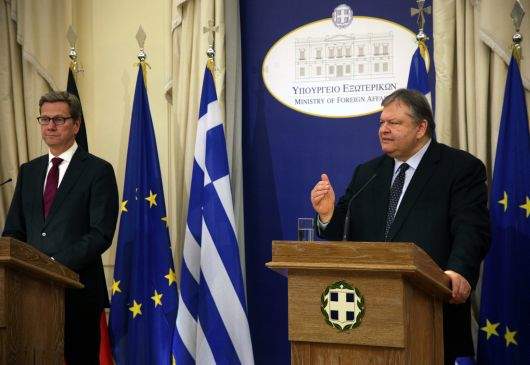
 E. VENIZELOS: It is a great pleasure to welcome to the Foreign Ministry and to Greece my dear friend Guido Westerwelle, with whom we are linked not only by our being the foreign ministers of our countries, but also by a shared teacher of Constitutional Law, as Mr. Westerwelle and I were both student and doctoral candidates of the much-lamented Dimitris Tsatsos.
I think it augurs extremely well that I am starting my meetings as the new Foreign Minister with the German Foreign Minister, who came, as a friend, just a few days after I took up my new duties, so that we could exchange views here in Athens.
We had a very interesting and productive one-on-one meeting, during which we had the opportunity to reaffirm the very high level of the Greek-German partnership. Mr. Westerwelle expressed himself very warmly and in a very productive manner regarding the sacrifices and efforts of the Greek people, because the international community sees that over the past three years something extremely difficult has been under way here. We are rebuilding the Greek economy. We are rebuilding the state. We are regaining our institutional equality within Europe and within the Eurozone.
The Greek people are undergoing these sacrifices because, in reality, they want to safeguard our national sovereignty and our national independence. They do not want Greece to be dependent on either anonymous markets or the necessary assistance of our European partners. It is of very great importance for us to hear words of friendship, acknowledgement and support from the lips of the German Foreign Minister.
We also had the opportunity to discuss all the pending issues of concern to the wider region – issues that concern the international community – and I will save a fuller briefing for after Mr. Westerwelle’s statements, when you can ask questions.
I would like to thank him once again for the initiative of coming to see me so that we could have these talks – talks that we’ll continue during the dinner that follows our press conference. Thank you.
G. WESTERWELLE: Thank you very much, Mr. Minister. Dear Evangelos, I would like to thank you warmly for the truly excellent meeting and the constructive collaboration and atmosphere we had in our talks. It is true that we have a common academic background. Both of us were students of professor Dimitris Tsatsos, whom I admire to this day, and to whom I owe much.
I would like to assure you that we Germans are at Greece’s side, and the fact that I came to Greece immediately following the cabinet reshuffle is an indication of solidarity and encouragement. We want to encourage you so that you can continue on this path: the path of a new beginning. And we want to express our solidarity, because we know what sacrifices the Greek people are making.
The objective is a common one, and it is before us. And it is for the debts and the economic crisis to be overcome; for there to be new growth, and, in this way, for the conditions for prosperity to be found for everyone. The results of today’s meeting in Berlin of the heads of government are also significant encouragement, particularly for young people throughout Europe, but also for young people in Greece.
In Europe it is our shared concern to fight unemployment, to take care to create new jobs – particularly for the young, so as to secure for them a positive outlook and a secure future. And this can be ensured only through reforms, through increased competitiveness, because only in this way will there be new investments in Greece.
I would like once again to stress that the Germans have great respect for and recognize the efforts of the Greek people, but we also have the sense that the first steps have already been taken. We are confident because we see that a new beginning has been made to create conditions of prosperity.
Greece’s exports are rising, the budget deficit is falling, and major investments are being made. The gas from the Caspian will be coming to Greece, and there are also other major infrastructure projects. So things are happening in Greece, and this is the success of the Greek people and, more specifically, of the Greek government. We hope this path continues, so that this reform momentum is not lost.
We also discussed other issues, of course. These talks will continue, particularly during the dinner. There are matters of global interest to talk about. Right now we are following the developments in Egypt, as well as in other countries in the southern Mediterranean region. And, of course, here we have a shared concern that we will discuss in every detail during the evening meal.
Really, I would like to stress my heartfelt thanks for the hospitality. I am particularly grateful that you are hosting me here in Athens, in this wonder metropolis, in this truly beautiful, great country, and I would like to express again, to say again, that we know the sacrifices Greece is making right now, and we share and want to state in no uncertain terms our sense of solidarity.
A. PELONI (Ta Nea): Mr. Minister, I remember your visit here last year. It was shortly before the haircut, the PSI, went into effect. The president of the Eurogroup, Mr. Dijsselbloem was in Athens a few weeks ago, and he stated that if there is a primary surplus for Greece in 2014, in April of next year there will be decisions on the Greek debt.
I wanted to ask you what decisions those might be. What might the Greek side expect? And also, because there is a lot of talk about the IMF’s desire to leave the support programme, the Troika, what is Germany’s stance on this discussion? Thank you.
G. WESTERWELLE: First of all, I would like to draw your attention to the fact that the Troika is an independent institutional organ, and not the arm of a European government. The Troika is doing its job, and this is right, because we want – through the reform effort – to open up new potential and perspectives. So what is needed is for the measures that have been agreed upon to be implemented gradually. And before this task is even complete, I don’t think we should jump to any conclusions. I didn’t do so in the past, nor will I do so in the future. An upcoming haircut is not on the agenda, but what is needed is for the reform package to be implemented as agreed.
E. VENIZELOS: I’ll answer that question too. As you know, Greece is in a position – thanks to the difficult sacrifices of the Greek people – to present impressive fiscal results. Right now, the Greek fiscal deficit, taken structurally – that is, taking into account the impact of the 6-year recession – is the smallest in Europe.
Right now, Greece can show the smallest structural fiscal deficit in the Eurozone. In reality, it is a structural fiscal surplus, but even in nominal terms we have achieved a reduction of more than 10% of GDP. Such a reduction has hardly ever been achieved, and we are really on the verge of a primary surplus.
It is also known – and I mentioned this to Mr. Westerwelle – that there is a political commitment on the part of the Eurogroup and the European Council with regard to the long-term sustainability of the Greek public debt, and naturally with regard to the equal and ensured course of Greece within the Eurozone. This is already a very important political acquis. We don’t need to get ahead of ourselves and raise issues on a hypothetical basis when we can show such significant, convincing and truly tangible results right now.
JOURNALIST (ARD2): My question is for Mr. Venizelos, regarding what you said before. There are reports, not just from journalists, but from economic experts, that say that there has not been enough progress on the reforms and that the servicing of the debt is inadequate. There is dissatisfaction on the part of the Troika, and many think a haircut – which Mr. Westerwelle ruled out – will be unavoidable, or the alternative possibility – you referred to a primary surplus – of reorganizing the assistance package and credit, for there to be a restructuring. What possibilities do you see here?
E. VENIZELOS: Thank you very much for the question, because it allows me to complete my previous response. As you know, the Greek public debt is being served in a completely secure manner, because in any case the cost of serving it is now very, very low. In fact, as some point, earlier than everyone expects, Greece may be able to organize a secure return to the markets with regard to its debt and with regard to the covering of its funding needs.
I have already set out our efforts with regard to the fiscal deficit.. The successes are universally acknowledged. You referred to the major front of the reforms, which are also, for our government and for me, personally, the major challenge. We are determined to move ahead with all the necessary actions so that we can have another, different state in Greece, and another relationship between the state and the economy. But – and based on the data so far – according to the OECD tables and assessments, Greece is the country carrying out the most reforms, as well as the most courageous and most drastic reforms, in recent years.
So we have another situation in the sector of so-called “structural changes” as well. The discussions with the Troika are in progress right now – they have not been completed. I have great experience of such talks, due to my previous experience as Finance Minister.
I think we will come to a mutually acceptable process and agreement that will allow for the smooth disbursal of the installments, but mainly it will allow the Greek economy to grow, because the Greek economy cannot endure more measures that fuel the recession and increase unemployment.
We have to work on what is called the denominator – that is, increasing GDP, because then we will have a geometrical and impressive fall in the debt and the deficit.
JOURNALIST (German Radio): Mr. Venizelos, I would like to refer to my colleague’s question. The next visitor will be the German Finance Minister, and I don’t know where the successes of the Greek government stand and the extent to which you want to say some things about 2014 and after.
And a question for Mr. Westerwelle. The IMF has leveled some criticism at the programme so far. They said that there should have been a haircut earlier on. The country doesn’t have a lot of potential structurally. Is there any similar critical thinking in the German government? What might one improve?
G. WESTERWELLE: I would like to say this: My impression is that for the first time we are seeing a ray of light on the horizon, and in politics both psychological impetus, if you will, and the state of affairs are important. If you have a situation where there is light in the sky – if in such a state of affairs we start hearing scenarios of collapse and pessimism, then I think one is off the mark and will be unable to capitalize on precisely this favorable moment.
That is why I want to look ahead. I think Greece can do it. I am convinced of this. And the decisions and investments (are important) and the objective data are encouraging in some other sectors as well, and we need to start learning in Europe to listen to the good news and not just stay mired in the negative data, the negative news, looking back, essentially.
That is why the point of my visit here is encouragement. For example, with regard to the investment decision on the pipeline, I think this is a very positive decision that can bring huge growth and job-creation momentum for Greece.
If one wants to overlook this optimism and focus on the spilt milk, I don’t think this is politically astute. That is why I agree fully with the descriptions of my Greek counterpart regarding the international press, which stresses precisely those points where we have a positive development. And you know, speaking personally, we all know how wrong things can go, but the political leadership needs to function constructively and say how things can develop positively. This is the constructive role of the political leadership.
And as I am in Greece, if we take a pointer from ancient Greece, I don’t think one should start to take the role of Cassandra, but rather turn one’s gaze to the future.
E. VENIZELOS: Allow me to continue in the spirit of Mr. Westerwelle’s response. Just as I today welcomed with great pleasure and feelings of friendship my counterpart the German Foreign Minister, on 18 July I will be welcoming an old friend and colleague from the Eurogroup, Mr. Schäuble. We will talk about Greece’s real economy, and with Mr. Westerwelle we dedicated a large portion of our one-on-one talks to the difficulties and prospect for Greece’s real economy, the matter of growth and employment, because the major issue is unemployment – and particularly youth unemployment – and, therefore, support for businesses.
There are two issues that we discussed with Mr. Westerwelle and that we will discuss with Mr. Schäuble as well. The two great problems of Greece’s real economy:
First, the very high interest rates as compared to the interest rates in other countries – not just Germany, which naturally has the lowest interest rates in the Eurozone, but as compared to other European countries. This creates huge problems for the funding of Greek enterprises and, thus, for jumpstarting the Greek economy. We have to organize smart, practical interventions to reduce interest rates. That is the point of a development fund, an agency for the growth we want to promote in cooperation with the German government and the German Development Bank, so that we can step in and support the functioning of the banking system for cheaper money in the market. This is a pivotal point.
And the second point, which is also linked with the prospects being opened up by the TAP, the natural gas pipeline through Greece, is the cost of energy. The cost of energy in Greece is above the European average in terms of both pricing of raw materials and for precautionary reasons deriving from the adaptation programme.
So, if we want to help Greek industry, Greek manufacturing, the Greek SME, we also need to intervene in energy costs, something which Mr. Westerwelle understood in his heart. So I am pleased because this discussion that we began today will be continued in a few days with Mr. Schäuble, because Germany’s intervention can be direct, practical and have results in both of these critical sectors.
JOURNALIST (ARD1): I have a question for the German Foreign Minister, and then one for Mr. Venizelos. Regarding Egypt. The army is about to seize power, and I would like to hear your view. What is your assessment of the fact that in the end the army is undertaking to maintain peace in a country, and in what way does this circumvent a democratically elected government? What is your position on this? Do you support it?
G. WESTERWELLE: We are monitoring the developments in Egypt very closely and with great concern. And we call on all involved parties to continue on the path of Democracy. To desist from violence and to continue the democratic dialogue. To invest in democratic dialogue. These are the first five minutes of an historic hour for Egypt, and I truly hope, in my heart, that Egypt will continue on the path in the direction of Democracy.
I want the involved political powers, who are at this time squared off against each other, to sit at the table of dialogue and be able to reach an agreement so that the very young democracy of Egypt does not fail right from the outset, but gets the opportunity it truly deserves.
E. VENIZELOS: I can say that I fully subscribe to the statements my colleague Mr. Westerwelle made regarding the critical situation in Egypt. Greece is linked to Egypt by very strong historical ties, and Egypt is a key country in the developments in the wider region; developments in the Mediterranean.
We want to see Egypt’s stability and democratic perspective safeguarded – just as we do for all the other countries in the region – and our thoughts are with the Egyptian people, the Egyptian citizens who are struggling for the course of their country, for the course of their homeland, and who want, I am sure, just as all the peoples of the world, to have a democratically organized state that ensures prosperity for all citizens.
Things are difficult. We cannot view them from our narrow viewpoint of European legal and political culture. We need to bear in mind other parameters, as well, and, beyond our interest and our concern, I would also like to express this fervent hope: that things develop in the best possible manner as fast as possible for Egypt and the Egyptian people.
D. KONSTANTAKOPOULOS (Epikaira): Mr. Minister, welcome to Greece. I would like to remind you, if you remember, that, in the Iliad, Cassandra was right. In this country, since the assistance programme started, GDP has fallen by 23%, a percentage greater than that in Crash of 1929-1933 in the U.S. and greater than that achieved by Chancellor Brüning in Germany, before the rise of Hitler, implementing exactly the same policy. This country has 1.5 million unemployed and will need 20 to 30 years of rapid growth to get back to where it was. It is experiencing a real economic and social catastrophe. What else could be done if you wanted to destroy a country rather than help it?
G. WESTERWELLE: First of all, thank you very much for your question, which at the same time is a appeal that I can understand very well. Greece is in the sixth year of a recession. It has lost about 25% of its economic power, and we see this clearly. That is why it is very important for us to work to improve the situation in Greece. But this can happen only through investments. And investments are the result of reforms and increased competitiveness.
Infrastructure is a truly decisive chapter in our view. The natural gas pipeline, in our opinion, will bring a major opportunity for growth of the Greek economy. For example, the programmes agreed on in Germany today, with a budget of €8 billion.
And I also believe it is really necessary for SMEs to secure better access to credit. And we also had really very good talks on this point.
How is it possible for us to move ahead with the opening of enterprises, and how can SME’s access to funding be improved? We have our own Investment Bank, with which we have had many positive experiences, and we want to have an exchange of views regarding what can be transferred here to Greece and implemented here in Greece by our Greek friends.
Of course, we also want to support the Greek policy on reforms to the public sector. We talked about a wide range of measures, and we will continue these discussions in the future.
I would like to make a general observation. I know, in part, what is being written in Greece and what the Greek people are thinking. I can assure you of this: We Germans know very well what sacrifices you are making, how great the fatigue and sacrifices of the Greek people are. But I can assure you that if you endure on this path of reform, I believe that this will mark the moment of the birth of a new recovery for the Greek economy. And this is the best thing one can give to Greek youth for their future.
We in Germany also know that things will not always go well for the German economy if our European partners are not in good economic shape, because we believe that these peoples have a common culture and a common destiny, and this is the spirit that governs the German people.
E. VENIZELOS: I would also like to make an observation as a kind of response to the question. In many capacities, as well as now, in my current capacity, I have leveled strong criticism at the European Union, at our European partners, because they were late in reacting to the crisis. They reacted in a manner that is extremely conservative, and then many of decisions of the European organs are taken, but then immediately called into question and not implemented.
The Fiscal Adaptation Programme was to a large extent imposed on Greece, because Greece had need of the assistance; that is, of the loan from its partners. If we hadn’t made that choice, which was a difficult, harsh choice – the other option was utter catastrophe. The other option was not 25% recession over 6 years, but a rapid deterioration of the Greek economy – in the space of a few weeks, with a much greater recession within days. The other choice would have meant the destruction of the Greek banking system. It would have meant the decimation Greek families’ savings, unemployment way above the dire levels where it is today, particularly for the young. It would have meant the cancelling out of Greeks’ real estate, mass closures of Greek businesses, particularly SMEs.
We avoided this. The Greek people did not live through that. If there had been another international and European environment, we might have made a much milder and slower adaptation, but that would have meant our needing a larger loan from our partners.
We are where we are now. And the Greeks have made and are making great sacrifices. The repercussions are negative. But now we have shaped an exceptionally firm foundation for Greece’s real economy. We have a healthy banking system, we have a much more competitive environment. We have a market that functions on purely competitive terms. So the younger generation in Greece is in an environment that enables it to create with its own abilities.
Naturally, we will not solve the unemployment problem through positive growth rates. It will take strong intervention – European and state intervention. We talked with Mr. Westerwelle about the importance of the new European programmes, and resources from the EU’s Structural Funds – resources that exist for Greece – have to be transferred to the European Social Fund, because we have to fund employment programmes for young unemployed and programmes for supporting enterprises so they can keep their employees. And this is the number-one priority for us, because this is how social cohesion is safeguarded.
So if we want to carry out an historical assessment, we mustn’t compare the situation today to an ideal situation, because unfortunately we never had the luxury of making an ideal choice. The dilemma was between a bad solution and an even worse solution, and I think that in the end we chose what was the least bad, the least painful, and that gives a new opportunity faster – a new, historic opportunity for the citizens of Greece, particularly young Greek citizens. Thank you very much.
G. WESTERWELLE: Thank you very much.
July 4, 2013