


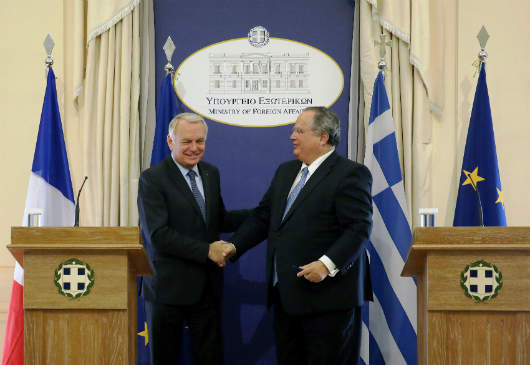
 N. KOTZIAS: Good morning. It is a great pleasure to have my friend Jean Marc here in Athens today. He is a prominent figure on the French political scene and has contributed from key positions to European integration, to the good cooperation between France and Greece. He is a man with concerns, with wisdom, with many rich thoughts, from which one can learn a great deal. So I thank him for coming and for the talks we just completed.
First of all, I would like to express my condolences at the loss of 5 French citizens in yesterday's plane crash in the Mediterranean. Even in times of peace, lives are lost in securing the peace.
Following French President Hollande's visit in the summer of 2016, our two Ministries, the Foreign Ministries of France and Greece, drew up an extremely productive roadmap that, three months after it was put together, is in the process of full implementation, with many aspects of it having already been implemented.
Greece and France have common visions for Europe. We want a Europe that guarantees prosperity for its citizens, growth, and a major role on the international political stage.
First of all, Greece supports the proposal France has put forward for seeking and promoting a solution to the Middle East problem. The initiative France has undertaken on the Palestinian issue is the last flame of hope, I would say, regarding a major problem. I would once again like to express my support for the French plan. This is support for seeking a solution, and I hope that all of the sides understand that problems grow as long as they remain unresolved. So it is of great importance to resolve them in a timely manner, through dialogue and exchange of views.
Greece and France have common concerns regarding the war in Syria. It is a war that has been ongoing for over five years and has intensified over the past year. Europe is now looking at a major humanitarian disaster.
Instead of safeguarding human rights -- as we want to do -- 400,000 people have lost their lives, while at the same time 12 to 14 million people, depending on calculations, have lost their homes; whole families have been uprooted. There are no good wars in the region. All are painful, with tragic stories behind them.
Wars that are generating the huge current of refugees, which met with the currents of economic migrants. Europe has been seeing the repercussions of these phenomena for over a year now, and they are very strongly felt on our Greek islands.
That is why my French colleague and I agreed that the solution of the refugee problem is the battle against war itself.
My French colleague and I agreed on the importance of the French initiative for Libya. We support the Government of National Unity in Libya. We want the stabilisation of Libya. At the end of next month, we will be going to Libya. We intend to rebuild our diplomatic relations with the country, and we support the need for all of the forces that are against terrorism in Libya to be incorporated into this government. Whether they are in the east or west of Libya.
My colleague and I talked in detail about the Cyprus issue. France is the country of light and of democracy, and it understands the need for Cyprus to be a truly sovereign and independent state, a member state of the European Union. We don't need to explain this to the French. History has shown them many things.
I explained what is described -- and you will have seen the first part -- in my text on the matter of eliminating the system of guarantees and the withdrawal of the occupation troops from Cyprus, concurrently safeguarding everyone's rights and bearing in mind the need for all Cypriot citizens to feel secure on their island. The need for all Cypriot citizens to be able to dream about the future of their children on the island of Cyprus.
We have a longstanding major strategic relationship with France. France is always at the side of Greece, including during the time of the dictatorship, with French democratism, and in the time of the tough negotiations in the European Union on the programmes that concern our country.
With France, we are partners and friends in the European Union, with common concerns, and once again I would like to thank my friend the Minister of Foreign Affairs of France for his visit and for the talks we are having and had in Paris and in Brussels and anywhere else necessary.
Welcome to our country, and have a pleasant trip to Cyprus, where you will be travelling this afternoon. Thank you again, Jean Marc.
J.-M. AYRAULT: Thank you Nikos. Thank you Mr. Minister. I had the great pleasure of meeting with the Greek Minister of Foreign Affairs, my friend Nikos Kotzias. Nikos and I see each other frequently. We have already met in Paris, we are meeting today in Athens, we both take part in many sessions of the EU Foreign Affairs Council.
Today I came here to see friends, to enjoy their hospitality, Greece's hospitality, which always rises to the occasion. I had a very warm meeting with the President of the Hellenic Republic, which reflects the high quality of Greek-French relations, the close friendship binding the two countries. I also met with the Prime Minister, Mr. Alexis Tsipras, and with Foreign Minister Kotzias.
You know, Nikos and I often talk in German. But today each of us spoke our mother tongue, precisely because we wanted to raise very important issues and deepen the dialogue we already have.
We really do share a common history. We are united by our friendship. You surely know the historic slogan, "Greece, France, alliance!". This is the ultimate symbol of Greek-French relations, our friendship and common course.
This slogan is exceptionally timely because it characterizes the relations between the two countries. We are not looking only to the past. We are looking together to the future, in the context of the strategic partnership that was concluded last October, on the occasion of the visit of the President of the French Republic, François Hollande, to Greece.
Today we raised very many issues. We looked at many issues that are mobilising us and that concern us. The mass flow of migrants and refugees is the first point to which we referred. We talked about the necessary implementation of the EU-Turkey agreement, an agreement that allowed for lives to be saved, for the trafficking rings to be combated; trafficking rings that are prospering by exploiting the misery and poverty of people forced to abandon their homes, often due to war, but also often due to poverty.
This agreement allowed us to have a joint management of the crisis, to the benefit of the refugees, the European Union and its member states, and Turkey. Results have been achieved. But it isn't enough. The efforts must continue: our joint efforts in the context of the commitments we have undertaken.
France has made commitments to Greece. It has undertaken a commitment to provide assistance at the borders, too. France has made commitments regarding the relocation of refugees to its territory. We are honouring and will continue to honour all of these commitments.
The same holds true for the commitments we have made within the framework of the EU-Turkey agreement on relocations.
We looked at the issues I just mentioned to you, as well as at the great crisis shaking humanity after the Second World War: the war in Syria. We have 300,000 deaths, 10 million displaced persons, many refugees due to the war in Syria.
Our goal is for the bombardments to stop and for the peace process to start again. We looked at this issue, we referred to the issue of combating terrorism in Syria and Iraq. We talked about the Libya issue. These are all major challenges for Europe.
In order to deal with these issues, Europe needs more unity and solidarity. I am here to make a reminder of this demand, at a time when the European endeavour is at a turning point, especially because of the Brexit.
We talked about the future of Europe. The efforts being made by Greece and the Greek people in recent years are very significant. We are convinced -- France is convinced -- that Europe needs Greece, just as Greece needs Europe. And President François Hollande said the same thing on the 9th of last September, during his visit to Athens.
So I said that the Greek government and the Greek people have made very significant efforts and have made great sacrifices. France is well aware of this. These are efforts that were necessary and decided upon by the authorities of a sovereign country. They are requirements for compliance with the agreements that have been signed with the institutional organs of the European Union.
The commitments must be honoured and are being honoured. We saw this at the Eurogroup. There was an agreement in principle on the disbursement of €2.8 billion. These efforts are being made, the commitments are being met, and this should continue within the framework of the second review of the assistance package.
The Greek authorities expressed their will for this review to be completed very soon, in the coming weeks. We will support the resolute stance of the Greek authorities for everyone to work in this direction.
At the same time, however, France and other member states have committed to providing technical support for the Greeks state in order to ensure the necessary means for the implementation of the ambitious public policies, to the benefit of the Greek people.
I know -- we said this with the Prime Minister and with Nikos -- that a speedy resolution of the issue of the Greek debt is important for Greece, because it is a prerequisite for Greece's being able to return to the markets. And this has also been highlighted by the European Central Bank, and we all need to pay careful attention to this.
There is still work to be done. In any case, France wants all commitments to be met. The Greek people should know that France is in solidarity with its efforts, so that Greece can achieve recovery and get results. The first results are already very encouraging.
We all need to work in this direction and implement the decisions that have already been taken. I already talked about the refugee issue. It does not suffice for us to talk -- we should decide and then act. And this, after all, is the basis of trust. The European Union should provide specific responses to European citizens so that the latter are not tempted into Euroscepticism.
We want a Europe that protects the citizens of Europe. We want a Europe that encourages prosperity and opens up roads and prospects for the young. In any case, France and Greece want to jointly contribute to the creation of this Europe.
We looked at the Cyprus issue. We express our support for the efforts being made. The reunification will be a wonderful message of hope for and confidence in the potential for coexistence between the two communities. It would be an exceptional message regarding the role the countries can play, regarding the values of Europe and the way we in Europe perceive our common coexistence.
We also looked at economic cooperation issues, as well as at the directions that should be taken within this framework. We referred to the sectors of culture, research and innovation. We are convinced that the young are the real advantage of the two countries.
And in any case, this is the impression I have gained through the meetings we had last night with civil society organizations. On the initiative of our embassy, I met with representatives of the country's cultural, economic and scientific life. I am well aware that we must encourage exchanges among students and encourage cooperation.
Greece is the country where we have the highest concentration of start-ups. Our embassy will soon host a forum where French and Greek businesses will meet and be able to work together and collaborate in the sectors of energy and sustainable development.
These are all extremely encouraging messages. They show that the cooperation between Greece and France not only exists, but will become even more intensive, to the benefit of both countries.
I thank Nikos for the very warm welcome. I am very pleased to be here at your headquarters in Athens so that we can continue to forge the ties of friendship that bind us.
JOURNALIST: I have a question for Mr. Ayrault. Mr. Kotzias said that he set out the Greek side's position regarding the Cyprus issue and the system of guarantees and the security issue. I would like France's stance on this issue.
J.-M. AYRAULT: I mentioned this issue briefly. France has been monitoring the recent developments very closely. They are recent and fast developments, and this is a message of hope that we hadn't seen in some time.
I want to welcome the endeavour that has been undertaken and the current process, which reflects a sincere in-depth dialogue between the heads of the two communities, with the aim of finding a solution. This solution needs to be found, because this issue has been an open wound for Cyprus since 1974.
You know that France, as a permanent member of the UN Security Council, and, of course, as a member state of the European Union, supports the negotiations on the Cyprus issue to the benefit of a solution that should be based, in our opinion, on the parameters set down by the UN. A bizonal, bicommunal solution that is fully in line with the European acquis.
France is not a guarantor power. It does not want to intervene -- much less directly -- in the process of the current negotiations. So I am not going to Nicosia to participate in the negotiations. I am going to Nicosia to meet with those responsible there and to listen to them, so that we can exchange views regarding common concerns.
The reunification of Cyprus would be and extremely strong message of a return to peace and of unity in a turbulent region. We all have an obligation to make every possible effort to show that a solution can be found, so that the whole of Cyprus can, at long last, become part of the European Union.
JOURNALIST: I have a question for Mr. Ayrault. You talked about the need for a speedy regulation of the Greek debt. The Prime Minister, Mr. Tsipras, also wants the matter to be regulated by the end of 2016. For the time being, however, Germany and its Finance Minister are putting the matter off to the end of 2017. Can France contribute to shifting the German line on this issue? Does it have the will to do it? What would be the ideal timeline for a significant lightening of the Greek debt?
J.-M. AYRAULT: The debate has already begun. But we have to move towards more specific and much more ambitious responses. We know the issue exists and we have to resolve it. We have to deal with this issue.
Of course the Greek Prime Minister, too, wants developments to move ahead fast, and I understand this completely. You referred to the statements of the German Finance Minister, who has another timeline in mind. But if this timeline is linked to the election process there, this is not a convincing enough argument. There should be a rational approach to the matter at various stages.
I have mentioned European commitments, the commitments of Europe and of Greece. We are talking about the negotiations, about the second review of the programme. The one stage should be followed by the other, and we know that there is an issue with the Greek debt, and at the same time there is a joint agreement. Everyone accepts it. Moreover, the European Central Bank itself has referred to the need to settle this issue if we want Greece to be able to go to the markets and enter a programme that the European Central Bank provides to all interested countries.
The faster the issue is resolved, the better. Or, rather, the faster we start to deal with this matter, the better, in our opinion. It is a debate that should be carried out with composure, and the news media should not limit themselves to various statements of this type.
Greece has made efforts, and it should be helped to succeed. Right now, Greece is speeding up this process and we should not delay. Everything we have achieved to date should be consolidated.
N. KOTZIAS: In closing, I would like once again to thank my friend the Foreign Minister of France for his presence here today. I want to thank France for the help it gives us -- both bilaterally and within the European Union -- on issues concerning Greece's position on the economic programme and the debt.
I would just like to make two comments. The first is that, in Europe, all the sides have to keep their commitments. There is no agreement that concerns just one country, and Greece is just one country. The agreement concerns everyone, and the implementation of what has been agreed on should bear in mind the historical examples. No one can behave more harshly towards Greece than the victorious allies behaved in 1953, in London, towards a country that had caused the Second World War and owed two loans from the 1920s.
The second comment I want ot make is that the solution of the Cyprus issue must be a just solution. It has to be a European solution that serves Cyprus, the Cypriot people -- all of the citizens of Cyprus -- and this has to be the main criterion. The interests of third parties cannot be the primary criterion.
I thank you for being here. I wish the French delegation a good day and a good trip to my beloved Cyprus.
October 25, 2016