


Excellencies,
I would like to thank the Secretary-General H.E. António Guterres for his remarks, as well as for his tireless leadership and dedication to international peace and security over the past decade. We are all very grateful. Excellency, allow me to express my country’s deep appreciation for your service and your steadfast defence of international law and the values and principles of the UN Charter. I also wish to thank the Executive Director of UN Women H.E. Sima Bahous for her statement. Greece reiterates its unwavering support for her mandate and expresses its profound gratitude for her dedicated work on the empowerment of women. Finally, I thank civil society briefer Ms. Tamana Zaryab Paryani for her very strong and powerful message to all of us. This is a very high responsibility that you convey to us today.
Excellencies,
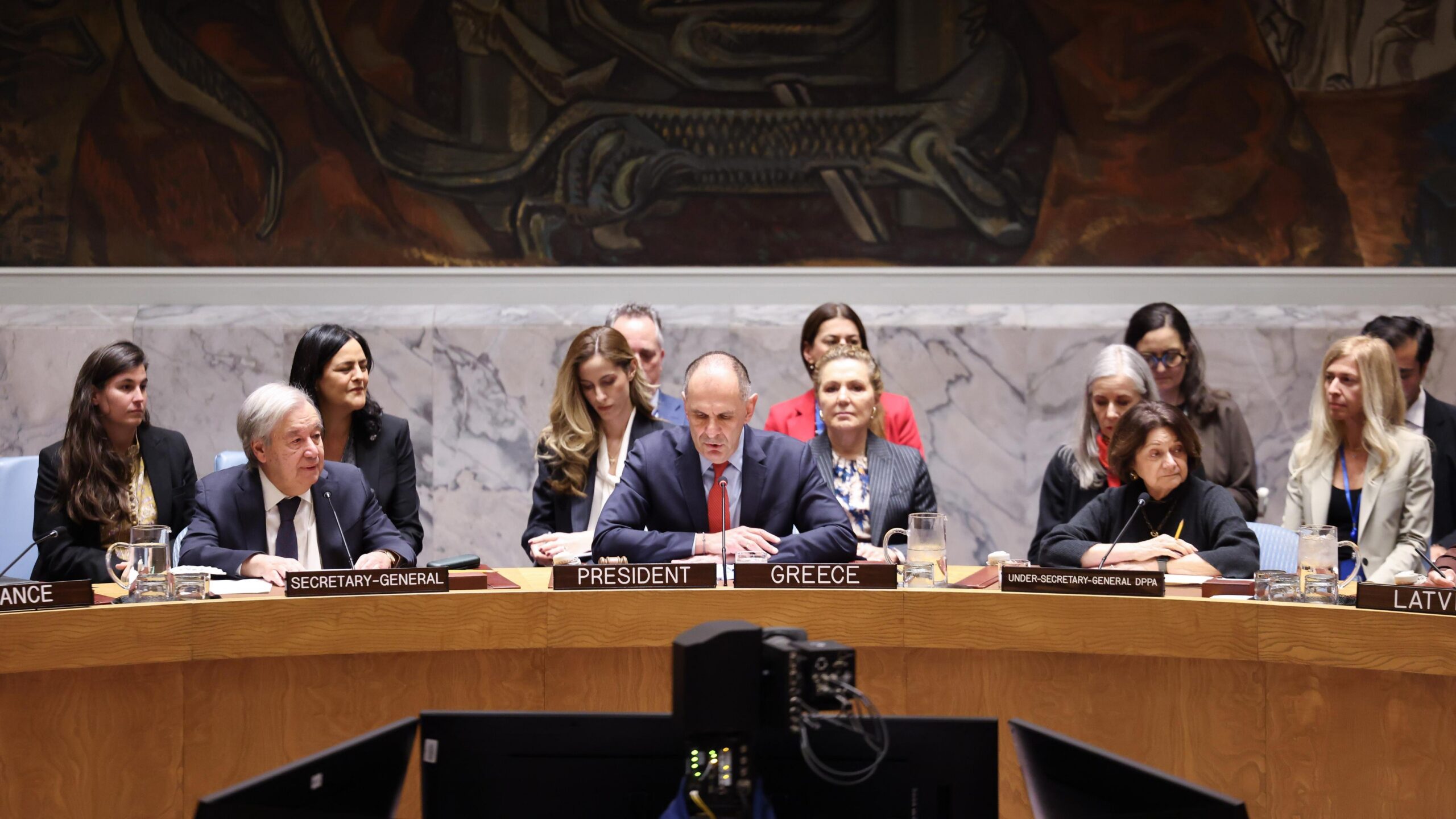
It is an exceptional honour for me to preside today at the SC Open Debate on WPS. I devoted a significant part of my 25-year academic career researching and publishing on equality and non-discrimination policies around the world. And I consider that such policies constitute an imperative of ecumenical international rights. But not only this, it is also most importantly, that societies cannot survive and thrive without the effective protection and meaningful participation of women in all layers of human interaction.
The legacy of Security Council Resolution 1325 on Women and Peace and Security is today more relevant than ever. As the toll of conflict on women continues to mount, as respect for their human rights erodes in many parts of the world and as emerging technologies, including artificial intelligence, pose new risks to their participation in public and political life, we must redouble our efforts to make the implementation of the WPS Agenda a reality for all women and girls.
In light of the above, I would like to make the following points:
At the outset, the protection of the human rights and fundamental freedoms of all women and girls must remain a top priority. There can be no real gender equality while millions of women continue to suffer violations and abuses of their basic human rights, including sexual and gender-based violence. We strongly condemn all such acts and call for accountability for perpetrators. At the level of the Security Council, the role of the UN sanctions Committees is crucial in ensuring that sexual and gender-based violence is included as a standalone designation criterion across all sanctions regimes. At the same time, it is imperative that victims and survivors of conflict-related sexual violence and other forms of sexual and gender-based violence have safe and unhindered access to sexual and reproductive healthcare and psychosocial support. Such assistance must follow a survivor-centred approach, respecting survivors’ rights, dignity, safety and confidentiality.
Equally important, women do not only bear the brunt of armed conflict, but they are also invaluable agents of peace. Peace processes yield higher implementation rates and are more sustainable when women are actively engaged due to the unique insights that they bring. We therefore call for their full, equal, meaningful and safe participation in peacebuilding and reiterate the Secretary-General’s call for women to constitute at least one-third of participants in mediation and peace processes. To make this participation effective and inclusive, we must advocate for adequate, predictable and sustained funding for women peacebuilders and civil society organisations. Equally important is the participation of women in politics and in decision-making positions at all levels. This participation must be substantive rather than driven solely by compliance with quotas. Moreover, attempts to intimidate or discredit women politicians and public figures, both offline and online, including through social media platforms, cannot be tolerated. The protection of women leaders and activists from physical and online harassment, threats and reprisals remains our collective responsibility.
Turning to our domestic efforts, Greece, as a WPS champion, remains firmly committed to implementing its National Action Plan on Women, Peace and Security, while mainstreaming gender equality into the Annual Action Plans of all Ministries. Within this context, we pursue a holistic approach that integrates the gender dimension into policies horizontally and budgets at the central government level. This contributes not only to a fairer distribution of resources, but also to the development of policies that address the barriers faced by women across all areas of public and political life.
Beyond the national level, Greece recognises the importance of translating these commitments into practical action on the ground. This includes linking high-level mediation efforts with the perspectives and experiences of local communities. We therefore advocate for the greater inclusion of women, young people, religious leaders and civil society actors in ongoing mediation efforts. We also support strengthening the organisational and technical capacities of grassroots organisations, enabling them to design and implement gender-sensitive, human rights-based peace initiatives.
At the same time, translating these commitments into action requires decisive efforts to address the threats and challenges that undermine women’s rights and participation. We must tackle emerging forms of technology-facilitated gender-based violence and challenge harmful narratives, both online and offline, that undermine women’s full, equal and meaningful participation in public and political life. Combating impunity for atrocities and crimes committed against women and girls is equally essential to ensuring accountability and upholding international law.
Excellencies,
The implementation of the WPS Agenda over the next quarter-century coincides with the era of digital revolution. Our shared responsibility is to ensure that all women and girls are equipped with the necessary tools to navigate these new challenges, that they are adequately protected and that they are meaningfully included in all decision-making processes concerning their future and the future of the world. Sustainable peace and security cannot be achieved if half of the population affected is absent from the negotiating table.
Thank you.
October 27, 2026