


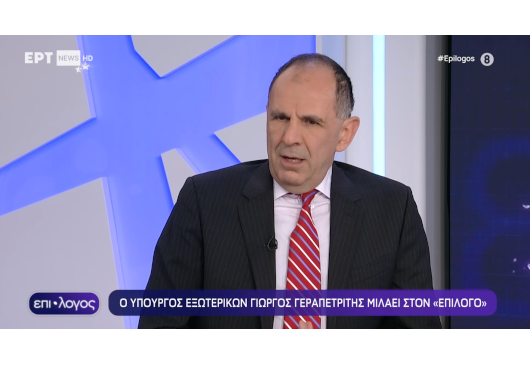
 JOURNALIST: Welcome to "Epilogos" TV show. Tonight, we have the pleasure and honor of hosting here in the ERTNews studio, the Minister of Foreign Affairs, Mr. George Gerapetritis. Mr. Gerapetritis, thank you very much for joining us tonight.
G. GERAPETRITIS: The honor is mine, Mr. Mangiriadis. Thank you very much.
JOURNALIST: Also joining us tonight are two esteemed colleagues, distinguished friends, and of course, experienced diplomatic editors, Mr. Nikos Meletis and Mr. Pierros Tzanetakos. Thank you both very much for being with us tonight.
JOURNALIST: We initially intended to address all current foreign policy issues. In a way, however, Mr. Gerapetritis, you have become the center of attention this week, not for foreign policy reasons, but also for art. I don't know how you feel about that. But since this is your first public comment on the flag issue at the Greek Consulate [in New York], I would like to start with that. While there are many other pressing issues, including the Beleri case, Greek-Turkish relations, the situation with the frigate in Suez, let us start with the flag issue to clarify things. I would appreciate your perspective on the removal of the artwork from the Consulate exhibition and on whether this signifies any intent on your part or the government’s part to impose limits on art.
G. GERAPETRITIS: Mr. Mangiriadis, thank you for this opportunity to express my views, because I have heard lately a lot of exaggerated claims. I want to tell you, honestly, that, especially to those who know me and are familiar with my background, labelling me as far-right or illiberal does in no way correspond to reality. Regarding the artwork’s removal, to put it in our own terms, I believe that the public discourse does not take into account the actual facts. The decision to remove this particular artwork was taken well before the issue was raised in Parliament. Thus, any association with the fact that the issue was raised by a specific political party in Parliament is totally unfounded.
JOURNALIST: However, the issue came to light when Mr. Natsios raised it. And we, somehow, came to the conclusion that your reaction occurred afterwards, subsequently...
G. GERAPETRITIS: The instruction had already been issued earlier. This has been clearly recorded and was not influenced by any subsequent incidents. Let me tell you the following so we can get a clear picture…
JOURNALIST: Just to clarify, could the response from the Greek diaspora, including articles in the National Herald and other reactions, have influenced your decision?
G. GERAPETRITIS: Let me be explicit, Mr. Mangiriadis. The truth is that I am not at the Ministry of Foreign Affairs in an academic capacity but as a representative of the Greek State. Thus, I serve the beliefs of the Greek Government and the Greek citizens, rather than my own. The Diaspora’s viewpoint has always been of particular value to us. Not for any other reason, Mr. Mangiriadis, but for the simple fact that the General Consulate in New York, like every diplomatic mission abroad, exists solely for one specific reason: to serve the interests and offer consular services to the Diaspora Greeks. Allow me to tell you the following: the General Consulate is dedicated to providing specific consular services. The art exhibition in question took place within the operational space of the General Consulate, that is, where our Diaspora members are served. Therefore, anyone visiting the Consulate would necessarily encounter the displayed artworks. So, we are not talking about a designated exhibition area.
JOURNALIST: Minister, does that mean that Consulates or diplomatic premises abroad should limit their activities exclusively to official functions or can they also accommodate other types of events, whether artistic or cultural ones? And if such events are to be held as part of public diplomacy, should there be some control or a general oversight over this matter? And by whom would such control be exercised?
G. GERAPETRITIS: The situation is rather straightforward. This particular artwork and every work falls within the freedom of artistic expression. I have been a lifelong advocate for the freedom of expression and the freedom of art, perhaps more than anyone else. Hence, I would be the last person to impose any restrictive measures. However, we must realize that this is not a gallery or a museum. I would be very happy for an exhibition concerning new, contemporary works that draw inspiration from the emblems, to be hosted at the National Museum of Contemporary Art. However, let us keep in mind, Mr. Meletis, that a Consulate is an area where consular services are provided. Allow me to tell you this: Diaspora Greeks, who come to obtain a passport, an identity card or a tax identification number, have no alternative but to visit the Consulate. Now, imagine they encounter a certain piece of artwork there. While you and I might not be offended by the specific artwork, those visiting the Consulate for the services they need should not be compelled to engage with it. And allow me to add a comment, because Mr. Mangiriadis rightly raised the issue of the Diaspora. In my opinion, the Diaspora Greeks have no other choice but to visit the General Consulate in order to receive these services. If some of our fellow citizens, our Diaspora Greeks, are offended by the specific artwork, my opinion is that the Greek State ought to take that into consideration. Personally, if you ask me, Mr. Meletis, I would very much like to see this specific work of art hosted in a private exhibition or in another setting, or I could even have it in my own house. However, the purpose of this particular office is to provide consular services.
JOURNALIST: Minister, was the Ministry informed about this exhibition?
G. GERAPETRITIS: Certainly not. It was not informed. I would like to repeat it, because it seems I did not make myself entirely clear: we are not talking about an exhibition, neither about a specific exhibition venue. We are talking about the actual space where consular services are provided. It is as if you, Mr. Meletis, went to a tax or an urban planning office and found yourself in the presence of an artwork, which may be fine by me, but deemed insulting for our symbols by some of our fellow citizens. So, to be clear, I want to state this once and for all. There is absolutely no censorship. There is utmost respect for the freedom of expression and the freedom of art. However, this specific case concerns a public building that exclusively provides consular services. It is not a special exhibition venue and therefore I feel that respect must be shown to those who go there to be served.
JOURNALIST: Minister, I am wondering whether you are concerned that at parliamentary level you essentially aligned with the parliamentary groups, to your right. Conversely, for example, PASOK, with which you share a common denominator on at least a few issues, criticized you for your choice. You also received, let us say, friendly fire from New Democracy members as well. Notably from Ms. Bakoyannis, who has also served as Foreign Minister.
G. GERAPETRITIS: Ms. Bakoyannis has served as Foreign Minister and her opinion is always respected, as is the opinion of all members of the Parliament. However, with all due respect, I must tell you that this not a legal nor a political issue. It is not legal because the subject of artistic freedom has been entirely addressed. Any constitutional law expert can tell you that the state cannot intervene in any private initiative related to the freedom of art. However, public facilities are under the absolute control and supervision of the State. So, it is a question of substance rather than constitutionality.
JOURNALIST: Is there an issue of seeking accountability for the use of an area without...?
G. GERAPETRITIS: To conclude, if you allow me, let me answer your questions one by one. You know, I respond to all questions. I will not avoid any question. You know me, Mr. Meletis. On the other hand, what is true is that there is no political alignment here. It is not a matter of right or left politics. For as long as I am in the position of Foreign Minister, I will not deviate from my own sense of public and national interest. I believe that out of respect for those citizens who come to the Consulate, regardless of my personal opinion as an academic and as a citizen, I must show this respect because it is an institution that solely provides consular services and citizens have no alternatives.
JOURNALIST: However, there is a work of art in the Ministry of Foreign Affairs, where the white stripes of the flag have transformed into clouds and the blue ones into sea and waves. I’m not sure if you have seen it, at the Akadimias St. building?
G. GERAPETRITIS: I reiterate, I am absolutely clear on this. This is an issue of a special space. For example, in a museum, even a public museum, an artwork can be exhibited that may even be quite “confrontational”. I recognize, as I always do, that art can have quite an aggressive character, even a heretical one. I can accept that. This is the purpose of expression and art. On the other hand, if we are not talking about special public exhibition venues, but rather about areas that purely provide services to citizens, we must respect those who come there.
JOURNALIST: To conclude, is there any accountability for the fact that this specific space at the Greek Consulate, which is for another purpose, was used for an exhibition, regardless of whether the specific work was there and of the reactions it sparked?
G. GERAPETRITIS: Look, this is something that has not concerned the Ministry for the time being. What I want to tell you, Mr. Meletis, is that diplomatic missions abroad always have the discretion to choose how their premises will be decorated, whether artistically or architecturally. As soon as it became known that there was a particular work of art that had caused some kind of annoyance in the Diaspora, the decision was immediately taken, before any parliamentary intervention.
JOURNALIST: I think we have covered this issue. Minister, allow me to ask you something else. Today, the government announced that a Greek frigate will be deployed to the Red Sea to participate in the "Prosperity Guardian" operation. Just a few hours ago, the President of SYRIZA expressed concern about the risk to the Greek Armed Forces and stated that Greece is taking part in an operation of willing parties, rather than under the auspices of an international organization. What is the government's response to this?
G. GERAPETRITIS: Look, I cannot comprehend how the main opposition party and its leader can equate having active diplomacy, being present in international fora, being involved in international developments, with hiding behind others, be it international organizations or coalitions of countries. I want to tell you something very specific. There is a very serious issue of maritime security that has been provoked by the crisis in the Middle East. The Red Sea is a pivotal point for the transportation of products and free navigation. Greece possesses a leading merchant fleet. For us, the Greek fleet is one of the most critical assets that we have to protect. We will never hide from our responsibilities. In my opinion, it is wrong to boast about having such a mighty fleet, such a strong voice in maritime affairs, and at the same time, do nothing to protect navigation.
JOURNALIST: Was Greek assistance requested by other countries?
G. GERAPETRITIS: Greek assistance is predominantly offered, Mr. Mangiriadis, and not asked for. Why? Because Greek diplomacy, Greek foreign policy as a policy of principles, is primarily active and multifaceted. We are the ones who set the terms of the game. And I want to emphasize this: Greece relies heavily on its own fleet. But it also relies significantly on the international capital it possesses. We always invest in it systematically, with principles, with ethics. We demonstrated this with our very active diplomacy in Ukraine and the Middle East. We will continue to act accordingly whenever our national interest calls for it.
JOURNALIST: Since we mentioned the Middle East, has there been any progress since the Israeli Foreign Minister’s talks in Cyprus regarding this maritime corridor, which seems to be underway with British participation? Is there anything new on this? Any Greek involvement?
G. GERAPETRITIS: We are working very hard towards finding both maritime and continental corridors. We are in constant contact with all sides, with Israel and the Arab world, with international organizations, the United States and the United Kingdom, to see how we can establish a sustainable corridor. I want to tell you that the conditions are extremely difficult to establish a maritime corridor directly to Gaza. And this is because, at this very moment, there is no safe harbor in Gaza for a ship to safely dock. We are examining all other routes. As you know, Mr. Meletis, there is currently a process in the UN Security Council for a resolution concerning a humanitarian pause. Greek diplomacy is present everywhere. We will undertake further initiatives in the immediate future to facilitate both the humanitarian pause...
JOURNALIST: That’s what we call a humanitarian corridor, right?
G. GERAPETRITIS: A humanitarian pause, a humanitarian corridor, but we should also start discussing for the day after Mr. Mangiriadis. Because the reality is that it is absolutely useful and wise to discuss sustainable humanitarian corridors today, but we must also look at the day after in the Middle East. Because without this sustainable, long-term solution, I fear that any interim solution will be merely temporary.
JOURNALIST: Let us turn to the Fredi Beleri case, as today we had, just a while ago, a post from the Albanian Prime Minister, Edi Rama, who stated that when it comes to justice, they make no compromise with anyone for any reason. Of course, there is an Albanian court ruling that states that Mr. Goro will not continue in office.
JOURNALIST: It is worth mentioning that, for the first time in a social media post, the Albanian Prime Minister acknowledged Fredi Beleri as the elected mayor of Himarë. Edi Rama referred in his perplexing statement -a style he is known for- to the court's ruling, which includes other things as well. On the one hand, the court essentially determines that Beleri cannot be sworn in or granted a permit due to particular reasons, pending the final resolution of the case concerning the common crime. This depends on whether he will be acquitted and thus be sworn in, or be convicted, which would result in the termination of his office. On the other hand, the ruling determines that the government reserves the administrative right to intervene and fill the vacancy in the Municipality of Himarë.
JOURNALIST: How does the Greek government interpret all this?
G. GERAPETRITIS: I am afraid there may be some confusion, since you provided a lot of information which I am not sure whether your viewers are familiar with. Let me say this: there was a decision today by the Albanian court. It is a special court that deals with corruption and organized crime. This decision included various considerations: First, that Fredi Beleri is the elected mayor of Himarë. Second, that his current restriction in temporary detention prevents him, under existing Albanian law, from being sworn in and assuming office. And third, that the former mayor can no longer perform the duties of the mayor.
Please note that the elections were held on May 14. In these elections -I am saying this for our viewers- the two main candidates were Fredi Beleri and the former mayor, Goro. Despite Beleri's detention just two days prior to the election and his subsequent victory, the defeated candidate, Goro, remained in office according to the Albanian government interpretation. Now, the Albanian court has ruled that Goro can no longer perform his duties. The Albanian Prime Minister has, for the first time, acknowledged the election results, thereby recognizing the people of Himarë’s choice and explicitly naming Fredi Beleri as the elected mayor.
JOURNALIST: Does this mean that Beleri is now able to be sworn in and assume his duties?
JOURNALIST: Does this satisfy Greece’s demand and the condition it has set to recognize the election result?
G. GERAPETRITIS: I will get to that – Edi Rama also acknowledged that Mr. Goro, the former mayor now serving as acting mayor, can no longer perform his duties, despite his ties with the Albanian government. So, at this moment what needs to be done is the immediate replacement of the acting mayor, Mr. Goro. Regarding whether this satisfies the Greek government, I will tell you that from the very beginning, the Greek government, had a very clear, very consistent, principled stance, just like in all matters. We insisted that the Albanian government should undertake concrete action so that Fredi Beleri can assume the duties entrusted to him by the people of Himarë.
JOURNALIST: Will the Greek veto be lifted, if he assumes his duties?
G. GERAPETRITIS: What does this mean today? This signifies that indeed, a positive step has been taken by the Albanian Prime Minister, who admitted in principle that we have a new mayor. Mayor Goro must definitely step down and then we will assess whether the subsequent actions align with the conditions we have set. Please, allow us to carefully examine the decision and see how it unfolds. However, in any case, I consider it a positive step that the Albanian Prime Minister has accepted the obvious, namely that Fredi Beleri was elected mayor.
JOURNALIST: Yes, so we understand, Minister, that we are taking a slight step backwards concerning the swearing-in.
G. GERAPETRITIS: There is absolutely no step backwards.
JOURNALIST: No, the Minister said that we would examine in the coming days, I assume, how the case will develop. I understand that the request in recent weeks was for Beleri to be sworn in, even if that needs to happen in prison. What I wanted to ask is whether you have also heard voices from within our country suggesting that we are spending too much political and diplomatic capital on the Beleri case. I would like to know if the government is truly willing to continue applying this kind of pressure and reach the next accession steps of Albania with the same attitude it demonstrates now.
G. GERAPETRITIS: You know, Mr. Tzanetakos, in general, we are not inclined to make concessions on any matter. And I would really want you to evaluate our country's foreign policy in recent months based on this assumption. From the outset, we have demonstrated great consistency in all aspects of our foreign policy. Regarding Albania, from the very beginning we said what we believed serves our national interests. We said no concessions regarding the Rule of Law, political rights, the presumption of innocence for Fredi Beleri; no concessions regarding the rights of the Minority. We respect justice, the Albanian justice, but we believe that there must be political will, since it is an administrative measure, so that Fredi Beleri can assume his duties. Today, with the court ruling there was a step forward and with the Albanian Prime Minister’s statement acknowledging Fredi Beleri’s election, a further one. One more step is still required, though.
JOURNALIST: Let us now turn to Greek-Turkish relations. When is your next meeting with Mr. Fidan scheduled? And I’d like a prediction from you: do you believe that 2024 will be the year of substantive discussions with Türkiye? Could this year be indicative of where this process might lead?
G. GERAPETRITIS: You know, in principle I don’t believe in making predictions. My fundamental stance on matters of foreign policy is not to make predictions but to prepare scenarios. I can therefore tell you that the Greek side is ready for all possible scenarios. If you’re asking whether I am inclined to discuss major issues, my answer is yes. My predisposition, based on the mandate given by the Prime Minister, is that when the conditions are right, when the time is ripe, we will discuss even the most challenging, the sole dispute that can be brought before international jurisdiction.
JOURNALIST: You mean the continental shelf and the Exclusive Economic Zone... Just to clarify something about the mechanism of exploratory talks which has been in place for so many years. Now, this discussion seems to have been upgraded to your level, that of the two Foreign Ministers, and higher up. Is the political dialogue part of this discussion? Where exactly do we stand in this regard?
G. GERAPETRITIS: It is all very well-defined. I don’t know what your impression is, but what I want to say, and I say this in full knowledge and without any exaggeration, is that the success of the Greek-Turkish dialogue depends, in my opinion, on how well-organized and structured this dialogue is. Until now, we have managed to have very specific structuring, very specific milestones, a truly orderly discussion. There is honesty, but in my view, the most important thing is that the dialogue is structured. So, what are we saying today? We say that the three pillars we have, namely, the political dialogue, the positive agenda, and the Confidence-Building Measures include individual chapters. A chapter of the political dialogue is indeed the part of the exploratory contacts, that is, the discussion that will be held regarding the delimitation of the Exclusive Economic Zone and the continental shelf. We all realize that this discussion will be at the highest level, at the level of the two ministers and the two deputy ministers who are engaged in the political dialogue. We are not at this point yet; I want to be completely honest with you. We are at the point where we are trying to establish a positive climate, to maintain the calm in the Aegean and the Eastern Mediterranean, to establish honesty between the two sides. The truth is that we have agreed on several points. There are 15 agreements, memoranda, and joint statements. Mr. Mangiriadis, we need to see them being implemented, though. And then, my intention is to address this major issue.
JOURNALIST: Minister, could you please elaborate on what you mean when you say 'we will address this sole issue when the conditions are ripe? Additionally, regarding the 15 agreements you referred to, I looked into my files and found those other 10 or 12 agreements signed from 2010 that appear quite similar. They were never put into effect.
G. GERAPETRITIS: With all due respect, allow me to say that the agreements are not at all the same. I have studied exhaustively and in detail, which accounts for my evident fatigue, the proceedings of the previous High-Level Cooperation Councils. You have correctly noted that agreements were made in the past. Turning your two questions into one, I believe the true measure of maturity in order to move from relatively simpler, mutually advantageous matters, to the more challenging ones, where we encounter core disagreements, is the actual implementation of what we agree upon.
JOURNALIST: So, you're saying that the positive agenda will be the path to reach the more challenging issues; this is what you’re explaining to us.
G. GERAPETRITIS: One is the positive agenda, that is, the implementation of the agreements, and the second is the continuation of the good climate, the calm over the Aegean Sea.
JOURNALIST: I respect the determination with which you approach the issue of the Greek-Turkish dialogue. I just wanted to ask so that both we and our viewers understand. How can there be, even if the conditions mature and the positive agenda progresses, any advancement in the dialogue and the talks on an issue where, not only are the positions diametrically opposed, but there are also major issues involved? Because the issues that Mr. Erdogan raised in his interview in Kathimerini newspaper are issues that pertain to national sovereignty, to sovereign rights. How can we bypass or surmount this barrier to facilitate political dialogue? Additionally, isn’t the shift from exploratory talks to political dialogue an upgrade in the process that Türkiye has long desired in order to secure political negotiations before any eventual referral to The Hague?
G. GERAPETRITIS: With all due respect, I disagree, and I will put it on a very technical level. First issue: the delimitation of the two maritime zones, that is, the Exclusive Economic Zone and the continental shelf, is a technical issue. It is not a political issue. Certainly, it presupposes a political will to discuss it. The part of the political will that is required is very important. What does political will actually mean? You know, Mr. Meletis, you are very experienced. Political will means to have a deliberative spirit, to sit at the table and discuss. One trait I cultivated over many decades in academia —a realm grounded in rationalism—before moving on to politics, is a deep appreciation for dialogue and the deliberative approach. I believe that with a principled, honest, and rational dialogue, the right solutions can be reached. You referred previously to diametrically opposed positions on sovereignty issues. Let me be clear: issues of Greek sovereignty, Mr. Meletis, are off the agenda. I say this explicitly and categorically, and I want to be held accountable for it. Issues of Greek sovereignty are inalienable rights subject to the exclusive jurisdiction of the Greek state. I will never discuss them. On the other hand, those issues which, according to International Law, are subject to discussion and ultimately international arbitration, such as the delimitation of these two zones, are the issues we will discuss.
JOURNALIST: They are not entirely technical, though.
G. GERAPETRITIS: They presuppose political will. I was very clear on that.
JOURNALIST: For example, let me say something, Minister. I have a question that I've been thinking about all these years while covering this topic.
G. GERAPETRITIS: And if it hasn't been answered for you yet, I will answer it.
JOURNALIST: That's exactly what I would like. For instance, when the time comes for the delimitation, which will be held in good political will by both sides, with sincerity and willingness for dialogue, and the moment arrives for the technical delimitation, in the area of Imia for example, is the delimitation easy? Is the delimitation in the Imia area a technical issue?
G. GERAPETRITIS: The issue of Imia is purely a legal issue. When I refer to technical, Mr. Meletis, I obviously encompass the legal aspect as well. As you are aware, any legal aspect is also technical, not political. What does this mean?
JOURNALIST: It's a matter of sovereignty.
G. GERAPETRITIS: Of course, it is a matter of sovereignty. What does it mean that it is a legal issue? It means that based on the international treaties that are applied, it is susceptible to only one solution. Therefore, in this sense, technical issues of sovereignty are out of discussion. The issues that are open for discussion are those concerning delimitation, and if the time comes and we agree on these issues, namely the Exclusive Economic Zone (EEZ) and continental shelf, reaching international jurisdiction will be something that will have been mutually agreed upon and will not involve sovereignty issues. Have I answered your question?
JOURNALIST: Nearly.
JOURNALIST: I’d like to ask you if there is even the slightest indication at this moment, from the Turkish side, if the Minister has received even the slightest hint from the Turkish side towards taking this revisionist agenda off the table and discussing our sole dispute. But let me take a step further. You have said, and I agree on this, that the Athens Declaration on Friendly Relations and Good Neighborliness was a historic document. I truly agree with this because ‘scripta manent’. Allow me at this point to read a clause from it. "The Parties are committed to refrain from any statement, initiative, or act likely to undermine or discredit the letter and spirit of this Declaration or endanger the maintenance of peace and stability in their region". You know that there have been voices suggesting that this may function in a reverse way that is, to the detriment of our country. For example, the extension of our territorial waters came to the table. Could you comment a bit on this?
G. GERAPETRITIS: I believe it’s far too easy to comment, Mr. Tzanetakos, and once again I will be clear. Firstly, I want to tell you that this interpretation is given by those who have not read the agreement carefully -I do not attribute this to you- but to those who have not read the agreement well. And because you can understand who was the historical drafter of this agreement, I want to make the following clear to you. Firstly, there is absolutely no, and I mean it, no violation of national interests, no degrading of them. Secondly, for the first time, we have in writing, which is not legally binding but is of high political stature and symbolism, Türkiye's explicit acknowledgement that we proceed based on International Law. For anyone familiar with the history of Greek-Turkish relations, the acknowledgement that International Law is our navigator is extremely important to me. I want to remind you, Mr. Tzanetakos, that International Law includes the Montego Bay Convention on the Law of the Sea, to which Türkiye is not a signatory party, but it is still International Law. So, let's be clear about what we're discussing. Thirdly, you're telling me about the clause, which states that this agreement should not be undermined by word or deed. Of course, it's very logical to include this clause because we cannot sign about goodwill and sincerity in our relations and on the other hand, undermine them by word or deed. We have had many examples in the past. You mentioned issues of sovereignty. Sovereignty is out of this agreement. And if you read the preamble carefully, it states explicitly that, regardless of what is included in this agreement, in this political declaration, the two countries retain their legal positions in full. You might ask, if the two countries maintain their legal positions, what would be the value of this agreement? Let me tell you very honestly that the value of this agreement, beyond its symbolism, is that it is the first document of friendship and good neighborliness in 100 years, actually in 93 years because we had the Venizelos-Inonu pact in 1930. Thus, we realize that after 93 years, for the first time, we have this declaration of friendship and good neighborliness. There is a very specific platform. I reiterate, do you realize how important it is at this moment to know with great precision the steps, the principles, and the law that is applied?
JOURNALIST: You haven't told us when you have decided to meet for the second round?
G. GERAPETRITIS: These are the little secrets that we keep a bit to ourselves. We meet periodically and talk frequently.
JOURNALIST: Minister, this clause should not negatively affect the exercise of sovereign rights or other rights through self-restraint.
G. GERAPETRITIS: What do you mean, wait a minute, time out, because what you said is really significant. I need to hear it.
JOURNALIST: For example, will we be able to install wind turbines on a rocky islet which Türkiye considers as a disputed area?
G. GERAPETRITIS: It's a matter of sovereignty for us.
JOURNALIST: I see.
G. GERAPETRITIS: Let me put it another way for you, because I want to be very clear. Issues regarding demilitarization, grey zones, minorities, the Greek state, at least as long as I am leading the Ministry of Foreign Affairs, will never discuss. And I want to say, to the credit of the Turkish side, these matters have not been raised.
JOURNALIST: Not even the issue of demilitarization of the islands?
G. GERAPETRITIS: Certainly not. The configuration of the Armed Forces, Mr. Mangiriadis, is strictly within the purview of the Greek State. It will never be put on the table, I assure you. Moreover, if you review the progress of the dialogue over the last five months, particularly since December 7th and Mr. Erdogan's statements and what emerged from the Turkish side, you will see that issues pertaining to Greek sovereignty have not been raised. This might well be the first time that they have not been brought up...
JOURNALIST: Indeed... we have extensively addressed the issue of Greek-Turkish relations.
JOURNALIST: I just have a question regarding the minority. For example, would you discuss a matter that has to do with self-determination, at a collective level rather than the individual level?
G. GERAPETRITIS: These are matters that are strictly ours, Mr. Tzanetakos. If the Greek state deemed that it should provide any relationship to our fellow citizens, it would do so. You know something? Equality, political equality for all Greek citizens, is strictly our own affair. We tend to it daily. We do not define ourselves by others and we do not take instructions.
JOURNALIST: Let me ask you one last question about the Parthenon sculptures. Because it appears that you met with [George] Osborne, the chairman of the British Museum on your last trip to London in December. Firstly, I would like to know where we stand on this matter and if you believe that an agreement may be reached under a Labour government Additionally, as a distinguished lawyer, do you see a way to bypass the ownership issue?
G. GERAPETRITIS: As regards the Parthenon Sculptures, let me tell you that the Greek government is making a very systematic effort, which is multifaceted. It is an effort that is directed towards the British Museum, with which we are indeed in discussions. And I must admit that, despite the fact that we have not approached any agreement, the dialogue that is taking place is very productive. The issue has been discussed with the British government and the opposition, with the Labour opposition during our last meeting in London.
JOURNALIST: Apparently, they will be the next government soon.
G. GERAPETRITIS: We shall see if the polls will be confirmed. Of course, there is a significant effort to stimulate public opinion on this matter. Because, you know, the issue of the Parthenon Sculptures is always linked to the great pressure exerted by both the international and the British public opinion. And it is very important to see over time how much this has changed.
JOURNALIST: But there is a practical issue here, and that is the issue of ownership.
G. GERAPETRITIS: Let me tell you this. There is a law, the British Museum Act of 1963, which in reality prohibits the permanent removal of the Sculptures from the British Museum. Given that at the present stage it is not anticipated that there will be a change of this law, at least with the current political balance, what could possibly be sought would be a solution within the framework of the law. The Greek side does not discuss a loan in the classical sense of the term. We consider that the Sculptures belong to us by ownership. However, in any case, there could be a creative solution, which, without overlooking each side's positions, can serve as a vehicle to accomplish the reunification.
JOURNALIST: So, might we see a branch of the British Museum being housed within the Acropolis Museum? Is this how the reunification could work?
G. GERAPETRITIS: I am not in a position to tell you that. I feel that the solution must be found primarily in the substantial showcasing of the Sculptures in their natural space, which is the Acropolis Museum. I am particularly interested in the terminology of things, Mr. Mangiriadis. It is important to state this in our public discourse. We do not talk about return, we talk about reunification, because it is about a unified architectural work, the Parthenon. Thus, what needs to be done is to reunite the Sculptures, which were alienated two and a half thousand years ago. The second and most important thing, in my view, is that these Sculptures should return to their natural space in a way that will showcase the global, the universal cultural heritage. Because, you know, everything is determined by the place in which it is incorporated.
JOURNALIST: Mr. Gerapetritis, I want to thank you very much for joining us tonight, as well as our colleagues, Mr. Meletis and Mr. Tzanetakos.
G. GERAPETRITIS: Thank you very much.
December 22, 2023