


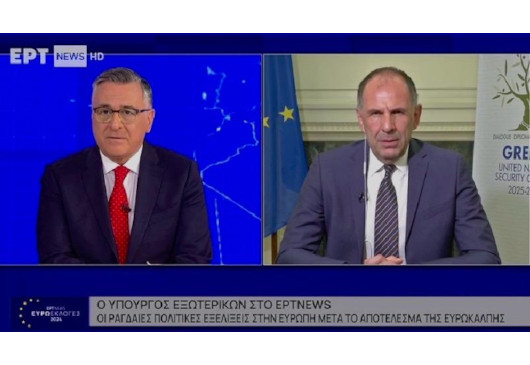
 JOURNALIST: Minister, good evening.
G. GERAPETRITIS: Good evening, Mr. Kouvaras. Thank you very much.
JOURNALIST: We are interested in your perspective, Minister, since Macron has just called for elections in France. We would like to hear what you think in light of this, if you believe today's European elections are finally producing developments in Europe, and what kind of developments we might see.
G. GERAPETRITIS: It is certain, Mr. Kouvaras, that there will be developments in Europe, in terms of both member states and the European Union. The two large European states, France and Germany, which are the driving forces of the European Union, have had results that overturn the established political order. In France, there is an overall far-right vote of approximately 37% and a clear defeat for President Macron. In Germany, the Social Democrats, participating in the coalition government, ranked third. As you are aware, President Macron has already dissolved Parliament and called elections for June 30.
JOURNALIST: Minister, under these circumstances and amidst two wars, one in Ukraine and one in the Middle East, Europe wonders how to deal with these events, while waiting to see what Washington will do. There is a difficulty in coordination among the European powers. When two significant governments, such as the French and the German, receive such a message in the European elections, how may this affect the stability of Europe as a whole, as well as the European position on these critical issues?
G. GERAPETRITIS: At this moment Europe will have to proceed based on the election results. I would also like to clarify that there are no major changes in the composition of the European Parliament because we forget that today's elections were primarily about its composition. The European People's Party, to which the New Democracy also belongs, is primarily strengthened. The far right is also relatively strengthened, and the Socialists and Liberals of the Macron Group are in decline.
JOURNALIST: However, currently, they outperform the far right.
G. GERAPETRITIS: This is the third political force in the European Parliament. However, based on the information available thus far, there is the possibility of a grand coalition, consisting of the three dominant forces in the European Parliament, namely the European People's Party, the Socialists, and Renew, so that there can be leadership in the European Commission. And this is something that will happen.
JOURNALIST: So, Mr. Gerapetritis, you will not appeal to Meloni or anybody else in order to elect the President of the Commission. The three political groups, the ones you mentioned, will work together.
G. GERAPETRITIS: As you are aware, our Prime Minister, Kyriakos Mitsotakis, has been working with Poland's Prime Minister, Mr. Tusk, to achieve the required political consensus in order to have leadership in Europe. On July 16, the European Parliament will meet in Brussels and Strasbourg to be constituted. If possible, the new President of the European Commission will be elected based on the newly formed political groups.
JOURNALIST: However, Macron wants Draghi to be the Commission's President. Could this lead to a change in alliances?
G. GERAPETRITIS: We will have to wait and see about that. The European Parliament will be constituted in approximately 40 days. These 40 days are extremely crucial for the future of Europe. I would like to emphasize the following, which is very important. The Europe we voted for is currently undergoing a transformation, transitioning into a geopolitical Europe. It is no longer merely an economic and political union. It is a geopolitical union that opposes wars in our region. It is necessary to have those compositions so that we can have a European Commission. I would also like to remind, this is important too, that Hungary will assume the Presidency of the European Council on July 1, whatever that may mean. Therefore, it is very important for the institutions of the European Union to be constituted, in order to overcome any difficulties.
JOURNALIST: I would like to focus a little bit on the international aspect. You mentioned that Hungary will assume the Presidency. That is correct. There is also a serious possibility that Trump will be elected President of the United States in November. Two wars are being waged, I repeat, in our region, which do not seem to be leading to a way out. Are you concerned about all this? The viewers who are listening to us think it is explosive. And when we have results like the ones we are witnessing now in Europe, it looks even more troubling.
G. GERAPETRITIS: We are concerned. Obviously, we follow developments. However, I would like to point out that the European Union has made significant strides toward substantive autonomy in the past five years, with respect to both the West and the East. It is crucial for the European Union to have geographical, energy, and political autonomy. For this reason, although there will certainly be turbulence due to the election results, one thing is certain: the European Union's course will not be halted.
It is highly significant, and I want to underscore that we have a term ahead of us in the European Union that is critical to Greece's interests. Unfortunately, I am disappointed that there was no extensive discussion and consultation on European issues during the pre-election period.
JOURNALIST: You are absolutely right.
G. GERAPETRITIS: The debate was extremely limited. However, I would like to point out that the next five years will be about rural development, a more competitive Europe in relation to the United States, the implementation of the Migration Pact, and, most importantly, a new geopolitical Europe in relation to the rest of the globe. It is crucial that we have a strong Greek voice.
JOURNALIST: Thank you very much, Minister.
June 9, 2024