


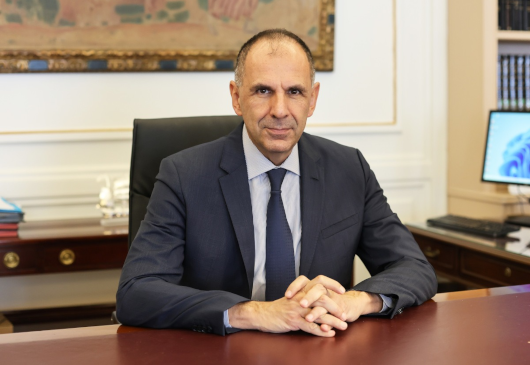
 G. GERAPETRITIS: Good morning, Mr. Pavlidis, thank you very much for your hospitality.
JOURNALIST: First of all, how do you feel as an Olympiacos fan today?
G. GERAPETRITIS: Today is a day of great joy for both the team and the city. We continue to aim high.
JOURNALIST: I believe Olympiacos' remarkable success yesterday has set a positive tone for our discussion today.
G. GERAPETRITIS: Amidst, unfortunately, various problems, which are far more important and serious for us.
JOURNALIST: So, Minister, let us turn to these matters and briefly discuss them. It would be quite interesting to begin with yesterday's conclusions, which also concern Euro-Turkish relations. There was some reaction on the part of Ankara. Do you think that this climate will have an impact on the Prime Minister’s visit on May 13th?
G. GERAPETRITIS: Mr. Pavlidis, let me tell you the following. The rapprochement being attempted between Greece and Türkiye constitutes, in my opinion, an historical imperative. The two countries are neighbors, destined by geography to live together. And those of us in service to our country should strive for a peaceful neighborhood.
That does not, of course, mean that we will always have a straight path forward. There will undoubtedly be times when we will see some setbacks in the relationship that is being developed. There will be issues that will cause tension. After all, our fundamental stance has always been that the positions of the two sides are not going to change. What we will try to do is focus on mutually beneficial areas that could facilitate progress in our relationship. We intend to foster a situation which will primarily, allow us to maintain relative calm, and secondly, ensures that when tensions do surface, they do not lead to major crises.
What we should always bear in mind is that a crisis might asymmetrically arise out of an accident, a misjudgment, or a false report. Therefore, it is wise to have safeguards in place in order to de-escalate crises when they occur, because they will inevitably occur.
Regarding the Prime Minister's visit, it will take place, as the Prime Minister himself said, on May 13th. There are issues that we need to discuss. Further directions should also be provided by both leaders. The trip’s arrangements are proceeding as planned, and hopefully we will have a positive and productive meeting.
JOURNALIST: Minister, reading the conclusions - as the Prime Minister highlighted - it is clear that the progress of Euro-Turkish relations is also affected by developments in the Cyprus issue. There is a relevant paragraph, which the Prime Minister also pointed out. The text approved by the European Council and welcomed by both the Greek and the Cypriot side, provoked reactions in Ankara. Considering that the Prime Minister has described the reactions as somewhat inexplicable and, if you prefer, excessive, do you believe that all this will have no impact?
G. GERAPETRITIS: Look, what is critical to emphasize now is that the European Union and Türkiye are in a process of discussing how productive cooperation can be achieved. I believe that a Western orientation is in the interest of both Europe and Türkiye. This, in my view, will have a favourable impact on both our bilateral relations, that is between Greece and Türkiye, and the Cyprus issue.
It goes without saying, Mr. Pavlidis, that when we speak of a supranational organization, such as the European Union, to which Greece and Cyprus already belong, it is primarily the member states that determine the agenda. Therefore, the connection being drawn between Euro-Turkish relations and progress in the Cyprus issue is, in my opinion, absolutely logical. Türkiye is obliged to respect the European acquis, which fully includes the participation of the Republic of Cyprus at all levels. It is significant that two paragraphs concerning Euro-Turkish relations were included. I believe it is self-evident that progress in Euro-Turkish relations should mean full respect for the sovereignty and rights of all member states, including the Republic of Cyprus.
JOURNALIST: Some people ask, Mr. Gerapetritis, why doesn't Greece - and this is even on the front page of a newspaper today - denounce the violation of the Athens Declaration?
G. GERAPETRITIS: With all due respect, you will allow me to say that the Athens Declaration - because we, and I personally, have worked on it extensively - contains a clear reference that the positions of the two countries do not change. There must be an acceptance by the parties of the legal positions of the two countries, meaning that their basic positions will not change. The legal position of both Greece and Türkiye remains.
What has changed with the Athens Declaration is that we have agreed to attempt an amicable settlement of these differences. Thus, the Athens Declaration, like any international agreement, does not mean that the contracting parties relinquish their fundamental legal positions.
Greece has its fundamental positions, which are based on International Law and, in particular, the Law of the Sea. We will never accept any discussion on issues that relate to its sovereignty. We will never discuss neither the purported by Türkiye demilitarization, nor issues of grey zones, or the religious minority in Thrace. Since Türkiye has some of these issues as its fundamental position, it may retain them. Obviously, it does not relinquish them. On the other hand, we should all realize that these positions must be expressed within a certain framework and that there should always be an attempt to de-escalate any tension that arises.
No Greek government could ever come forward and agree to relinquish any such right. The same applies to Türkiye. Therefore, allow me to say that the interpretation, which suggests that the Athens Declaration implies the parties' relinquishment of their fundamental positions, is completely mistaken.
JOURNALIST: You are clear. Let us turn to a topic that is causing a lot of discussion and tension. Today the Prime Minister is visiting Mytilene. If I am not mistaken, on April 8th, it was announced by your Ministry that two large marine parks will be created in the Aegean and the Ionian Seas. There was immediate reaction from Türkiye, which refers to unilateral fait accomplis and also expresses a state of high alert. How do you explain this, Minister? Why is there such a reaction? Particularly for the Ionian?
G. GERAPETRITIS: I believe there was an overreaction to this issue. The facts are quite specific. Within the framework of the 9th Our Ocean Conference, which was held in Athens with a significant participation of more than 120 international delegations and crowned with great success - regarding the environmental commitments undertaken by the participants -, our country has committed to creating two large marine parks, one in the Ionian and one in the Aegean Sea.
These marine parks, which fall within the scope of our country's sovereignty and sovereign rights, have not yet been demarcated. They will be demarcated based on environmental criteria related to the protection of marine species and the general protection of the waters. That will have absolutely no influence on our underlying sovereign rights, nor could Greece ever renounce any of these rights. In this regard, I believe that Türkiye’s reaction was rather excessive. I do not believe that this will have a significant impact on our cooperation. And in any case, it will not prevent us from making this demarcation, which will be determined based on, as I told you, purely environmental criteria.
JOURNALIST: I think you are absolutely clear. Let us, now, move to an issue, Minister, that I believe will take on fairly significant proportions. On May 16, we are expecting the Committee of Ministers to reach a final decision on Kosovo's request to joining the Council of Europe. Let me say here for our listeners that the request was approved with 131 votes in favour, 29 against, and 11 abstentions. The statutory report introduced by Ms Dora Bakoyannis was approved, confirming that Kosovo meets the conditions for membership in the Council of Europe. There was, however, a reaction from Serbia. There is, if you will, a reaction on this matter in Nicosia as well. What is the position of the Greek government?
G. GERAPETRITIS: First of all, for our listeners, let me point out that there are three levels here. The first level is the non-binding opinion of the competent committee of the Parliamentary Assembly, which was positive for Kosovo’s accession. The second level is the Parliamentary Assembly itself, which is comprised of representatives from all Council of Europe nations. It likewise issued a positive recommendation. However, both these views, as expressed, are non-binding. The decisive body for the case of Kosovo's accession to the Council of Europe is the Council of Europe’s Committee of Ministers, which, as you rightly said, will meet on May 16th and will decide.
What I want to emphasize is that, regardless of the position expressed at the level of both the Committee's report and the Parliamentary Assembly – which I repeat consists of parliamentary members, not governments of the member states – Greece's position remains firm and unaltered.
As we have done in the past in similar cases, Greece will abstain from this vote. That is to say, it will not support the request for Kosovo's accession to the Council of Europe for political reasons.
Furthermore, I want to highlight that one of the fundamental issues that were set as a precondition for Kosovo's admission, which was the restitution of property to a Serbian monastery, has been fulfilled. However, some of the fundamental issues, and particularly the creation of an Association of Serbian Municipalities in Kosovo, have not yet been satisfied, and thus our essential policy has not changed.
Greece remains steadfast in its principled foreign policy. We do not change our opinion unless the actual facts, upon which decisions are based, change. We will continue with this logic of principles. We encourage dialogue between Pristina and Belgrade. Moreover, there have been decisions towards this direction in Ohrid. We seek a peaceful resolution of the disputes. Of course, this depends on the willingness of the parties to comply with the agreements and adhere to International Law. In this regard, at the current stage, the Greek government will abstain from this vote.
JOURNALIST: Well, Minister, since I know your time is precious and your workload immense, let me close with a question, because this issue needs clarification. Mr. Beleri, the elected Mayor of Himare is running on the New Democracy’s European electoral list. It was reported in part of the press that the Ministry of Foreign Affairs, you personally, and Ms Papadopoulou, had reservations about this candidacy. Is this information correct?
G. GERAPETRITIS: The answer is very clear, Mr. Pavlidis. This is not an issue that primarily concerns the Ministry of Foreign Affairs. It is a matter that concerns the party of New Democracy. What I want to emphasize, within my competence, is that Greece obviously supports the Greek national minority in Albania.
The events leading to the situation we know, regarding Fredi Beleri, are well known. Significant issues were raised concerning the strict application of the principles of the rule of law which constitute a European requirement. It is not a bilateral issue, but strictly a European one. Greece will continue to have a substantive say in Albania's pre-accession process to the European Union. We will closely monitor the process. It is extremely important to us that all conditions set at the level of democracy and rule of law are strictly met. And that will remain our firm position.
JOURNALIST: Minister, thank you very much for the conversation we had. I wish you a nice weekend.
G. GERAPETRITIS: And most importantly, may we have a peaceful weekend.
JOURNALIST: We didn't comment on that. We had the attack at 5 a.m. in Isfahan.
G. GERAPETRITIS: There must be self-restraint from all sides. We are at an extremely critical point. The negotiations regarding peace in the Middle East and the cessation of hostilities are unfolding, so that we can discuss more humanitarian corridors and furthermore have a sustainable solution to the Palestinian issue. I believe we should persistently continue to work towards a solution to the Palestinian issue. Certainly, all sides, not just Iran and Israel but the entire Arab world and the involved parties, should provide their good services in order to prevent the crisis from spreading further, which would undoubtedly have destructive consequences not only for the region, but also for the entire world.
JOURNALIST: Mr. Gerapetritis, thank you very much. Have a good day.
G. GERAPETRITIS: It was a great pleasure. Good day to you, Mr. Pavlidis.
April 19, 2024