


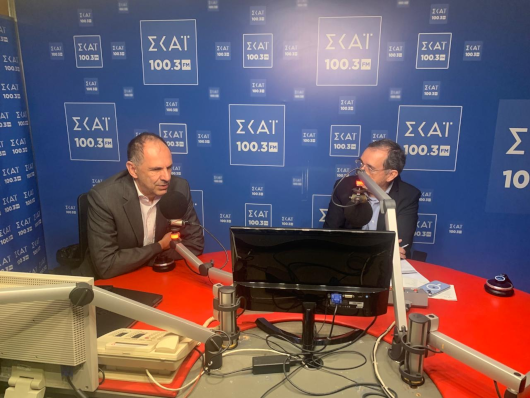
 JOURNALIST: Good morning, many happy returns!
G. GERAPERTITIS: Many happy returns, Mr. Tsimas. Many happy returns to the listeners. The truth is that I am in the spotlight, since all the station’s news concern foreign policy, so I am not sure if we will have enough time.
JOURNALIST: I am not sure if this is a good thing because it indicates that we live in a turbulent world and in an area that that is beginning to make waves.
G. GERAPETRITIS: Mr. Tsimas, there are two dimensions. The first dimension is the international one. Indeed, we live in an exceedingly asymmetrical world. I would say that in the last two years, extremely strong asymmetries have developed in the world. This means that there are potentially many hotspots which can eventually prove to be disastrous.
It is not only the obvious ones, Mr. Tsimas. It is not only Ukraine or the Middle East. Right now, Africa, particularly Sub-Saharan Africa, is actually a minefield. Many developments are also unfolding in Asia and Latin America. In general, the world is extremely vulnerable and asymmetrical.
Our national dimension is that in this asymmetrical world, we are attempting to establish a pillar of security in Greece that is not affected by external events.
Mr. Tsimas, I am glad that despite what is happening in the international arena - issues with multiplier effects that affect the whole world - I see in the opinion polls that Greek citizens are not worried about Greece's position, its national position. They are not worried about its status and its security. That is also my objective. For Greek citizens to feel safe and be proud of their country.
JOURNALIST: You are right. On the other hand, European citizens felt extremely safe and calm on the eve of the First World War. Europe was sleepwalking into a slaughterhouse, but the citizens were unaware of it …
G. GERAPETRITIS: That is something we can discuss. I hope you are not a soothsayer bringing bad news...
JOURNALIST: No, no.
G. GERAPETRITIS: What is crucial is that the European Union, the world’s major powers, the United Nations are currently engaged in significant international initiatives. Many parallel efforts are underway to restore the international security architecture, which is extremely challenging.
It is extremely challenging, firstly because many leaders across the world are developing highly aggressive and revisionist features. Furthermore, populism appears to prevail in many parts of the world. Indeed, the combination of revisionist leaders and populism is a highly explosive one.
However, I would like to emphasize that for us it is of major importance that Greece is a pillar of security. A strong country that can talk, but in terms of dignity and prudence.
JOURNALIST: Let us turn to the topics of today's news bulletin. I will begin with the latest news regarding the election results in North Macedonia. The VMRO nationalists are back. "Make “Macedonia” yours again" was their campaign slogan, as I mentioned earlier. Are you worried? Are we in danger of having problems again in our relations with a small neighbouring country with whom we had been in trouble for decades but have managed to get out of?
G. GERAPETRITIS: We are closely monitoring this. We are prepared for all scenarios. After all, proper diplomacy always plans ahead for all possible developments.
On the other hand, I hope that there will be no change in foreign policy and in the internal affairs of North Macedonia. Indeed, as you correctly mentioned VMRO won an overwhelming victory. Its election agenda focused also on the issue of the Prespa Agreement and whether the Prespa Agreement is a decent solution for the citizens of North Macedonia.
I would like to say the following in this case. The New Democracy party, while in opposition, raised the grey areas of the Prespa Agreement, as you recall Mr. Tsimas. On the other hand, coming to power, we have both the political and legal obligation to not only respect the Prespa Agreement, but also to ensure its full implementation, something that is based on our Constitution.
As you are aware, agreements, ratified by Parliament, take precedence over any provision of law to the contrary. This means in practice that Greece and North Macedonia cannot unilaterally amend the Prespa Agreement, even if they wanted to. In other words, an internal law cannot revise or repeal the Agreement. Therefore, we are all obliged to abide by what has been agreed.
Although there were some rhetorical outbursts during the pre-election period, I believe that this climate will not be disturbed, for the additional reason, Mr. Tsimas, that the Prespa Agreement is a prerequisite for the accession of North Macedonia to the European Union. Something that I do not believe is questioned as a major objective of the neighboring country.
JOURNALIST: Is not the overall effort to enlarge the European Union, to bring the Western Balkans closer to the European Union, which I believe Greece has every reason to support, becoming complicated? Yesterday's election result does not facilitate the effort. That is certain.
G. GERAPETRITIS: I would like to say that this has two dimensions. The first dimension is our national dimension. As you are aware, it was Greece that advocated for the Western Balkan countries’ accession to the European Union, already at the Thessaloniki Summit in 2003. We have always been in favour of the integration of all Western Balkan states into the European family. This is because we believe that this is the way to consolidate peace and security in our wider region.
On the other hand, particularly regarding North Macedonia, I would like to say, Mr. Tsimas, that the big problem that I believe exists today is not so much the issue of Greece and the Prespa Agreement, but rather the one of Bulgaria. You are well aware that in recent years there has been great tension between North Macedonia and Bulgaria, which was linked to the fact that the two countries reached an agreement to constitutionally recognize the Bulgarian minority in North Macedonia. There was an attempt to revise the constitution in order to accommodate this recognition. It did not proceed because the required qualified majority was not reached. The inclusion of the Bulgarian minority issue in the constitution, just like the Prespa Agreement, is a precondition for progress in the accession process.
Therefore, at this moment North Macedonia with its new government and President will face significant dilemmas. My conviction and hope is that the neighboring country will continue on its European path and that we will not see a resurgence of nationalism and problems of the past.
JOURNALIST: Let us turn to the second topic from the just aired news bulletin, which is Edi Rama's upcoming arrival in Athens. He is looking for a place to address a gathering of his fellow Albanians, who live and work in Greece. I understand that this has put the government in an awkward position. I wonder if we have unnecessarily complicated Greek-Albanian relations by rightfully reacting to Fredi Beleri’s extremely unfair treatment in Albania, namely to his prosecution, which was outrageous. However, the inclusion of Beleri on New Democracy’s European electoral list is provoking a visit by Rama in response. It is similar to a "ping pong," game, where each side makes symbolic moves that annoy the other. Was there a reason to complicate things?
G. GERAPETRITIS: Mr. Tsimas, allow me to say that this is not a bilateral tug of war. The rule of law and democracy as well as respect for minorities and civil rights can never be the subject of a bilateral tug-of-war. This issue pertains to the essence of sovereignty and the democratic character of every country.
What I would like to emphasize is that the Albanian Prime Minister, indeed, decided a long time ago to tour Europe and the world to meet with the Albanian diaspora in view of next year's Albanian elections. Athens is part of his tour. Mr. Tsimas, you are aware that Greece is a state...
JOURNALIST: Did he inform? Was the Ministry of Foreign Affairs aware that this trip would take place?
G. GERAPETRITIS: I will explain in detail. Greece is a country characterized by a deep-rooted democratic consciousness and firmly established rule of law. We all understand that it could never prevent a foreign leader from addressing his own diaspora, his compatriots. Therefore, we would never raise this issue.
What is truly the case - and I believe you rightly put it - is the untimely character of this visit, given that, on the one hand, the Albanian elections do not take place until 2025, and on the other, we are already in an election period due to the European elections. To be totally honest, I do not believe it will affect, in any way, the issues that have to do with our path towards the European elections. However, I believe this is an untimely visit.
Certainly, we will not prevent it. Of course, we will provide all necessary security measures. We do not expect any problems with this visit.
Allow me to tell you that the Ministry of Foreign Affairs was formally informed of this visit just two days ago, on Tuesday. We are taking all necessary measures. Regarding the venue where Mr. Rama's event will take place, it is a matter which obviously concerns the Albanian Government itself and the Albanian Embassy, as it is a private visit. It is not a visit which takes place upon invitation from the Greek government. It is not a visit for which any formality has been requested. Therefore, the aspects relating to the management of the event are entirely up to the Albanian side.
JOURNALIST: We will see how this unfolds. In any case, as far as I understand it, the Greek government will not assist him in the search for a venue to give a speech.
G. GERAPETRITIS: Mr. Tsimas, we have absolutely no problem with him coming and speaking in a place that provides the guarantees of security. He will address his fellow citizens. He has every right to do this. We, the Greek State, will ensure that no problems arise as a result of this event. I believe it is appropriate for leaders to address their compatriots. After all, we too always converse with the Greek diaspora when we are abroad. However, it is beneficial to have stronger political foresight regarding these issues.
JOURNALIST: You stated that the crisis that has arisen with Albania is not a bilateral one, because it concerns issues of the rule of law. However, it has a bilateral dimension because it is us who stand opposite Tirana. Do you see a light at the end of the tunnel? How is the crisis going to be de-escalated? Because I do not see Mr. Rama backing down on anything.
G. GERAPETRITIS: Mr. Tsimas, we are not the obstacle. This is the reality. As you may be aware, in order to open Albania's accession negotiations, the first chapter on which Albania will be assessed is the fundamentals, namely compliance with the rule of law, democratic principles and the Union acquis.
We understand that respect for the rule of law also depends on the guarantees that the candidate country provides its citizens in what concerns the exercise of their political rights. Thus, the issue of Fredi Beleri and its handling - which obviously has an element of disproportionality - is not linked to relations between Greece and Albania, but rather to whether the European acquis is consistent with what is happening in Albania. From an objective standpoint, there were clear indications in this case that fundamental values of rule of law were respected. However, it will be assessed by the European Union.
As you are aware, this European path also involves Greece. In principle, as I stated in the case of North Macedonia, we support Albania's European path. This does not call into question the fact that there should in no way be any concessions in terms of the European acquis and European values.
JOURNALIST: The agenda is packed. A major issue is on the horizon, the Prime Minister’s upcoming visit to Türkiye. We will devote the remainder of our time to try to unravel the mysteries of Greek-Turkish relations. What has transpired lately, most notably the inauguration of the conversion of this magnificent church - one of the finest I have seen in my life - the Chora Monastery into a mosque, which, given our previous discussion on an untimely visit, also seems to come at an inconvenient time. It could have happened two weeks later. They could have waited until the Greek Prime Minister’s visit was over before doing so. But of course, the Chora Monastery is not a bilateral issue. Nevertheless, let us dedicate the remaining time to this, Mr. Gerapetritis.
Ever since Kyriakos Mitsotakis met with Recep Tayyip Erdogan on the sidelines of a NATO Summit in Vilnius in July, Lithuania, it is as if we live in a different world, Mr. Gerapetritis. And all these changes do not make Monday's trip any easier, I think.
G. GERAPETRITIS: The truth is that in an asymmetrical environment, any communication becomes extremely difficult. However, I want to emphasize at this point, Mr. Tsimas, that it is crucial to de-dramatize the meetings between the leaders of Greece and Türkiye. I consider it important to perceive these as normal working visits, as happens all the time with leaders from other countries. It is important to meet, to discuss, to diffuse crises, to plan our next steps, without necessarily expecting major agreements to arise from them. Nor, on the other hand, should we anticipate that they will lead to tension, crisis, or anything else.
JOURNALIST: Hold on, because in some way, the decision by Recep Tayyip Erdogan to inaugurate the conversion of the Chora Monastery into a mosque on our Easter Monday does dramatize the situation. This is not a new decision. The decision to reconvert the Chora Monastery into a mosque was made in 2020. The Chora Monastery, for those who haven't seen it, is one of the most splendid examples of what is called the art of Byzantine Renaissance, namely the era of the Palaiologos dynasty. It has some of the most beautiful mosaics and frescoes in the world. In 1948 it was converted from a mosque into a museum. It remained a museum until the day before yesterday when it was re-inaugurated as a mosque. The fact that this happened just a week before the visit of the Greek Prime Minister adds a dramatic flair. And I want to ask you directly: did it ever cross your mind, or the government's mind, to change something about the visit?
G. GERAPETRITIS: The answer is no. It never crossed our minds to change anything about the visit. It was indeed an extremely disappointing development, particularly because of its timing. But above all in its essence. You said that the event was untimely because it occurred just before the visit. I would say, Mr. Tsimas, that even if it had occurred after the visit, it would have been equally inappropriate.
JOURNALIST: Certainly, because the decision itself to convert a museum of world culture into a mosque and therefore to cover up the frescoes and mosaics would have been inopportune anyway.
G. GERAPETRITIS: For this reason, I believe our visit will not be affected. Certainly, as you correctly said, it is a decision that was made four years ago and was part of the decision to begin its operation as a mosque, along with another 200 monuments in Türkiye last Monday. The fact that this took place before the visit gives us a good opportunity, Mr. Tsimas, to raise the issue before the Turkish President and the Turkish Minister of Foreign Affairs, precisely to make them understand how significant this is not just for Greece, but for the entire world. As you rightly pointed out, the Chora Monastery is a monument of unparalleled cultural value. Anyone who has visited it, must have been astonished by its interior decoration.
JOURNALIST: Beyond its religious significance, the beauty of this temple is truly moving.
G. GERAPETRITIS: Its aesthetic is incredible, and I believe it constitutes the finest example to introduce someone to the real Byzantium. A sense of Byzantine culture is captured within a single monument. For this reason - for the monument's universality, for its eternal nature, and precisely because it reflects multiculturalism and the osmosis of peoples and cultures - I find what happened extremely disappointing. The issue will be raised as it should be.
Evidently, it will not change the nature of our visit, but it provides a good opportunity to raise these long-standing issues. I understand, Mr. Tsimas, that many are concerned about the tensions, the actions often emanating from the Turkish side. We all recognize that this is not pleasant and does not satisfy us either. On the other hand, we are all aware, Mr. Tsimas, that both Greece and Türkiye have fundamental positions from which we will not deviate.
It was a basic assumption from the very beginning that our fundamental positions will not change, not because they are long-established. They will not change because they are part of the national strategy of each country that has been cultivated for decades and will continue to be cultivated. What we aim for through a Greek-Turkish rapprochement is, first and foremost, a period of calm. I particularly want to highlight that there are almost zero violations of our airspace during the past year. And you know, this is not just a financial or military issue. Because the reality is that crises usually arise from accidents, not from any deliberate actions. So, it is important that we have no violations.
JOURNALIST: From accidents and subsequently poor communication.
G. GERAPETRITIS: And the second and more important, from the lack of channels which can de-escalate crises. We now have open communication. I could describe it as a relatively honest communication, that I also share with my Turkish counterpart. Mr. Tsimas, during the last year, I have spent a great deal of time and energy discussing all issues that arise in Greek-Turkish relations, even minor ones. You know, we have established a channel of communication so that even if something seems relatively minor, it can be discussed at the highest level. This approach prevents issues from starting low and ending only when conditions for tension have matured. By discussing matters at the highest level, we can resolve any disagreements before they lead to a crisis. For me, this process of preventing crises is extremely important, Mr. Tsimas, and I believe that this is particularly significant.
And of course, the second important dimension, beyond the issue of tranquility over the Aegean, is the issue of migration. In the past year, we have witnessed a dramatic reduction in migration flows. We have established a communication and cooperation channel so that Greek and Turkish authorities can primarily combat human trafficking networks. This has had the significant consequence that not only have irregular migration flows been almost eliminated, but additionally many lives have been saved at sea. In my view, all these conditions are crucial for achieving a level of mutual understanding and basic honesty, if not complete agreement. We recognize that we won't agree on everything, but attaining this level of understanding is significant.
JOURNALIST: Now, aside from what happened with the Monastery of Chora, which was just another sign among several we have seen lately. For instance, the quite unexpected way Türkiye, or rather the Turkish Ministry of Foreign Affairs, responded to Greece’s announcement at the Our Ocean Conference about the creation of marine parks to save the seas. Secondly, let me remind you the news report that "blue homeland" theories would be included in the school curriculum. All these events together prompt the question: Is Ankara trying to send us a message?
G. GERAPETRITIS: My sense is that there is no message at all. There is a fixation on the fundamental positions of Turkish foreign policy. It is part of their agenda. Similarly, we have very specific positions which are based on international law and from which we will never deviate. That is the reality.
There are points, Mr. Tsimas, that we won't even discuss in negotiations. I have repeatedly emphasized that our sovereignty issues are not open for dialogue. Sovereignty is an internal, inalienable issue that we will never put up for discussion. For this reason, we will never talk about demilitarization, obviously, nor will we discuss matters related to the protection of the religious minority. We will never discuss issues that are traditionally the responsibility of our state. Likewise, the Turks believe they should maintain their fundamental positions.
However, I must say that in many cases there is a disproportionate reaction from Türkiye. There is also a disproportionate overexposure of these issues. For example, I can tell you that when it comes to protected marine areas, Greece is a pioneer in the environmental management of oceans and seas, and we will continue to do so. There was a reaction from the Turkish side, which I believe subsided immediately. We had the discussion about this issue. Obviously, it is of major importance to protect our seas. We will certainly not deviate from this policy. It is a policy not only for today but also for future generations.
On the other hand, regarding the inclusion of the "blue homeland" theories in the school textbooks, I just want to point out that this was a post for public consultation on a draft curriculum. We will wait and see, Mr. Tsimas, what will eventually be included and then will do the necessary. In any case, rest assured, as should the Greek citizens, that we are prepared for all scenarios: from the scenario of calm that we experience today to the scenario of greater tension and disagreements. We will not relinquish any of our rights. On the other hand, our expectation, Mr. Tsimas, which reflects the worldview of the Greek government and our Prime Minister, is that maintaining a peaceful neighborhood in an extremely difficult and volatile international environment is preferable to constantly having our finger on the trigger and waiting.
Our readiness is reflected in the major strengthening of our national defense over the last five years, which Greece, the Greek state, has never experienced before. This bolstering provides us with much greater security and confidence. Furthermore, I believe it is our duty towards future generations to leave a legacy of peace in our broader region.
JOURNALIST: Here two questions emerge from opposing starting points. How do you feel when you hear criticism of what you just described, namely the effort to maintain peace in the region, being labeled as appeasement to Türkiye?
G. GERAPETRITIS: I want to say that I respect all opinions. I respect the view that wants us to adopt a much more combative rhetoric, a much more combative approach in the field.
Ι would like, however, to emphasize that calm, prosperity, national security, and confidence are not achieved through cost-free verbalism or dangerous maneuvers on the field. They are achieved through dialogue, through consultation, through power and self-confidence. I want to tell you, Mr. Tsimas, that Greece's diplomatic capital today is greater than ever, and I say this in full knowledge, having traveled extensively and having actively participated in international fora of great challenge and scope, such as the Middle East, Ukraine, the United States, or the European Union. We are heard; we have a very strong voice, we have very strong alliances; we have developed alliances beyond those traditionally incorporated in our national foreign policy arc, resulting in us having acquired a very strong diplomatic capital. Therefore, it is with this strong diplomatic capital, without any penchant for compromise, that we approach discussions.
However, I want to underscore this: it is important that we approach dialogue with a deliberative spirit. That does not mean that we make compromises and concessions, Mr. Tsimas. It means that we should listen to the other side, learn their positions, and have an understanding of how not only Türkiye but all our neighbors and all international players perceive things, and be ready for all eventualities. Personally, I am always in favor of consultation. Consultation, Mr. Tsimas, means being able to sit at the same table, to discuss, to disagree under decent conditions. If we are wrong, we should be open to recognizing our mistakes and adjusting our policy accordingly. However, I must emphasize that the greatest danger lies in the deadlock created when we isolate ourselves and refrain from discussion. This isolation risks leading to a significant rupture with potentially severe consequences for the country.
JOURNALIST: The second issue is that this period of calm, which has actually lasted about fifteen months and is obviously beneficial, cannot persist as long as the core of our differences remains unresolved. Of course, when the differences involve sovereignty issues, these are clearly not up for discussion. But when I say “the core of the differences”, I mean the delimitation of maritime zones. Following the meeting in Vilnius last July, there seemed to be a prospect that we might be at the beginning of a path that could lead to resolving this difference by referring it to The Hague, for example. It appears that we are not at the same point now. Are we?
G. GERAPETRITIS: I do not believe there has been any backtracking in terms of communication, understanding, and discussions. Certainly, I recognize that in certain circumstances there has been some regression due to incidents like those you mentioned or even due to misunderstandings or miscommunication.
On the other hand, I do not feel that we have regressed in terms of the dialogue we have engaged in. I say this because one major pillar of our dialogue, the positive agenda, is progressing in a consistent manner, Mr. Tsimas. I want to particularly emphasize that we have signed a series of agreements, memoranda, and declarations with Türkiye in many areas of political, social, and economic activity, which are advancing very systematically and will be discussed next Monday, to determine how far we have progressed in relation to these agreements. These are very important agreements that elevate the relations between the two countries.
We have made significant progress in people-to-people diplomacy. I particularly want to highlight the notable efforts of the Greek government, led primarily by the Ministry of Foreign Affairs, in implementing the process for on-site visa issuance on Greek islands for Turkish citizens and their families.
JOURNALIST: This has caused excitement on the other side, among people who want to travel.
G. GERAPETRITIS: If I may, this initiative has generated even greater excitement on our own islands. Indeed, I feel the pressure from islands that are not yet included in the program to join in as well.
JOURNALIST: Now, allow me a very simple final question: what should we expect on Monday? At the very least, if all goes well, we should see this period of calm confirmed and extended. At most, an additional step can be taken. Do you expect that we are ready for this next step, or not yet?
G. GERAPETRITIS: I believe what we should expect is a sincere discussion. Issues that need to be addressed, will be raised, including the thorny ones, between the two leaders and our delegations. A timeline will be outlined for the next steps, which include meetings on the positive agenda, the political dialogue, and confidence-building measures.
JOURNALIST: A timeline has been established and is currently being concluded, isn’t it? So, we need to see what happens next.
G. GERAPETRITIS: Let me tell you this, Mr. Tsimas: the success or failure of our dialogue efforts with Türkiye depends greatly on thorough preparation and the professional nature of this significant project. That is, adhering to timelines, being meticulously prepared in details. My staff and the Deputy Ministers are working very hard to ensure that all details of the meetings, the timeline, and all agreements are well processed, that is to ensure a professional handling of these matters. We will have the schedule for the coming days. You asked if we can expect long-lasting peace without resolving the underlying issue of maritime zone delimitation.
I would like to tell you that indeed, as long as the issue of the delimitation of continental shelf and Exclusive Economic Zone persists, we cannot assume that we will have long-lasting peace in our region. For this reason, both the Prime Minister and I have emphasized that it is one of our personal goals to discuss this underlying issue at some point, to explore all its technical aspects. It is a matter that inherently involves technical details under International Law. Both countries are members of a large international community. We cannot deviate from this and expect to sit at the table and have as tangible an example of alignment as possible on this issue. If we fail to understand each other, to agree on the delimitation of the Exclusive Economic Zone and continental shelf, then at least we can sign a special agreement and refer to international jurisdiction. If you're wondering whether we are prepared for that (your expression suggests this was about to be your next question), let me...
JOURNALIST: How close are we to that?
G. GERAPETRITIS: I would like to tell you that significant steps have been made, because the first and foremost prerequisite is mutual fundamental understanding and honesty. On the other hand, I will wait to see the results of the agreements we have. We need to see that there have indeed been positive outcomes. In many cases, the agreements we've made have had a beneficial effect and, of course, there must be the political will to begin this dialogue. We have not yet reached that point. The next major steps are the two leaders’ meeting on Monday and their meeting in Washington in July within the framework of the NATO Summit. These are the next major milestones.
Our expectation is that we can - and I conclude the cycle you initiated with your opening song – turn on the lights of peace, both in our region and in the entire world. It is of tremendous value for us to restore security in the world, so that we can live peacefully and achieve a state of prosperity. We are preparing for all contingencies, but our ultimate goal can only be peace, both in our neighborhood and globally.
JOURNALIST: Mr. Gerapetritis, thank you very much. Have a good trip to Ankara on Monday. We will be waiting to see the results. Thank you very much.
G. GERAPETRITIS: All the best. It was my honor. Thank you, Mr. Tsimas.
May 9, 2024