


Distinguished Ladies and gentlemen,
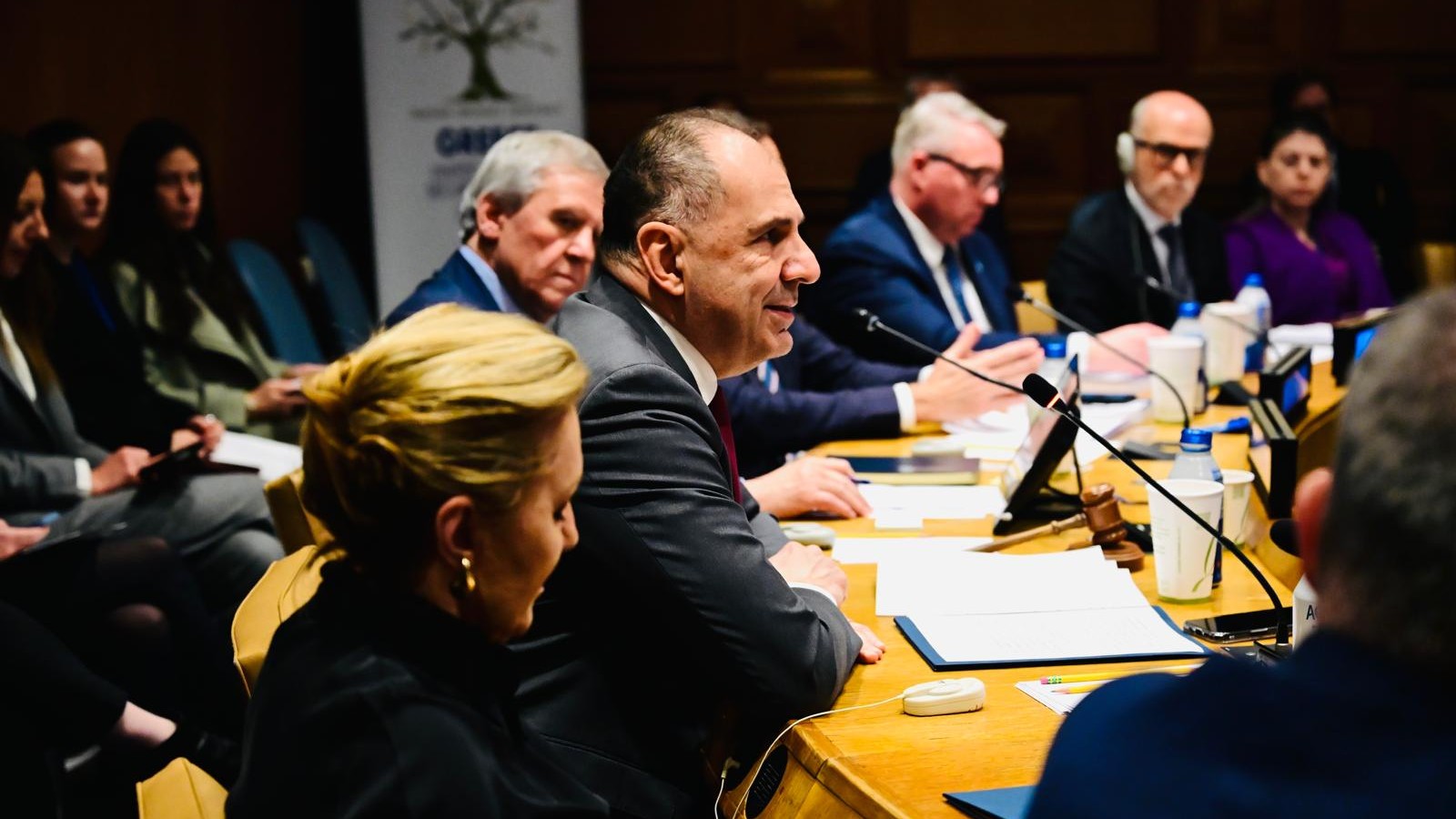
It is a great pleasure and a great honor to address you today at this Discussion on maritime security and the global economy. I would like to commend the Permanent Mission of Greece to the UN and the Delphi Economic Forum, especially Mr. Symeon Tsomokos, always present at major events.
For Greece, maritime security is an integral part of its national strategy.
Geography has shaped Greece's policy. Greece is a maritime nation by tradition, and today is the world’s leading ship-owning nation. The Greek-owned merchant fleet has been the cornerstone of global sea trade -accounting for more than 20% of the global fleet and over 61% of the EU fleet. Albeit the fact that Greece represents only 0.2% of the global GDP. Additionally, Greece seeks to leverage its geographical advantages strategically. Positioned at the crossroads of three continents, with thousands of islands and one of the longest coastlines in the world, it serves as a crucial connection hub, facilitating trade and supply to third countries for decades.
International Law and the Law of the Sea have been fundamental to our approach in foreign affairs. We emphasize the importance of ensuring maritime trade safely and upholding freedom of navigation in accordance with established rules and regulations. In this context, Greece has made Maritime Security a top priority during our tenure on the United Nations Security Council and seeks to have it given high priority within the United Nations.
Human welfare and stability are intertwined with free seas. In an increasingly unstable and rapidly changing geopolitical landscape, our world remains deeply interconnected, with the sea playing a crucial role. In fact, over 80% of international trade by volume is transported by sea, which impacts supply chains, food and energy security, and the prosperity of every single national economy.
But are seas free and secure?
Traditional and emerging threats pose significant risks to our ships, trade routes, connections, and ports. This is a global issue that affects all nations without exception; it impacts us all.
Various maritime threats, including piracy, terrorism, and other unlawful activities at sea, as well as drone attacks and hybrid threats, represent a serious danger to human lives, the environment, and safe international navigation.
To protect commercial shipping and ensure the uninterrupted flow of maritime trade routes in the Red Sea, Greece has taken a leading role in the EU Naval Operation "Aspides."
Additionally, Greece is actively participating in Operations "Atalanta" in the Indian Ocean and "Irini" in the Mediterranean. Not to mention the fraudulent activities related to the shadow fleet, which require coordination at the regional and international levels.
Ladies and gentlemen,
Addressing these threats necessitates collective action through several key frameworks.
First, within the United Nations, the International Maritime Organization, whose role in international rule-making and in promoting the safety and protection of the seas remains vital, and the European Union.
Stronger collaboration, secondly, between the shipping industry and the states. We should draw on the experience and know-how of the shipping industry, as fostering stronger synergy between the public and private sectors would add a new dynamic.
Thirdly, preemptive collective measures to mitigate or disable imminent threats, and law enforcement capacities to ensure strict adherence to a robust and effective rules-based maritime order that serves peace, security, and sustainable global prosperity.
Given the fluidity of the world order today, we must remain focused on three realities.
First, many fronts of tension, many active or frozen conflicts around the world – a difficult, complicated, puzzling situation.
Secondly, multilateralism, which is indeed under pressure nowadays.
Third, rules-based international order, which is also in retreat.
Therefore, in today's geopolitical transition, all like-minded countries must actively uphold the guiding principles and the values of international relations, while adopting a realistic approach to effectively tackle the emerging challenges we are faced with - what I call, a value realism.
Ladies and gentlemen,
First, I have to apologize that I have to leave after my opening statement due to strict time commitments. But I would like to just place emphasis on the fact that, in my capacity as Foreign Minister of the Hellenic Republic, and as a representative of an elected member state of the Security Council, I wish to reaffirm my country’s unwavering commitment to multilateralism and to International Law. This is of outmost importance. We need to reiterate it on every single occasion.
Greece firmly believes that the United Nations remain today a unique and indispensable forum for dialogue, coordination and cooperation among states and that it continues to serve as the central pillar of the rules-based international order, including on matters of maritime security and governance.
Peace is closely intertwined with free trade and the economic interdependence it generates. As early as 1795, probably the most prominent of modern philosophers, Immanuel Kant, in his treatise, Toward Perpetual Peace, argued that durable peace among states depends on three conditions — one of which was the facilitation of contacts and commerce among peoples, including the security of maritime routes. More than two centuries later, this insight remains profoundly relevant. Secure maritime trade is not only an economic imperative; it is a foundation for peace, cooperation and mutual understanding among nations.
Thank you so much for your attention.
January 30, 2026