


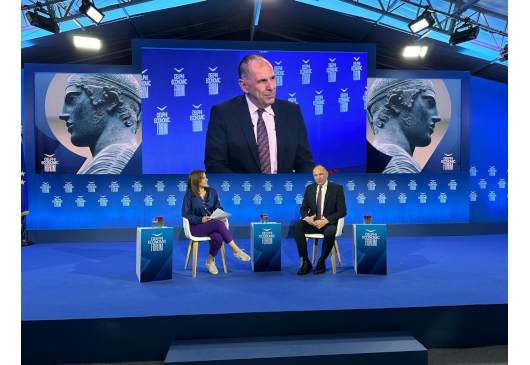
 JOURNALIST: We are meeting at a critical juncture. Upon entering, I visited the BBC website to see what is happening in the world. The lead story concerns Netanyahu’s consultations in Israel amid fears of a strike from Iran. If we didn't know this was real and saw it in a TV series, we'd think we were watching -I hate to say it but everything points that way when we speak of such conflict- the beginning of a global conflagration. I would like your initial comment on this, Minister.
G. GERAPETRITIS: I believe that reality now surpasses the imagination as regards events. The density of political time, the density of diplomatic time and of events is such that I believe it has exceeded all predictability, all imagination. Ultimately, Ms Lymperaki, what is crucial is that, at the moment, it is very difficult for anyone to predict events. You know, in the past, foreign policy, any policy, had one fundamental component, which had to do with the predictability of events. Whoever had a better understanding of what was to come was better prepared and thus, in a more advantageous position. Today, in my view, precisely because there is an asymmetry in events, a lack of predictability, as well as a supranational nature to events, a small conflict, a minor natural event occurring on the other side of the world, can have a direct impact on us. I believe our strategic thinking is no longer based on predicting events, but simply on addressing all hypothetical scenarios.
There are so many potential scenarios that it is extremely difficult to have a response for each and every one. I still remember, and it is always on my mind, that the scientists' prediction about the natural phenomenon in Thessaly, the Daniel disaster, is a case that technically occurs once every 400 years. We actually had two phenomena of almost similar scale in the same area, which condensed time. Likewise, an epidemic that historically emerges every thousand years — we have witnessed several in just a decade. You realize that these events are beyond the ability to predict. Preparedness has now become our primary concern.
JOURNALIST: I would like you to tell us more about the Middle East. Hopefully, we can revisit this topic towards the end of our meeting, as well as discuss Ukraine. I get the impression though that most people here share a heightened interest in our relationship with neighboring Türkiye. We are about a month away from the anticipated meeting of the Prime Minister with the Turkish President. One wonders, Minister, -quite reasonably in my view-, if, following a long period of calm in Greek-Turkish relations, the recent exchange of rather sharp statements by the two Foreign Ministries focusing on an environmental issue, the marine parks, could signify the onset of a return to tension. I am asking this because this exchange of statements comes after a poor electoral result for Erdogan.
G. GERAPETRITIS: I want to be clear. We are neither naive nor utopian to believe that we can resolve the problems we have with Türkiye, which go back decades, overnight. On the other hand, I believe that an important point in the good relationship we are trying to develop with Türkiye, is the understanding that the fundamental positions of the two sides are not going to change. And this was, after all, one of the explicitly stated points in the Athens Declaration of December 7th. We realize, however, how important it is to be able to defuse these tensions. The first thing I said when I took over the Ministry of Foreign Affairs was that I wanted the tensions that arise - you cannot avoid this in a relationship where geography has placed us so close yet so difficult - to not generate crises. And I would like to tell you that there have been many opportunities for tension over the last ten months. What is the difference compared to previous years? That these tensions were defused because there was swift management at the highest level.
JOURNALIST: Would you like to share with us an example of a situation that could have generated tension but was avoided?
G. GERAPETRITIS: The fact that there was a temporary suspension of the service in Panagia Soumela on the 15th of August, or issues related to the sea usage by fishermen. These are issues which, I want to reiterate, have occurred overtime and will most likely continue to arise in the future. What is the difference today? That instead of having a management approach that escalates tension, so that by the time we reach the top of the political pyramid, the tension generated is such that it does not deflate and could even lead to a possible rupture, management is done from the top down, that is, at the highest level, so that there is a quicker de-escalation. I believe at this level it is critical to have a direct line of communication to defuse tensions promptly. However, I want to say the following. I fully understand those who say that Türkiye will never change, that it remains an extremely unpredictable ally, a neighbor forever poised to create problems for us.
Allow me to emphasize this. We must all realize, and I believe that should be a common understanding, that it is critical to maintain calm in our region. If we accept the fact that there are countervailing positions on both sides, we can then achieve this mutual understanding. So, I reiterate, in my understanding of things, and under the instructions of the Prime Minister, over the last ten months, we have ensured that there has been zero activity on the ground, although the rhetoric may indeed fluctuate in some cases. But in reality…
JOURNALIST: A kind of sweet rhetoric?
G. GERAPETRITIS: This rhetoric is far from what we have seen in the past. I want to be clear. I want Greek citizens to feel confident about their country and feel a sense of calm and security. I want my children to live in a region where they will not have to keep their finger on the trigger. I will never engage in rhetoric that is disproportionate to the facts. It would be all too easy for me to use the position of Foreign Minister for personal gain. You know, in Greece, becoming popular on national issues may be the easiest thing to accomplish. I will not do that. What I want is to be primarily beneficial for my country, not popular, and that is what I will continue to do.
JOURNALIST: Ahead of this meeting - because after the meeting will come the time for assessments - I want to ask you a priori what results would render this meeting between Prime Minister Mitsotakis and Turkish President, Tayyip Erdogan, a successful one? What are the expectations we can reasonably have, and what result will make us speak of a successful meeting the day after?
G. GERAPETRITIS: First, I should point out that the fact that a meeting is taking place between the leaders of two neighboring countries should not necessarily be expected to produce a very specific and tangible outcome. In other words, every time we meet with a neighbouring country's leader, should we set a success bar? No. The answer is that we should, in my opinion, try, to some extent, to de-dramatize the meetings that take place between the Greek and Turkish delegations. They are leaders of neighboring countries, they ought, in my view, to discuss issues that arise and should engage in open and honest dialogue. Certainly, conclusions will be drawn at the end of the day, because, as you are aware, we have a broad, open, positive agenda. We have mutually beneficial measures that relate to migration, civil protection, trade, the economy. We have a wide range of exchanges and agreements. On the other hand, I reiterate, it is very important to communicate. I am a proponent of deliberative democracy. I want us to sit at the same table and discuss. When we do not talk, it is inevitable that we will worsen our position.
JOURNALIST: So, you're saying that the mere act of discussing is a success.
G. GERAPETRITIS: No. What I am saying is that we should not necessarily evaluate that a discussion must produce a result. Dialogue should be open and sincere. Just as the Greek Prime Minister discussed today with the Polish Prime Minister, he should discuss with the Turkish President, all the more so with the Turkish President because they are in our neighborhood. We should finally de-dramatize the issues with Türkiye. We know we have significant chapters open, most notably the delimitation of the Exclusive Economic Zone and the continental shelf. These are unlikely to be discussed and resolved at present. However, we know that the more we maintain open channels of communication, the less likely we are to find ourselves in a state of excessive tension, and hopefully this will not occur during our tenure.
JOURNALIST: You mentioned, Minister, that we have open issues, the most important of which are the EEZ and the continental shelf. Our longstanding position is that this is our sole difference, isn't it?
G. GERAPETRITIS: That’s right.
JOURNALIST: Nothing has changed regarding this, has it?
G. GERAPETRITIS: Certainly not. This is the only difference that can be brought before international jurisdiction, and that marks the end of the path. Of course, there are several other issues that we can discuss.
JOURNALIST: Are you optimistic that we will see an end to this in the coming years? I mean, in the immediate future.
G. GERAPETRITIS: What I can assure you is that I would like to see it. I am clear. I want to leave a legacy of a peaceful neighborhood. As long as the underlying problem of the delimitation remains unresolved, there will always be tensions. At some point anyway, we need to face things with courage. I know that this is not a pleasant discussion. It is a difficult discussion, which will likely have negative consequences for the person conducting the talks, which will probably be me.
JOURNALIST: What did you say?
G. GERAPETRITIS: That it will probably be me who will lead the discussion regarding the delimitation of maritime zones.
JOURNALIST: What does courage mean in this discussion, Minister? It is quite interesting that you mention it. What does it mean to face this matter courageously?
G. GERAPETRITIS: I think it is very clear. We should sit down with Türkiye and see how we can have a balanced stance, which based solely on International Law, can lead us to a resolution of this only problem we have concerning its legal nature. We should move forward and possibly refer to The Hague or Hamburg, to an international jurisdiction that can resolve the issue of delimitation. You know, referring to jurisdiction itself has an element of courage, because the outcome of international jurisdiction is always uncertain.
JOURNALIST: We could continue on this for much longer. However, in our brief discussion today, I do not want to leave out the rest of the issues with our neighbors. Let us turn to Albania, Minister, and the issue with Fredi Beleri, which caused significant tension. I will also put on the table all the speculation that has developed over the possibility of seeing Mr. Beleri on the New Democracy's European electoral list. Although I know I will not get an answer, we, journalists put issues on the table. However, I would like you to tell us if this has essentially impacted our relations with our neighbors, with Tirana.
G. GERAPETRITIS: You understand that you will not receive an answer about the European electoral list because this issue is above my pay grade. What I want to tell you is that our relations with Albania should remain good neighborly relations. The Fredi Beleri case was not bilateral. I stated this from the very beginning. I have conveyed it to our neighbors, I have conveyed it to international organizations. I believe it has now become a common understanding that the way the case of Fredi Beleri was handled is inconsistent with an advanced rule of law. For this reason, the issue is not bilateral, but European.
JOURNALIST: Is Greece satisfied with the way our partners handled it?
G. GERAPETRITIS: Based on the architecture of decision-making in the European Union, I believe that we can have a substantial say. However, I want to assure you that our fundamental position has not been overturned, both in terms of Albania and the entire Western Balkans. Greece advocated for the integration of the Western Balkans into the European family, 21 years ago with the Thessaloniki agenda and it continues to do so. We want to see Albania, as we want to see the other states of the Western Balkans, integrated into the European Union. And we will do everything in our power to make this happen. However, respect for the fundamentals, namely the rule of law, democracy, and the rights of minorities, is a condition that cannot be conceded.
JOURNALIST: You referred to the Balkans more broadly and I recalled a pending issue that remains and has to do with the Prespa Agreement and its accompanying protocols. Should we expect all this to move forward at some point?
G. GERAPETRITIS: Of course, it will progress when the political conditions allow it. And when I say political, I do not mean internal politics. You are aware of our stance as a party, both as an opposition in the past and today as a government. The Prespa Agreement is an international treaty. You well know what an international treaty means. International treaties, when signed, supersede any other law. They cannot be unilaterally modified and bind every government. Therefore, what we are obliged to do is to monitor the full implementation of the Prespa Agreement. And that is what we do. When there is a common understanding, a mutual understanding, and a real state of full compliance, the Memoranda will be submitted for ratification to the Hellenic Parliament.
JOURNALIST: So, you are saying that this delay so far has nothing to do with internal political reasons or intra-party balances.
G. GERAPETRITIS: Ms. Lymperaki, the delay is primarily due to the relationships developing beyond the Prespa Agreement.
JOURNALIST: Minister, we heard at the beginning of this year's Forum IX, Ukraine’s leader, Mr. Zelensky, emphasizing, I think quite dramatically, that this war cannot be won if support from the West ceases. We saw this in practice with the Prime Minister's very recent visit and his statements. Where does Greece stand? And do you ultimately believe, wherever we stand, that reluctance is gaining ground in the West?
G. GERAPETRITIS: I would like to emphasize the importance of support for Ukraine, which I believe is apparent. At this moment, the perception that prevails in part of the world - that what is happening in Ukraine is purely a European matter - is absolutely mistaken. In the case of Ukraine, we have a clear violation of International Law. A violent, blunt, cynical act. An act of raw revisionism. It is in the absolute interest of the West and in the interest of the international security architecture that Russia’s stance is not rewarded.
For this reason, both the European Union and the United Nations, but also bilaterally all member states, have supported Ukraine's effort. My view is that we are at a very critical juncture, and I say this in full knowledge of the facts, having discussed privately with my Ukrainian counterpart. What Ukraine currently requires is unified support from the West, from all the states that collectively constitute what we call the West.
And I want to tell you this: I understand the fatigue that may exist due to the prolonged operation that is currently underway in Ukraine. However, we must understand how closely connected today's events in Ukraine are to global peace and security. Having this understanding, I believe everyone could agree that we must continue to support Ukraine. And this support should be perceived as necessary for universal solidarity vis-à-vis those who defend International Law.
JOURNALIST: But is this happening lately? Or do you also perceive what I mentioned earlier, that indeed reluctance is gaining ground in the West, in Europe and the United States?
G. GERAPETRITIS: We understand that conditions always shape realities. The fact that this period, in 2024, about half of the planet's population in approximately 65 countries is going to the polls, creates a political condition that often alters the good understanding of events.
There are indeed some political considerations being made regarding Ukraine. There is fatigue. There is, of course, the issue of limited resources that can be granted. I insist and will continue to insist: the effort being made at the level of the European Union, at the level of NATO, at the level of the United Nations, must continue, because support for Ukraine is more than just support for an ally country. It represents support against violent revisionism.
JOURNALIST: You mentioned the polls. Among these 65 countries, the elections that, I believe hold the most interest - and some might say even invoke fear in the free world - are those that will take place in the leading power of the free world. Let me ask you succinctly, and please frame your response within the context of Greek-Turkish relations, the situation in Ukraine, or wherever else you deem appropriate. And what if Trump returns, Minister?
G. GERAPETRITIS: Democracy will speak, Ms. Lymperaki, if democracy...
JOURNALIST: That's what I'm saying. If democracy speaks and says Trump.
G. GERAPETRITIS: Then Trump it is. The reality is that democracy is a regime that is inherently imperfect, but it is the most perfect one that exists.
JOURNALIST: That is exactly the same thing Mr. Pikrammenos told me earlier.
G. GERAPETRITIS: Look, I want to be honest. I do not anticipate that there will be a significant difference from the outcome of the US elections.
JOURNALIST: Not even in regards to Ukraine or Greek-Turkish relations? We recall that Erdogan enjoyed privileged access during Trump’s presidency, didn’t he?
G. GERAPETRITIS: Allow me to tell you that our current relations with the United States are neither circumstantial, nor are they personalized. Our relations are profound and substantial, governed by rules and principles. And it is my firm belief that they will continue as such. I am confident that the level of international capital we have acquired in recent years will continue to exist both with the United States and with all the countries we converse with. And they are not few.
JOURNALIST: Minister, one last thing. Let us conclude from where we began: the Middle East. Most people would agree that in recent months there has been a shift in international public opinion and the international community, both in terms of rhetoric and in terms of criticism. We have shifted from unconditional support for Israel following the October massacre by Hamas, to criticism exercised for the scope of the military operations and for alleged violations of international rules. Where does Greece stand on this?
G. GERAPETRITIS: Greece, today, April 12, 2024, stands exactly where it stood on October 7, 2023. And for this reason, it can converse with terms of prudence, honesty, and consistency towards everyone. Because as we speak, there are not many countries that have managed to converse with both Israelis and Palestinians, while simultaneously being regarded as reliable partners by both. But at the same time, we converse with all major partners in the Middle East, in the world, in the United States.
So, Greece stands where International Law stands. What is that? Yes, Israel has the right to self-defense within the limits set by International Law and especially Humanitarian Law. Yes, we must differentiate the Palestinian people from Hamas. Yes, the Palestinians should be given a vision. And this vision is none other than the implementation of the Security Council resolutions, based on which there must be a Palestinian state within the pre-1967 borders with East Jerusalem as its capital.
Allow me to emphasize that Greece’s foreign policy will never become transactional. Its great asset is its consistency. Based on the international capital of consistency and self-confidence we possess, we will continue to play a pivotal role, both in terms of the cessation of hostilities – we are actively involved in these discussions -, and in terms of humanitarian aid and the architecture of the next day for the Middle East.
JOURNALIST: I confess that I would like to ask you a lot more questions. Time is relentless. Minister, thank you very much.
April 12, 2024