


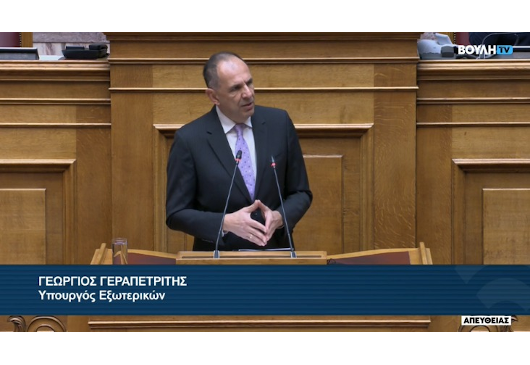
 Thank you very much, Mr. Speaker,
Ladies and Gentlemen Members of Parliament,
We are experiencing an era of multiple crises. A crisis of aggression and revisionism, food crisis, climate change, migration, public health. These crises have two main characteristics. The first is that they are supranational in nature, which means they are not confined to one country or region. Second, and arguably more significant, is that they dismantle the certainties upon which the post-war security architecture has been founded.
In the face of these crises, I believe it is crucial to pursue a foreign policy based on concrete principles, a policy that should be defined by diplomacy founded on principles. A foreign policy that is by no means conjunctural or opportunistic, but rather one that is meticulously and vigorously grounded in International Law, intergenerational justice, solidarity, democracy, and dialogue. A foreign policy that is proactive, outward-looking. It is significant indeed that since 2019, this active foreign policy has created a substantial diplomatic capital for the country, allowing Greece to convey its positions both bilaterally and in international fora.
Of course, a foreign policy that is multifaceted, relying not only on traditional forms but also on other types of diplomacy, most notably soft power and public diplomacy. However, the most important aspect is that these principles are consistent, applied in the same way in all circumstances. And this is our fundamental stance, our core policy: to be reliable and able to have significant diplomatic capital at all levels of crises, whether they concern the Middle East, the South Caucasus, or Ukraine. In every crisis, Greek foreign policy retains the exact same characteristics.
In the case of the Middle East, Greece took a principled stance from the outset. We adopted five positions including the condemnation of any form of aggression, the protection of civilians, the creation of humanitarian corridors, the release of hostages, and of course, the convening of an international conference to resolve the Palestinian issue on the basis of the United Nations Security Council resolutions for two states based on the 1967 territorial borders, with East Jerusalem as Palestine’s capital.
We followed the same principles regarding Ukraine. It is important that from the beginning, both as a country and within the framework of international organizations, we stood by the side, which was against revisionism and aggression. We remain committed to this stance and certainly welcome the European Council’s decision this week to launch negotiations with Ukraine for EU membership. Its European path, as well as that of Moldova, lead to the European Union.
The same applies with respect to the Western Balkans. It was Greece that advocated for the EU’s enlargement towards the Western Balkans twenty years ago in Thessaloniki and that continues to play a leading role. In this regard, it is important that we provide political guidance for security, prosperity, and, most importantly, perspective to the people of the Western Balkans in order for them to join the European family based on the principles and values of the European Union. Specifically, regarding Albania, the Fredi Beleri case continues to be an obstacle to its European course. I would like to emphasize that it is not a bilateral issue, but it is an issue that pertains to the Rule of Law, the protection of political rights, and the international protection of minorities.
In any case, it is clear that Albania's path towards European integration hinges on Fredi Beleri assuming his duties, which ensures the implementation of the European acquis and aligns with the political will of the citizens of Himarë.
Within the framework of our principled foreign policy, we continue to support the resolution of the Cyprus issue on the basis of the Security Council’s resolutions as a fundamental principle of ours. My visit to Nicosia was the first I made. We are in full coordination with the government of Cyprus. We are convinced that direct dialogue needs to be relaunched, especially from where it left off and that a solution based on the Security Council's resolutions should be found. Cyprus always represents a fundamental value of our foreign policy.
I will shortly have the opportunity to speak in detail about Türkiye. We have already scheduled a discussion within the Committee on Defense and Foreign Affairs next week, where we will have the opportunity to analyze both the issues related to the High-Level Cooperation Council and Greek-Turkish relations in general.
What I want to emphasize is that there should indeed be a good neighborly relationship with Türkiye, as well as with all our neighbors.
A relationship that will be based on International Law. It is obvious that there are specific parameters in this discussion that are inviolable. Issues of sovereignty are not included in the dialogue with Türkiye. And, of course, the sincerity of both parties must always be reflected so that we can proceed step by step on these issues. I believe it is a common understanding that we need to move forward in a climate of detente, perpetuating the climate of peace currently prevailing in our neighborhood without resorting to aggressive rhetoric. In my view, the historic Declaration on Friendly Relations and Good Neighborliness as well as the 15 agreements, memoranda, and joint statements signed in Athens during the High-Level Council mark precisely the beginning of a new era in Greek-Turkish relations. We shall advance our relationship with our neighbor step by step.
I would briefly like to touch upon the pillars of our foreign policy, starting with the issue of economic diplomacy and extroversion. Under Deputy Minister Mr. Fragogiannis, we have taken significant steps in promoting the commercial interests of Greek enterprises abroad, as well as the presence of Greek products in international markets.
I would like to point out that Greek exports have now reached the European Union average, which demonstrates the resilience and competitiveness of the Greek economy.
We all realize how significant it is that direct foreign investments have already increased by 50% in 2022 compared to previous year and by 80% compared to the pre-Covid era, reaching historic highs. And, of course, we estimate that in 2023 we will be six times above the European average with considerably greater flow and momentum, as we recover our assets including our recently granted investment grade rating, and certainly the resources from the Recovery and Resilience Fund.
I would like to emphasize that the coming period is particularly critical, as regards our economic diplomacy. Our priority is always extroversion, with a focus on major countries and markets.
We have already developed a specific plan in relation to India and the India-Middle East-Europe Economic Corridor, which will pass through Greece. The fifth round of strategic dialogue with the United States will take place in the first months of next year. At this point, I would like to emphasize the importance of our country's energy policy.
Greece has emerged as a pivotal energy hub in recent years. We have bolstered our energy security by weaning ourselves off natural gas following the war in Ukraine, while also assisting our neighbors with supplies of both natural gas and electricity. We have achieved independence through TAP and Azerbaijan. We have significantly assisted Bulgaria with natural gas supplies. As soon as the flow from Russia stopped, we launched the IGB pipeline. We are sending gas to Moldova and developing the Floating Storage Regasification Unit (FSRU) in Alexandroupoli. We are building a pipeline to North Macedonia, expanding the TAP and IGB pipelines. In the electricity sector, we have established a new interconnection with Bulgaria and we are exploring the extension of this network to Italy as well as constructing a new line to Türkiye. Through these initiatives, we are redrawing the energy map of the region, placing Greece at its core.
Regarding public diplomacy and the Diaspora under Deputy Minister Mr. Kotsiras, I would like to underscore that especially for Greeks living abroad, we have established a special section on gov.gr, where all the digital tools allow them to come as close to Greece as possible. Moreover, by virtue of the digital transformation of consular services project, all consular services will mainly be provided digitally. It is now functioning in testing mode but will be operational on a regular basis from the beginning of next year. During the next Ministerial Council, we will put forward a Strategic Plan for the Greek Diaspora, spanning from 2024 to 2027, which will be based on the institutions of the Greek diaspora. Its primary objectives will be promoting the Greek language, attracting young Diaspora Greeks, combating brain drain, improving services, and simultaneously implementing a strategic plan for public diplomacy.
I would like to take a moment to emphasize the significance of extroversion and Greece's representation in international organizations. Currently, our candidacy for a non-permanent seat on the United Nations Security Council for the 2025-2026 term figures prominently in this respect, supported by our methodical efforts in recent years. At this moment, we can say that we have secured the necessary support for election, and we are actively working to broaden it as much as possible.
Our candidacy for the Human Rights Council for the 2028-2030 term holds great significance as well. We all realize the importance of this Council and it will be the first time that Greece will participate. Additionally, our candidacy for the presidency of the UN General Assembly in 2035 is underway.
I must also say that Greece has achieved all its objectives regarding international organizations. Thus, just a week ago, Greece attained the top position in category A at the International Maritime Organization (IMO), following a coordinated effort with the Ministry of Shipping. Also, in November 2023, Greece was unanimously elected to UNESCO’s Committee for the Return of Cultural Property. We all realize the importance of this Committee. Looking ahead, in April 2024, we will host the “Our Ocean Conference”, an event of significant importance for climate change and marine biodiversity.
At the same time, we are striving to strengthen the Ministry of Foreign Affairs in terms of infrastructure. We are already moving towards the energy upgrading of our buildings within the framework of the “Electra” project. That includes enhancing the electronic infrastructure of the Central Service with 1,000 new technology items, upgrading electronic correspondence through the Recovery Fund, and of course, digitalizing the Historical and Diplomatic Archive.
Please allow me to conclude with a personal remark. In my view, foreign policy cannot be conducted on the basis of intuition, political expediency, or oversimplified verbalism. Foreign policy requires a profound knowledge of history, institutions, and international relations.
Before entering politics and accepting the honorable position of Greece's Foreign Minister, I taught international history of political and constitutional institutions at the university for nearly twenty years. And yet, I can never say that I feel secure about what is happening in the world. I rely primarily on the excellent staff of the Ministry of Foreign Affairs and on my daily study to be able to fulfill my duties. History will judge us all and will do so based on the prudence and courage we demonstrate.
However, courage is not about saying pleasant things, but about doing what is beneficial for the country.
Thank you very much, Mr. Speaker.
(...)
December 17, 2023