


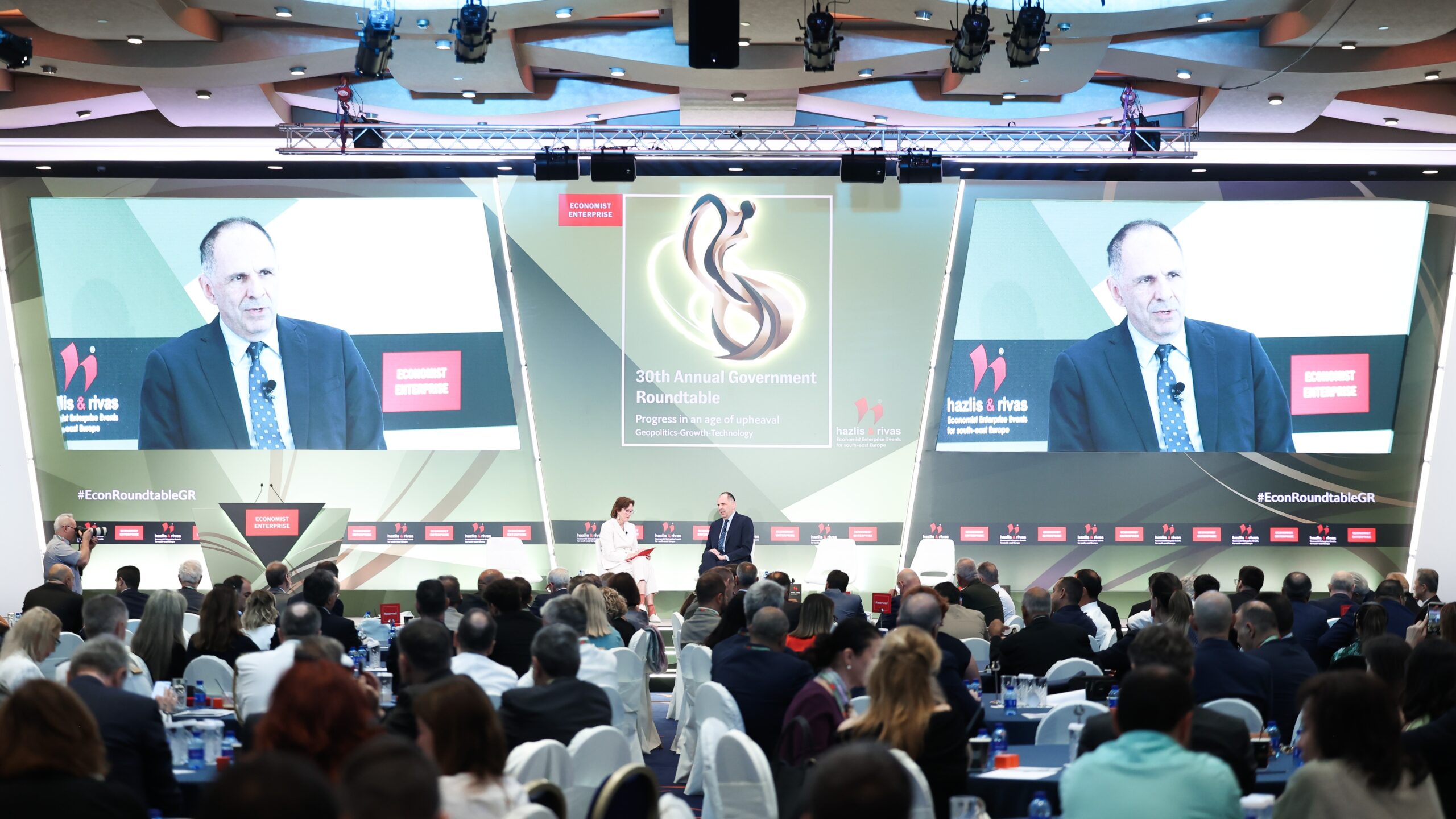
J. HOEY: We are going to continue our foreign policy geopolitical focus now with a particular focus on the foreign policy agenda of Greece. So, please join me in welcoming the Minister of Foreign Affairs of Greece, George Gerapetritis. Welcome.
G. GERAPETRITIS: Thank you.
J. HOEY: Thanks very much for being with us this morning, Minister. Μay I start off by asking you just to outline the key questions on the foreign policy agenda of Greece as you see them right now?
G. GERAPETRITIS: It could take hours, though. The agenda is huge. First of all, I would like to thank “The Economist” for this very honorable invitation. It is wonderful to be here and to celebrate the 30th Roundtable. And I was especially happy because of the theme of this year concerning growth in times of upheaval, concerning also technology. I think it is important, first of all, to determine why the upheaval in the current situation, and I think it's very prudent to say that nowadays we have something that we haven't encountered in the past at all. We have at the same time, I think, three phenomena which are unique simultaneously.
And that is, we have a geopolitical realignment, we have a new industrial revolution, and we have a complete change in the way people communicate with each other. When it comes to geopolitical realignment, I think the most important aspect is the retreat of International Law and multilateralism. You can see that there are middle powers emerging. And traditional tools and organizations essentially setting the agenda for international security architecture are now having a backstage role, such as the United Nations or even the European Union. The issue of industrial revolution is closely related to artificial intelligence.
I think we just see a tectonic change in the way we perceive things. And artificial intelligence is going to exercise a huge influence, not only upon the relationship between people, but also the relationship between states and the balance of power, and the regional dynamics. So, I think this is truly a significant change in the mindset of people and diplomats. And thirdly, we have a significant change in the way we communicate with each other. I think the explosion of social media has made a tremendous impact, not only on the way that we circulate information, but also concerning the way we think about the news. The truth is that now speed essentially overcomes the need for integrity in information, and that essentially determines the state of information altogether. Now, this is the upheaval, and this is why I think the job of the Foreign Minister of a country is not an easy job, to put it very mildly. But, I think every Foreign Minister and every state has to make a preliminary choice which is, I think, a very critical one. And this is to employ the way we exercise diplomacy.
I think there are two ways to conceive diplomacy today. Either you stick to the traditional tools of diplomacy, including International Law, integrity, the conventional international security architecture, as it was presented after World War II, and especially the principles and rules enshrined in the UN Charter, in which case what you try to do is to be consistent and to apply the principles to their full effect. Or you employ a more transactional approach, which means that you are trying to benefit from the situations in the international arena by benefiting from upheavals.
And you know, the main difference, I think, Joan, is that in the latter case, what you do as a diplomat is essentially to try and manage double standards, because if you stick by the rules, the standards are single. You are devoted to them and there are no deviations whatsoever from them. When you are transactional, you just develop the art of double standards to try to explain why cases which are almost identical should be treated in a different way. And I think that type of transactional diplomacy is very dangerous for the globe altogether because it leads essentially to a “global jungle” when it comes to security architecture. For us in Greece, we have been very persistent in our policy, very consistent.
We have the integrity to be able to say that we have a foreign policy which is akin to International Law. We keep on saying that this is something which is existential for Greece, because Greece is a country which is located geographically in a very volatile region. We are at the crossroads of three continents. We have huge historical burdens in this part of the world. So, sticking by the principles of International Law, for us, is non-negotiable.
And I have to say this because everybody will understand when we speak about international rules, principles, and security architecture, there can be no cherry-picking process. Either we take it as a whole or there is no International Law whatsoever. So, we're going to fight. We have a major role to perform. Greece has been the bridge of many countries, many civilizations, many geopolitical fora. We discuss at the same time with Israel as a strategic partner, but at the same time with the whole of the Arab world. We're part of very strong international alliances such as the European Union, NATO. We're a non-permanent member of the Security Council. We have a very strong voice and we are going to apply this not only for the benefit of my country, but also for the benefit of the globe.
J. HOEY: Excellent. Well, thank you very much for that. I don't think I could have asked for a better summary of the relationship between geopolitics and some of the major themes that we're discussing over these 3 days. Yeah. And thanks for the emphasis on the foreign policy being grounded in consistency and principles. And I guess what we want to do now is dig into, you know, some of the issues and maybe to start local and then broaden out the discussion. We've been talking already this morning about the importance of keeping channels of communication open and channels of diplomacy. So, may I ask you to give us an update on the high-level dialogue between Greece and Türkiye? What's your assessment or how that's been going? And are we likely to see expanding areas of dialogue and cooperation?
G. GERAPETRITIS: Three years ago we started a different type of dialogue with Türkiye. We work on a structural dialogue which is founded on three pillars: the Positive Agenda concerning bilateral agreements, especially trade, the Political Dialogue which addresses issues of political significance such as migration or civil protection, and Confidence Building Measures, essentially concerning military exercises and military cooperation in order to ease any potential crisis. If I have to make an assessment, I would say that the results are positive. And they are positive not only because we have some very tangible results to present, such as the significant decrease in migration, or the significant decrease in violations of Greek airspace, or the increase in bilateral trade, but mostly because there is a different mindset in approaching this rapprochement. And we do believe firmly that open channels may be very critical in order to prevent potential tensions. We have seen in the past that small incidents may easily result in huge crises. And as I mentioned, the fact that this geographic region is very volatile, I think essentially entails that we be more deliberative on things and to try to keep up channels of communication on many layers.
Now, on the other hand, the truth is that there is an outstanding issue of huge importance for us, and this is the delimitation of maritime zones, and in particular of continental shelf and Exclusive Economic Zone. This is particularly important in the sense that this is the only difference that can essentially go to international adjudication, but also because the lack of delimitation essentially reproduces tensions in the Aegean Sea and in the Eastern Mediterranean. To be totally frank and honest with you, I think that in order to have long-term peace and tranquility in our region, it is absolutely essential to enter into a discussion about those issues. Up until now, we have not made it. We have not agreed on the scope of this discussion. We are hoping that at some point in the near future we will be able to open this chapter. We do realize that there are divergent opinions about this and there are opposing views, but we still believe that through full implementation of International Law, we can find a sustainable solution. I think it's important to actually discuss difficult themes. Obviously, the understanding is that we do remain in our fundamental positions, we wouldn't expect from one day to another to actually withdraw legal positions that go back decades.
The truth is, nevertheless, that in spite of all those different posisitions, we have managed to have a constructive dialogue and to develop our relationship. Now, if you ask me whether I am optimistic that we can take another step and discuss about the delimitation of maritime zones, I think that we are not there yet. But I am very hopeful that at some point we will be able to actually enter into this discussion. I think this is going to be a tremendous legacy for future generations: a region of peace and prosperity.
J. HOEY: Okay, thank you. Well, that's encouraging. I mean, I was going to ask you whether you think there is a realistic pathway towards - I wouldn't want to say resolution - I kind of don't like to use that word “resolving”, when we're talking about very difficult and longstanding disputes, but a realistic pathway, as you say, to pursuing the dialogue beyond the very important topics that have already…
G. GERAPETRITIS: Realism is a very dynamic notion, as you know. And, to be honest, I think, on some occasion, we need to address realism on a principled manner. I understand that now there is a huge discussion whether we should rely mostly on power, which is totally inconsistent with a rules-based order. But the truth is that realism can be quite dangerous at points. What we need is a principled discussion based on international law.
J. HOEY: Well, thank you for that. So, Greece has the Presidency of the Council of the EU in the second half of 2027. I know a core priority for the Greek Presidency is to advance the integration of the Western Balkans. We had a discussion - very interesting discussion - yesterday on this question. Because there is still a tremendous deadlock, it seems there. So, do you already have any concrete proposals in mind or initiatives in mind?
G. GERAPETRITIS: The truth is that I have a whole master plan that I'm not going to reveal today. The Ambassadors from the Western Balkans being present here would know about it. The truth is that I have taken an initiative to actually promote the acceleration of the process concerning the enlargement, in particular the accession process of the Western Balkans. I think it is of utmost importance for a variety of reasons. First, because the Western Balkans is a very difficult region. It is a region where history has been very traumatic, so we need to be very cautious and to be able to accommodate the particular needs of the region. The second ground is that we encounter a very high level of foreign interference in the Western Balkans, and this could be detrimental for the accession process of the Western Balkans, let alone the fact of potential instability of the region. And when I'm talking about foreign interference, I am speaking in particular about malign influence exercised in the Western Balkans. And we can see now that nationalism is rising again in the Western Balkans. We need to prevent this from happening. It is absolutely critical. I would dare say that it is one of the milestones of the European Union to actually embrace the Western Balkans, to be able to bring them into the European family.
Within the next few months, we are going to take some further steps on this - in this respect. And we hope that by the time we take on the presidency of the Council of the EU, we will be able to actually welcome another state within our family coming from the Western Balkans. In any case, it is important to emphasize that the Western Balkans should not be left behind.
J. HOEY: Thank you. Let's move on and talk about what has been happening over the past 24 - 48 hours, very close to this region, in the Middle East. What is your response to the latest developments, is it an effective resumption of the war? And what are the repercussions and risks for Greece?
G. GERAPETRITIS: Repercussions for Greece and for the globe, I am afraid. The truth is that the glimpse of hope which was produced after the memorandum between the United States and Iran is kind of shaky at the moment because of the attacks that we see. We will try very hard, both in our capacity as honest interlocutor with all parties, but also as a non-permanent member of the Security Council, to advance the peace process.
I have to tell you that the war in Iran had a very negative, a very adverse effect, which was that the Iranians realized the importance of controlling the Strait of Hormuz, and that was a very tough realization for everyone, including the Gulf countries, which are landlocked, but also countries with a strong merchant fleet like Greece. But the truth is that at this moment we cannot but emphasize that there can be no other solution apart from total freedom of navigation, unrestricted freedom of navigation, no tolling, no fees. This is very critical, not only because of the global trade, but also for food security in the globe. It is important for the balance of the global system of security. So, for us, there is no way to concede from our fundamental principles.
I have to tell you that I am in discussions all day the last couple of days with our allies in the region. There is a relative optimism that we can overcome the problems that we have seen in the last 40 hours, but it will take some strong work to do this.
J. HOEY: Thanks. I know you're pressed for time, if I can ask you some quick questions.
G. GERAPETRITIS: Thank you so much for not asking about NATO.
J. HOEY: Oh, well, I am getting there. Well, just to say, Greece-US relations are better than ever, transatlantic relations, there are more frictions there. President Trump, I saw in his press conference said he was “feeling the love” in the room. But there obviously are still frictions, maybe less so on defense now, but on trade, on digital, and so on. So how do you see things? Are things looking up, do you think, after Ankara?
G. GERAPETRITIS: To be honest, I think “love” is slightly an overstatement. However, I think that there was a very collegiate spirit and there was a very frank and open discussion among the leaders, and it is very important to address our issues and not try to hide them. The truth is that at the moment we see a very painful realignment, a reshuffling when it comes to burden sharing within the Alliance. I think with the new American Administration, we Europeans realized the importance of being more autonomous when it comes to defending our territory. The truth is that for many decades we had an overreliance on the United States security provision. So, I think it is important to try and increase our defense capabilities. I think that the transatlantic relationship is very critical for the balance of power in the globe. I think that we need to insist. There is obviously some turmoil when it comes to this relationship, but I am very confident that this relationship will go further.
NATO has been undoubtedly the most successful defense alliance in the world. I think it still has a role to perform and Greece will be there to be constructive and productive. The Greek-American relationship is now at its peak We have very strong channels of communication. We have a Greek diaspora, which is increasing its dynamic presence in the United States. So, I think that, in spite of some problems concerning the basic understanding of the international landscape, I think that the transatlantic relationship, again, will be the basis for the international security architecture in the future.
J. HOEY: Thank you. And just to widen the lens with the last question, I wanted to ask you about IMEC, the India - Middle East - Europe Economic Corridor, which was announced by world leaders at the G20 Summit in New Delhi in 2023. And I ask about this because it is an initiative of quite significant geo-economic and geo-political importance. It brings together a very unusual group of actors, from India to Saudi Arabia, to the UAE, to Israel and of course the EU, and Greece is, you know, at the heart of this as well. So, I just want to ask you how much of a priority is IMEC for Greece and what are the obstacles to implementation?
G. GERAPETRITIS: This is a super top priority for us for many reasons. The first is that we realize the need to actually develop differentiated routes of trade. The war in Iran demonstrated that overreliance on specific waterways could be detrimental for global trade. So, definitely we need to develop alternative trade routes. We need to emphasize, however, that the IMEC project is not only about trade, but it's also about communication and it's about bringing peoples together. I think that it's much more than a trade project, it's a peace project. So, for us, it's very, very critical. Secondly, I think Greece is probably the only country which talks to all actors involved in the project. We have a strategic alliance with India, and we also have strategic relationships with all the Gulf countries. We do have the relationship that you know with Israel, plus, we have an excellent relationship with the United States. And on top of this, I would say that Greece, being the gateway to Europe, is also the natural gateway for IMEC, not only because we have our ports, which are very suitable in order to fulfil the IMEC ambitions, but also because we have a merchant fleet which is the best and richest in the world.
So, I think for Greece it is a very critical project but I think that also Greece is very important for this project. We are having a series of conferences about this. We're working hard with our colleagues in order to develop the project. Obviously, there are problems. At the moment, there is a lack of confidence among some of the actors. We do realize that the regional tensions are not contributing positively. But I think that, at the end of the day, this is clearly a win-win project, and I think this will change the way we perceive connectivity, because connectivity is going to be the major issue for the decades to come, and we need to work well in advance in order to have a whole scheme in place.
J. HOEY: Well, Minister, thank you very much. I’m afraid that’s all we have got time for. Please join me in thanking the Minister.
G. GERAPETRITIS: Thank you.
July 9, 2026