


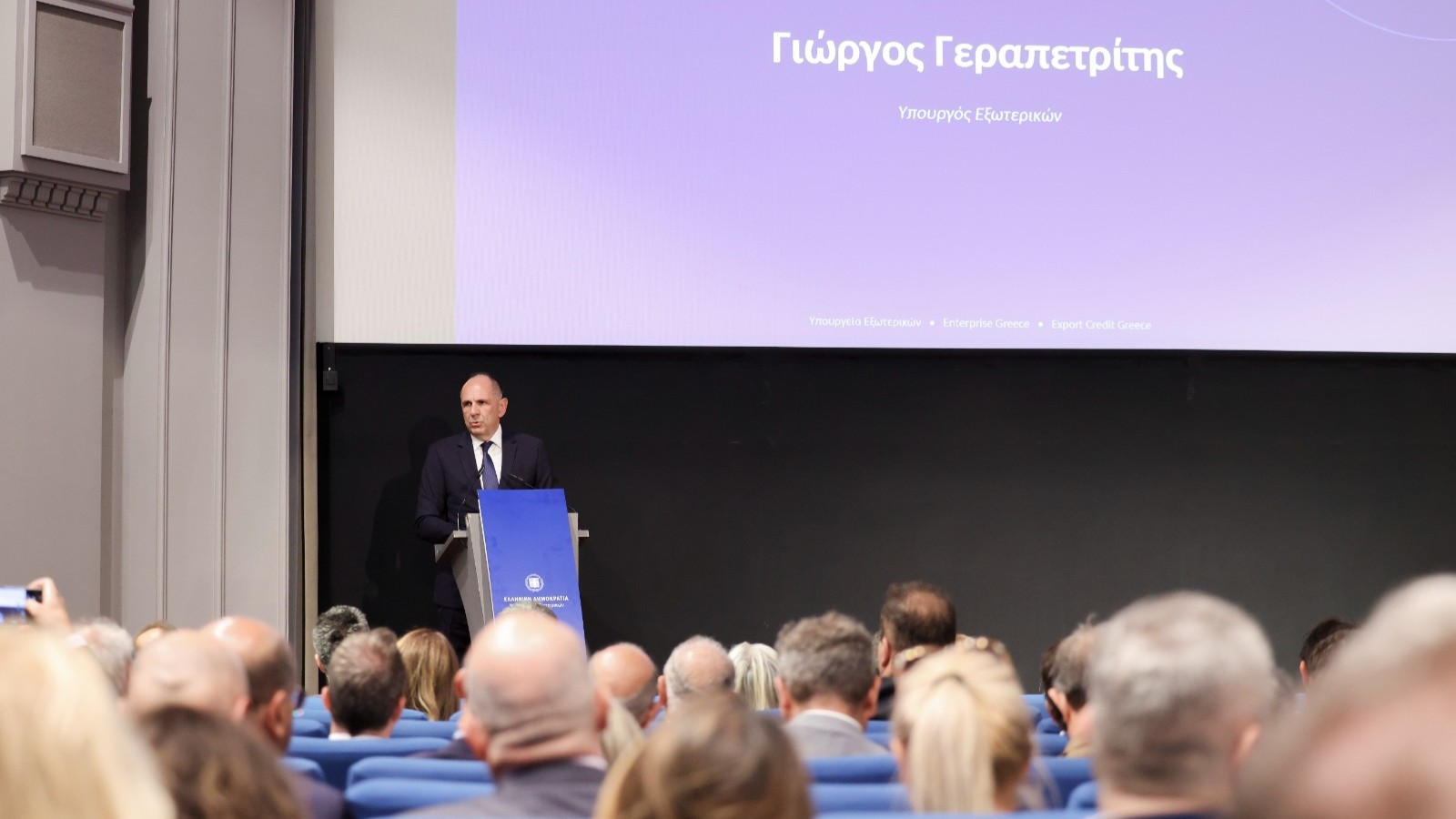
Dear friends, distinguished guests,
It is a great pleasure and honour to be here today, first and foremost to be in Thessaloniki, and secondly to have the opportunity to speak about the international outlook of the Greek economy. Anyone who does not have a broad, profound vision for our country may find it difficult to appreciate how the international outlook of the Greek economy relates to diplomacy and Greece’s geopolitical footprint.
The reality is that, in the complex times we are experiencing, the international outlook of an economy is not simply one component of a successful foreign policy. It is a key pillar. Because an outward-looking economy is one that does not turn inwards or confines itself to the domestic market, but instead looks to the wider world. Such an outlook does not merely reflect the values of economic globalisation; on the contrary, it is an instrument for strengthening social cohesion, reducing inequalities, fostering growth, and creating numerous and high-quality jobs.
We have been experiencing in recent years, on the international stage, a veritable geopolitical upheaval. We are facing global crises of an unprecedented nature, wars in our immediate neighbourhood, and immense social upheaval across large regions, such as Africa. Above all, we are witnessing a fundamental shift in the way the global economy operates. The rise of China; tariffs, which have recently emerged as an instrument of interventionist economic policy; the logic of unrestrained competition; energy dependence, as indeed any form of dependence. All these are driving a fundamental change in the global economic paradigm. An economy that looks inwards is an economy destined, sooner or later, to enter a state of absolute contraction.
As regards Greek foreign policy, from the very first day that I had the honour of assuming the leadership of the Ministry of Foreign Affairs three years ago, the Prime Minister’s direction was clear: to strengthen, by every means available, economic diplomacy and the international economic engagement of Greek foreign policy. The reality is that, in today’s emerging world, there can be no effective diplomacy unless it is underpinned by a strong economy. My colleagues at the Ministry of Foreign Affairs, Deputy Minister Mr Theoharis and Secretary General Mr Skalkos, have, I believe, fully embraced the Prime Minister’s instructions concerning the need for a strong and dynamic presence abroad.
A few months ago, we presented the National Strategy for Extroversion, which sets out a highly specific plan, with clearly defined objectives, instruments and target countries, reflecting Greece’s ambition to become a key pillar of influence in the world. This is precisely what we are implementing under the Prime Minister’s guidelines.
Today, Greece is organising an increasing number of business missions around the world, both to countries of particular importance to Greek foreign policy, such as Libya, and to emerging economies, such as Iraq, as well as to mature economies in which Greece must also have a voice and a presence.
Greek entrepreneurship possesses all the means and credentials required to assume a leading role in today’s emerging world. Given the challenges before us, it could hardly be otherwise. In this context, I believe that the efforts of the Greek Ministry of Foreign Affairs, in cooperation with all Greek ministries and under the guidance of the Government Council for Economic Policy, have already yielded positive results. In the first half of 2026 alone, exports increased by approximately 15%, while the trade deficit declined by around 4%.
And these figures are constantly improving. This goes hand in hand with Greece’s significantly enhanced geopolitical footprint. Greece today has more alliances, stronger and more dynamic alliances than it has ever had. It has alliances that span the globe. At the same time, we may have strategic relationships with countries which, amongst themselves, may not be cooperating sufficiently. Above all, however, we have realised that there can be no national foreign policy strategy without a strong, outward-looking economy, and a resilient defence.
Resilience is the modern, measurable and defining factor associated with a country’s international economic outlook, because resilience ultimately determines its macroeconomic strength. We need only consider where the dependencies of recent decades have led us, whether in the field of energy or defence. They led to a Europe that was less competitive, dependent on Russia for energy and dependent on the United States for its defence. Today, through a rather painful process, we are coming to realise that the new era is not an era of dependence, but an era of resilience through diversification.
This is precisely what Greek foreign policy aims to achieve through international economic engagement and economic diplomacy. In this regard, Thessaloniki and Northern Greece have an exceptionally dynamic role to play. Thessaloniki and Northern Greece as a whole are not merely situated at a geographical crossroads for the Balkans and South-Eastern Europe. At the same time, they possess a number of positive factors which are leading to Thessaloniki’s emergence as a hub for the wider region. Alexandroupoli has become the major energy hub of South-Eastern Europe, through the Vertical Corridor and the FSRU, which is already operational and has made a decisive contribution to the country’s energy diversification. Northern Greece has also become a transport and logistics hub for the Balkans, a region to which we have attached particular importance.
A few months ago, through the signing of a relevant agreement with the six Western Balkan states, Greece reaffirmed its role as a driving force behind their accession process towards the European Union. This path towards the European family must also be accompanied by a serious, extensive and dynamic presence of Greek businesses, many of which are based in Northern Greece. Through this economic presence, we can strengthen our influence and our voice in these countries.
The truth is that a state’s economic presence in its wider region is of immense importance, particularly today, when we are witnessing significant interventions by foreign powers in key countries. Hybrid threats, economic threats, economic penetration and the exploitation of countries’ strategic resources, sometimes through the vehicle of the defence industry, constitute major risks in our immediate neighbourhood. What we must do, for our part, is mobilise healthy and dynamic Greek entrepreneurship so that, through it, we can enhance our national footprint and strengthen our country’s position.
And because Greece is performing well at the broader geopolitical level - in just a few days, we will assume the Presidency of the United Nations Security Council, and in less than a year the Presidency of the Council of the European Union - this must be accompanied, and will be accompanied, by much stronger incentives for the Greek business community. Our aim is to enable Greek businesses to become genuinely more outward-looking and, in doing so, to strengthen Greece’s position in the world economically, diplomatically, geopolitically, and in terms of defence. Because Greece must be present everywhere. It must have a strong presence in the countries of our immediate neighbourhood and beyond. And the Greek State will do everything in its power to ensure that this becomes a reality.
I would like to thank the two organisations under the supervision of the Ministry of Foreign Affairs, namely Enterprise Greece and Export Credit Greece, which work to promote the strongest possible international presence of Greek businesses. We also have the honour of having with us today the political figure behind the establishment of Enterprise Greece, Mr Mitarakis, who, approximately thirteen or fourteen years ago, had the vision and foresight to establish this organisation. The institutional tools are in place. I call upon the business community, particularly that of Northern Greece, to make full use of the incentives we provide and of the opportunities available today, so that together we can make Greece stronger throughout the world.
Thank you very much.
September 5, 2026