


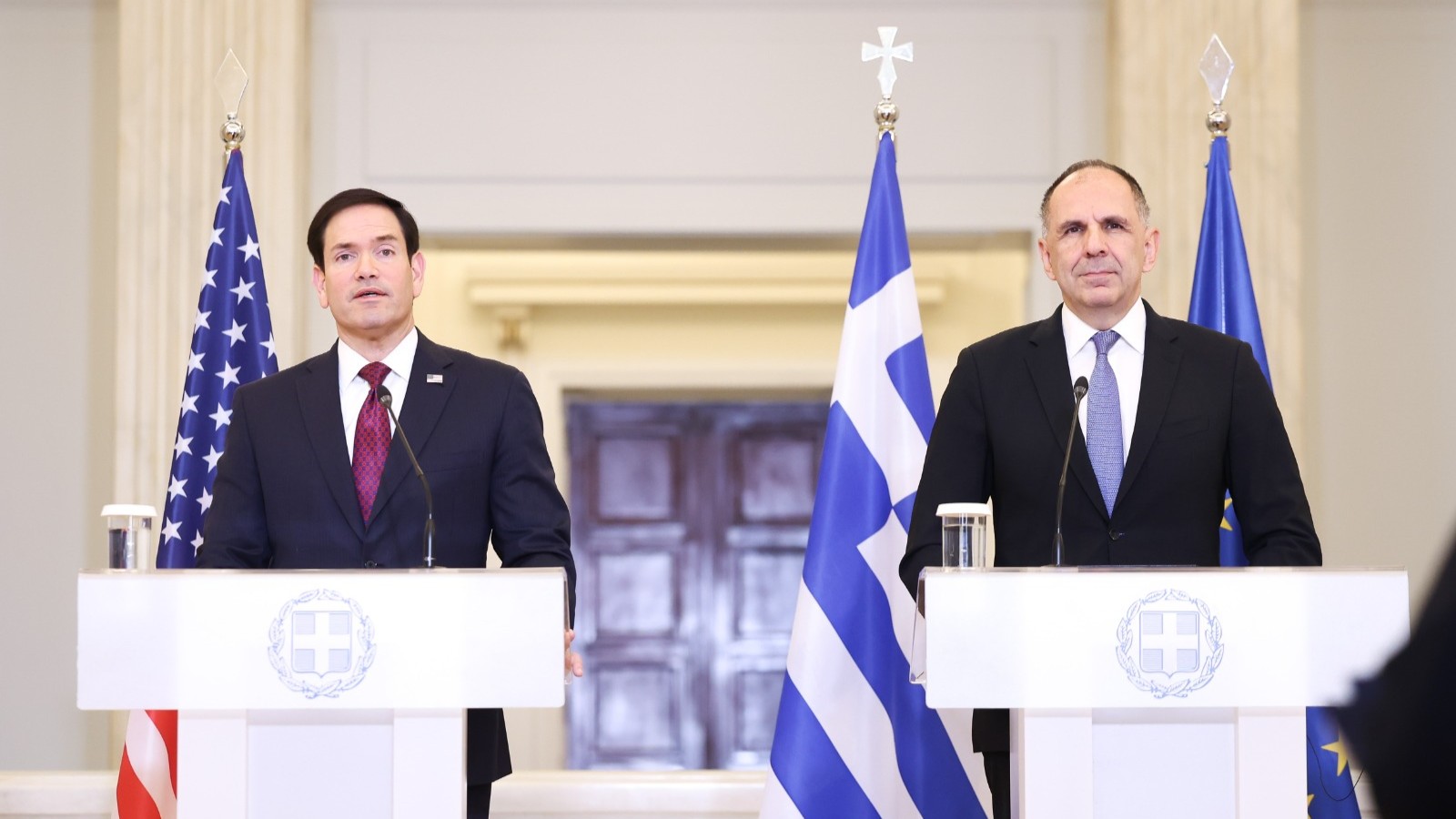
G. GERAPETRITIS: Distinguished Secretary Rubio, dear Marco,
It is a great pleasure for me to welcome you today to the Ministry of Foreign Affairs, here in Athens, and an equal honour to jointly launch the 6th round of the Strategic Dialogue between Greece and the United States.
Today, we welcome you not only as the Foreign Minister of an allied country, but also as a statesman of international standing, with deep knowledge of the region, and a friend of Greece. Amid intensifying strategic competition, increased geopolitical instability and serious shifts in our immediate and wider neighbourhood, the Strategic Dialogue between the United States and Greece has become a constant that reflects the very high level of our relations, as well as our shared commitment to further deepening them, strengthening the transatlantic bond and promoting international and regional stability and security.
With regard to our bilateral relations, energy and trade, energy cooperation between the two countries has reached unprecedented levels. We have highlighted Greece’s pivotal role through the Vertical Corridor, which constitutes the backbone for the transportation of American liquefied natural gas to Central and Eastern Europe. The Greek-owned merchant fleet transports more than 20% of LNG to global markets, enhancing energy stability, security and resilience.
We underscored the enhanced presence of American energy companies in Greece, particularly with regard to the development and exploration of offshore hydrocarbon deposits, which demonstrates the confidence of the American market in the Greek economy and our investment environment. And, of course, the significant American investments being made in Greece, particularly in high-technology companies, but also in shipyards.
With regard to our defence cooperation, the Mutual Defence Cooperation Agreement is the fundamental bilateral treaty governing our relationship. Souda and Alexandroupolis are precisely those points that highlight Greece’s pivotal role in the security architecture and the strategic presence of the United States in the region. The ongoing upgrade of the F-16 Viper fleet, as well as the integration of fifth-generation F-35 fighter aircraft into the Hellenic Air Force, does not merely reinforce the strenght and resilience of Greek defence. At the same time, it also highlights the steadfast defence cooperation between the two countries.
I could not, however, fail to refer first and foremost to people-to-people diplomacy. The Greek-American community constitutes a strong bridge of friendship and cooperation, and a driving force for deepening our relations. They are fully integrated members of American society, while at the same time remaining proud of their Greek heritage. In your birthplace alone, dear Secretary, live more than 100,000 American citizens of Greek origin. And, on the other hand, this year it is estimated that, in 2026, more than 1 million American citizens have already visited our country, to experience ancient as well as modern Greek culture. For much of the year, we were more than 100 direct flights per week between the United States and Greece.
With regard to international issues, we had the opportunity with the Foreign Minister to discuss the pressing issues currently affecting the world: the ongoing armed conflicts in the wider Middle East, in Ukraine, and, of course, the situation in Africa, particularly in Sub-Saharan Africa, which substantially affects not only state structures and the humanitarian situation in the region, but of course also migration flows, and to see how we can develop our cooperation to address these international crises.
Greece attaches particular importance to the issue of freedom and security of navigation, not only because it has a strong Greek-owned fleet, but primarily because the safety of navigation constitutes an essential prerequisite for ensuring security in the supply chain and avoiding the risk of a food crisis. During its Presidency in May 2025, Greece highlighted the issue of maritime security and freedom of navigation, and it will do the same in a few weeks, on 29 October, at a high-level event that will link emerging technologies with the issue of security and freedom of navigation.
A shared concern for Greece and the United States is the creation and safeguarding of conditions for stability in the wider Eastern Mediterranean region and the protection of Christian populations, as well as every other ethnic or religious community. Greece maintains very strong ties with the Greek Orthodox Ancient Patriarchates in the Near East, and remains in constant contact with them in order to ensure unhindered worship, as well as the protection of places of religious worship.
I would like to make a special reference, dear Secretary, to the issue of the European perspective of the Western Balkans. It is extremely important to highlight the issue of their European path, which is the guarantee of prosperity, and in particular the prevention of the re-emergence of outdated nationalisms in the wider region, with respect for International Law, the European acquis, as well as the requirement of good-neighbourly relations.
Distinguished Mr. Secretary, Greece today constitutes a pillar of stability, reliability and growth. The Greek economy is growing at a rapid pace. The continuous quantitative and qualitative strengthening of the Greek Armed Forces for the protection of our sovereignty and sovereign rights also aims overall at the prosperity of the region and at the security that is required.
With defence expenditure consistently above the threshold set by the transatlantic alliance, Greece has now also become a security provider for other countries, with a leading role in all European Union naval operations, in Operation “EUNAVFOR ASPIDES” in the Red Sea, in Operation ‘’EUNAVFOR ATALANTA’’ in the Western Indian Ocean and in other maritime areas, as well as in Operation ‘’EUNAVFOR IRINI’’ in the Central Mediterranean, which operate in a complementary manner to American initiatives, while reinforcing Greece’s significant diplomatic footprint.
A member of the United Nations Security Council, with the Presidency underway, a member of the European Union - we will hold the Presidency of the Council of the European Union in the second half of 2027 - and, of course, a member of NATO, with strategic alliances with critical countries of the region, such as Israel, Egypt, Saudi Arabia, the United Arab Emirates, and, of course, with a significant participation in multilateral formats, as I will particularly refer to the 3+1 format, with the participation of Cyprus, Israel and, of course, the United States, and with your own participation, dear Secretary. This format has evolved from an energy cooperation framework into a strong geopolitical multilateral format which substantial influence.
And I would, of course, like to highlight, through your presence here, the issue of Cyprus. Cyprus constitutes an integral part of the security architecture of the Eastern Mediterranean. It is necessary to find a solution for the reunification of the island within the framework of the decisions and resolutions of the United Nations Security Council for the end of the illegal occupation, guided by International Law and the promotion of dialogue and diplomacy as the only means through which peace and prosperity can be re-established, while steadfastly preventing any revisionist attempt or threat.
Mr. Secretary, your visit coincides with the celebration of the 250th anniversary of the Declaration of Independence of the United States, as well as of 205 years since the Greek Revolution, which overthrew the Ottoman yoke. Our fate is bound together by revolutions.
The Greek spirit, the values of Greek civilization, inspired the American Revolution and the Declaration of Independence, just as the ideals of the American Revolution and, in particular, the first formal Constitution of the modern world in 1787, the American Constitution, inspired the Greek Constitutions of the Struggle.
Thomas Jefferson, one of the Founding Fathers of the United States, principal author of the Declaration of Independence and third President of the United States, wrote in reply to the great Greek, Adamantios Korais, during the Greek Revolution, on October 31, 1823. Among other things concerning the form of government that was being shaped in revolutionary Greece, Thomas Jefferson wrote the following:
“No people feels more lively sympathy than we do for the sufferings which the Greeks endure. None addresses more fervent and sincere prayers to God for the success of their cause.
Should my thoughts provide you with even a single idea that could be of use to the Greeks, I shall consider it a tribute to the spirits of Homer, Demosthenes and the brilliant constellation of sages and heroes, whose blood still continues to flow in your veins and whose virtues remain as a heavy debt upon the shoulders of the present and future generations of humanity.
I address to Heaven” — Jefferson concludes — “the warmest supplications that your countrymen may regain the freedom and the learning of their ancestors.”
Mr. Secretary, these are the bonds that unite us.
Welcome to Athens.
JOURNALIST: Thank you very much, Mr. Foreign Minister, for taking the question. As President Trump weighs the potential of renewed strikes on Iran, is consideration being given in Greece to support those strikes from Souda Bay, especially in light of the events at Fairford that demonstrated increased Iranian threats to U.S. assets in Europe?
G. GERAPETRITIS: First of all, let me point out that Greece has adopted a principled position on all issues concerning armed conflicts, whether in Ukraine or in the Middle East. This position is based on the respect for International Law and support for the party defending itself against aggression. In this context, the Greek state not only defended the Greek territory and, of course, supported the Souda base, but also became a security provider. We provided security to neighbouring countries, we provided security to Cyprus when it was directly threatened, to Bulgaria, to the Gulf countries. Greece now has the capacity, thanks to its advanced defence systems and thanks to its very strong geopolitical position, to be able to provide security, to project security, to be a pillar of stability. And, as I mentioned, Greece is currently already the principal actor in the operation taking place in the Red Sea under the auspices of the European Union, the Operation “EUNAVFOR ASPIDES”, for the safe passage of vessels transiting the Red Sea. If a further operation is required, then, within the framework of a broader operation that will be responsible for the smooth passage in the Gulf as well in peacetime, it is obvious that Greece will once again be at the forefront.
JOURNALIST: Good morning, Vassilis Nedos from Kathimerini. My question is addressed to the Greek Foreign Minister. You have already referred to the missions in which Greece participates in the Red Sea. There are very open and, I would say, clear requests from the American side for participation in more American initiatives in the Middle East, in Hormuz, in the Red Sea, in the wider region. So, my first question is whether Greece intends to participate in such a mission. And I would also like to ask you whether you discussed the Greek-Israeli relationship with your American counterpart and how this causes concern to a neighbour of ours.
G. GERAPETRITIS: With regard to the issues concerning Greece’s participation in operations, let me first point out that the operations taking place in the Red Sea, in the Mediterranean, and in the Pacific Ocean are all complementary to American initiatives. Therefore, they are not in a state of opposition, but rather of complementarity. Greece, as you know, has a leading role in the presence, particularly in the Red Sea. On the other hand, if it becomes necessary, we are in a position to be able to cooperate with the United States so as to provide the necessary naval assistance in the area of the Strait of Hormuz as well, provided that the situation allows it, provided that there is a viable peace process. I would like to point out that Greece is not interested solely because it is a leading power in shipping. Its interest stems primarily from the fact that shipping safeguards supply chains, energy security and, ultimately, the prosperity of our peoples. With regard to the discussion we had with the United States Secretary of State concerning the wider region, we discussed issues that also concern Israel. As you know, Greece has a strategic relationship with Israel. We have already developed multifaceted cooperation with Israel. I would particularly like to refer once again to the 3+1 initiative, which also includes Cyprus and the United States and is both energy-related and, more broadly, geopolitical.
Our relationship, our understanding of Middle East issues with the American Secretary of State, is entirely aligned. There must be peace in the region. The 20-point Plan must move forward to the second phase in order to achieve sustainable peace and reconstruction in the Gaza Strip. And those actions, particularly in the West Bank, which create conditions that hinder a solution based on the Resolutions of the United Nations Security Council, must cease.
JOURNALIST: Mr. Minister, where does Greece and the European Union stand on regulating American AI?
G. GERAPETRITIS: Artificial Intelligence constitutes a major human achievement. It constitutes a new industrial and scientific revolution. And this is because it can provide people around the world with the ability to fill gaps, develop expertise, and improve the level of education and knowledge. On the other hand, we understand that the risks it poses are extremely significant. With regard to issues involving addiction among vulnerable groups of citizens, with regard to issues involving disinformation, even to the detriment of democracy itself, and with regard to issues that lead to greater inequalities in the world.
For this reason, our position is that meaningful, smart regulation is required. And as much as we understand that it is by no means easy, in technological achievements, to be able to set normative and regulatory limits, the reality is that Artificial Intelligence is dual-use. It can be beneficial, but it can also become destructive. I will use one of the very ingenious linguistic references of the rich Greek language. Artificial Intelligence can, in the proper dosage, become a real medicine for societies. In excessive dosage or in a dosage that is not appropriate, it can become poison. Therefore, yes to regulation, yes to technology, no to technophobia, yes to substantive regulation, which will protect public goods and our citizens and safeguard inclusion in the age of technology.
October 7, 2026