


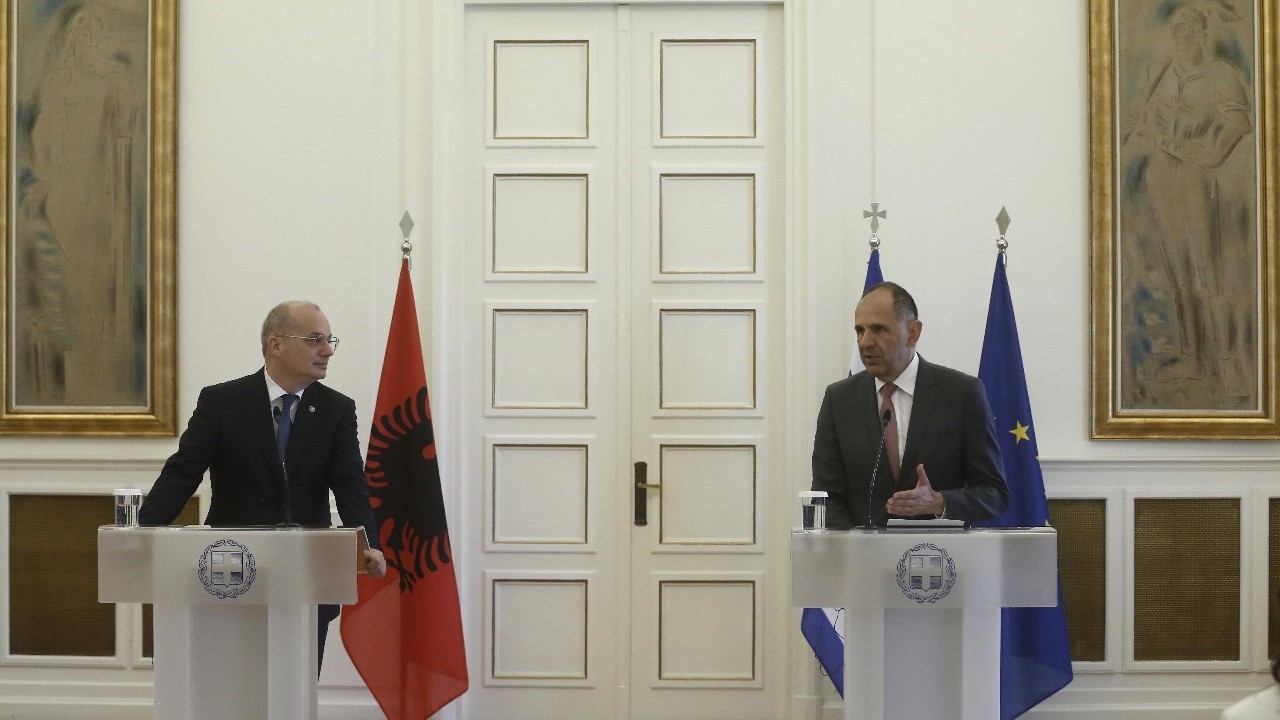
It is a great pleasure to welcome today in Athens the Minister for Europe and Foreign Affairs of Albania, Igli Hasani. A remarkable politician and a dear friend.
Dear Minister, I would like to take this opportunity to express my warmest congratulations on your election and wish you every success.
Ladies and Gentlemen,
We are living through a painful period in global geopolitics. Wars, armed conflicts, and humanitarian crises have shaken the international security architecture. These developments and contemporary security challenges concern both my Albanian counterpart and myself, within the framework of NATO, and of the United Nations as well. Greece, as the country presiding over the UN Security Council during the month of May, undertook a number of initiatives for the protection of civilians and in response to the humanitarian crisis in Gaza.
The world is changing rapidly and, unfortunately, not for the better. Multilateral diplomacy often stands helpless in the face of developments that surpass its ability to respond.
At this juncture, developing regional cooperation, particularly between our neighboring countries is of exceptional importance in fostering stability and prosperity in our region. Shadows that have troubled the relations between our two countries should be eliminated, never to be repeated. We should look to the future with a positive outlook, on the basis of full adherence to international law and always seeking relations based on friendship and good neighborliness.
With this as our compass, we discussed the whole range of our bilateral relations. Cooperation in the fields of economy, trade, foreign direct investments, interconnectivity, education, culture, as well as environmental issues.
Our position remains that, for stability and security to be firmly established in Southeastern Europe, the enlargement of the EU through the integration of the Western Balkans into the European family is essential, leaving behind nationalism and the forces of regression and destabilization. Greece, fully aware of its prominent role in the region, has been a pioneer in the integration of the Western Balkans, with the Thessaloniki Agenda in 2003, and remains committed to this goal.
Regarding Albania’s European perspective in particular, Greece, in line with its long-standing position, has agreed to the opening of accession negotiations between the EU and Albania, assessing the progress made in the individual chapters.
In this context, I would like to make particular reference to the absolute respect owed to the protection and safeguarding of the rights of the Greek National Minority, which is a top priority for us.
The indigenous Greek National Minority is one of the strongest links in the relationship between our countries. For centuries, it has been a bridge of communication and understanding between our two peoples.
The same can be said for the large number of Albanians living and working in Greece, who have distinguished themselves by their remarkable integration into the Greek society.
It is in the interest of both our peoples to cultivate our common interests and to work together to combat stereotypes. And indeed, this is an excellent opportunity to give our relationship a new, comprehensive and creative impetus.
Not only because there is a political will on both sides to do so. But also, because we are fortunate to have, in our neighbor, Albania, a Minister for Europe and Foreign Affairs who not only possesses outstanding abilities but also speaks our language. The language of European reason. But also, the Greek language, thus honoring his Greek roots today.
And I feel truly fortunate to be standing here at the Greek Ministry of Foreign Affairs alongside a counterpart who does not need a translation from Greek.
With these thoughts I would like to welcome you, dear Igli.
June 3, 2025