


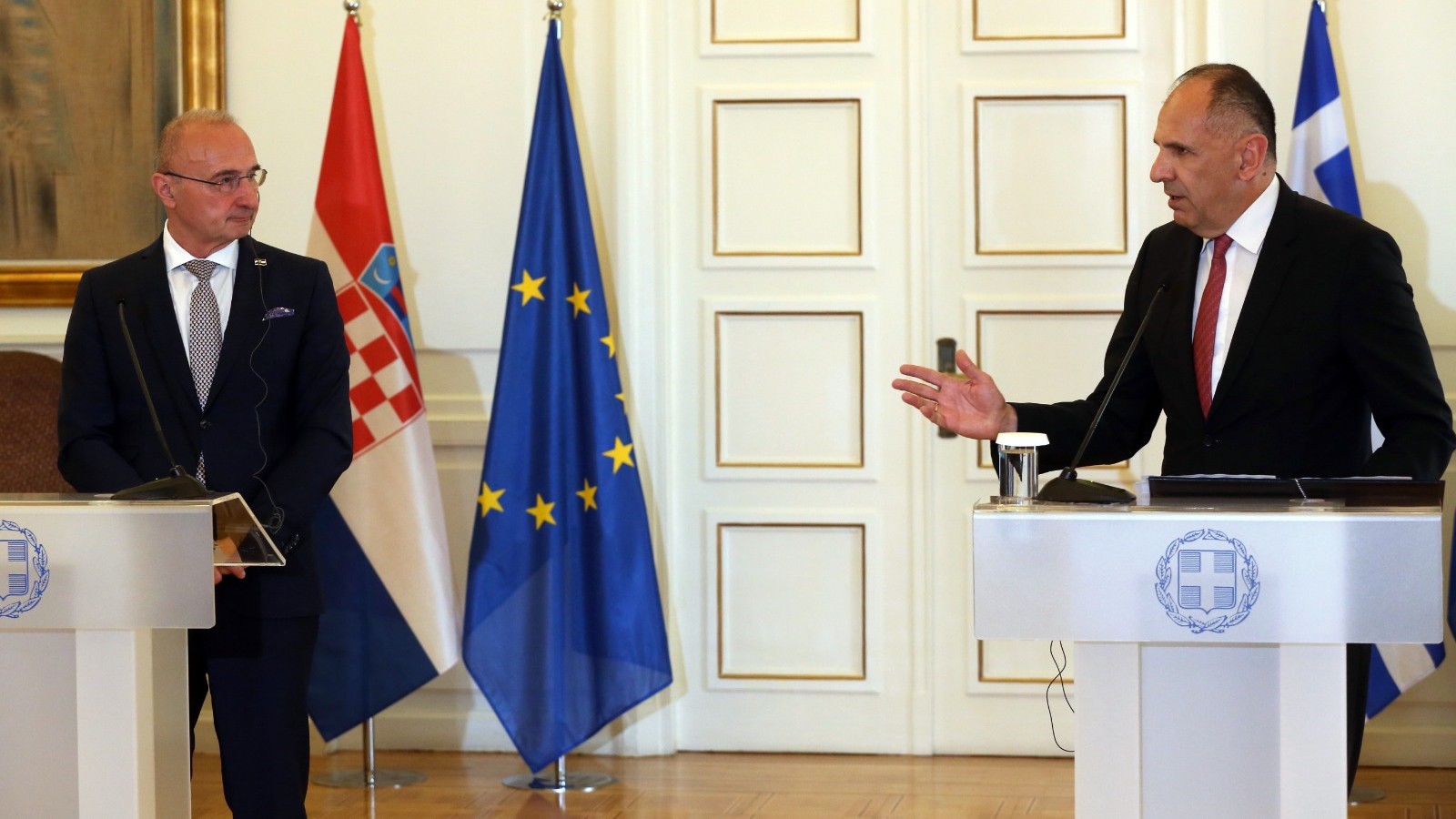
It is a great honor to welcome today in Athens the Minister of Foreign Affairs of Croatia, Gordan Grlić Radman, one of the most active European Ministers of Foreign Affairs, an experienced diplomat, with whom we have an excellent cooperation, and dare I say, we have developed a significant friendship. He is currently the longest-serving Minister of Foreign Affairs among the Ministers of Foreign Affairs of the Member States of the European Union, with great experience and wisdom.
Dear Gordan,
After an intensive Foreign Affairs Council in Brussels on Monday and after yesterday's meeting of the “Friends of the Western Balkans” Group in Bratislava, I am very pleased to welcome you to Athens.
With Croatia, as partners in the European Union, we converge on issues of mutual interest, concerning enlargement, competitiveness, and also the strategic autonomy of the European Union.
Due to our geography and history, we attach particular importance to the Western Balkans, which we discussed at length today. Of course, we had the opportunity at the Foreign Affairs Council meeting, but also yesterday in the “Friends of the Western Balkans” Group, to have an extensive discussion on promoting the pre-accession process of the Western Balkans to the European Union.
As the oldest EU member in the region, Greece remains at the forefront of efforts to advance the integration of the Western Balkans to the European family, based on the principles of conditionality and own merits, without, of course, departing from the obligation of all interested states to respect the European acquis, the principles of the rule of law, International Law and good neighborly relations.
In particular, it is obvious that no concession can be made by candidate countries for accession to the European Union with regard to the observance of International Law, including all international treaties, as well as the Fundamentals, the principles of the rule of law and democracy.
We believe that a new dynamic has been given to the enlargement policy, which is now extremely important for strengthening the resilience of Europe, and Greece, like Croatia, have contributed towards this goal with our own initiatives. We aspire, with the Greek Presidency of the Council of the European Union in the second half of 2027, to be in a position to make significant progress in terms of the integration of the Western Balkans.
As countries of the wider South-eastern European neighborhood, we promote regional cooperation within the framework of our participation in the South East European Cooperation Process (SEECP) and the Quadrilateral Cooperation Scheme of Croatia - Greece - Romania - Bulgaria.
The sea is part of the identity of Greece and Croatia. We coordinate our actions in the MED9 group, of which Croatia is currently holding the Presidency in an exceptionally constructive manner.
As Mediterranean states, we unite our voices and together, dear Minister, with your compatriot, the Commissioner for the Mediterranean, Dubravka Šuica, we are working to implement the Pact for the Mediterranean and highlight the strategic importance of our sea, strengthen cooperation to address common challenges, such as irregular migration, as well as to strengthen economic ties between the coastal countries of the Mediterranean.
At this point, I would particularly like to congratulate Croatia and my dear friend the Minister for the successful organization of the recent Summit on the Three Seas Initiative in Dubrovnik, in which the President of the Republic participated on behalf of Greece.
Greece became the 13th member of the Three Seas Initiative in 2023. It is significant that the Aegean Sea became the “fourth” sea in the whole endeavour that unites those countries. We firmly believe that this southern dimension is important because it serves as a bridge between South and North, promotes mutual understanding among people and interregional cooperation, as well as the promotion of all forms of interconnectivity.
As NATO allies, we are concerned - Croatia and Greece - about the future of the North Atlantic Alliance, the fair sharing of defence burdens, and the further promotion of transatlantic relations.
As you are aware, Zagreb is a valuable partner and ally with whom our relations are based on common values and principles. Therefore, we reiterate our full support for Croatia's accession to the OECD (Organization for Economic Co-operation and Development).
Dear Minister, over the past four years, the number and the intensity of conflicts in Europe’s wider neighborhood have increased significantly. Within the framework of the European Union, we are called upon to deal with unprecedented situations.
The main challenge is, of course, preventing the spread of the wars that plague our neighborhood.
The Mediterranean, our sea, must remain a sea of peace. For this reason, no turning the Mediterranean into a theatre of military operations will be tolerated. Greece will work to ensure that the Mediterranean remains untouched by military operations and remains a sea of peace, a sea of its peoples.
As for the Middle East, the maintenance of the ceasefire between the United States and Iran and the continuation of diplomatic efforts allow us to be cautiously optimistic about finding a solution.
Greece maintains its will to assist, when conditions permit, in initiatives to ensure free passage through the Strait of Hormuz. Safeguarding freedom of navigation is a universal obligation based on International Law and, in particular, on the United Nations Convention on the Law of the Sea.
One of the key priorities of our tenure on the United Nations Security Council is precisely to ensure freedom of navigation everywhere in the world. This freedom is directly intertwined with the global supply chain, energy, trade, and food security. And of course, it was the central theme of the Rome meeting a few days ago.
Gaza continues to be a matter of major concern and interest for both our countries, which requires coordinated diplomatic vigilance, with priority, of course, given to improving the humanitarian situation in the heavily-stricken region, by providing enhanced protection at all levels.
With regard to humanitarian aid, Greece is one of the countries that has provided significant humanitarian assistance at many levels and we will continue to do so. Greece will be present in all developments regarding Gaza, based on International Law, which should have universal application.
We have also underlined on several occasions the need to maintain the ceasefire and the full implementation of the second phase of the Peace Plan based on Resolution 2803 of the United Nations Security Council.
Dear Gordan, Honorable Minister,
Today we had the opportunity to discuss the further expansion of our bilateral economic cooperation, particularly in the areas of investments, tourism, connectivity, cultural, and educational exchanges.
Our bilateral relations are already at an excellent level.
Croatia and Greece are on the same side of history in almost all areas of foreign policy. Our countries are connected by long historical ties and, above all, they are united by a common European future.
With these thoughts, I would like to welcome you again, my dear Gordan, and wish you a pleasant stay in Athens.
May 13, 2026