


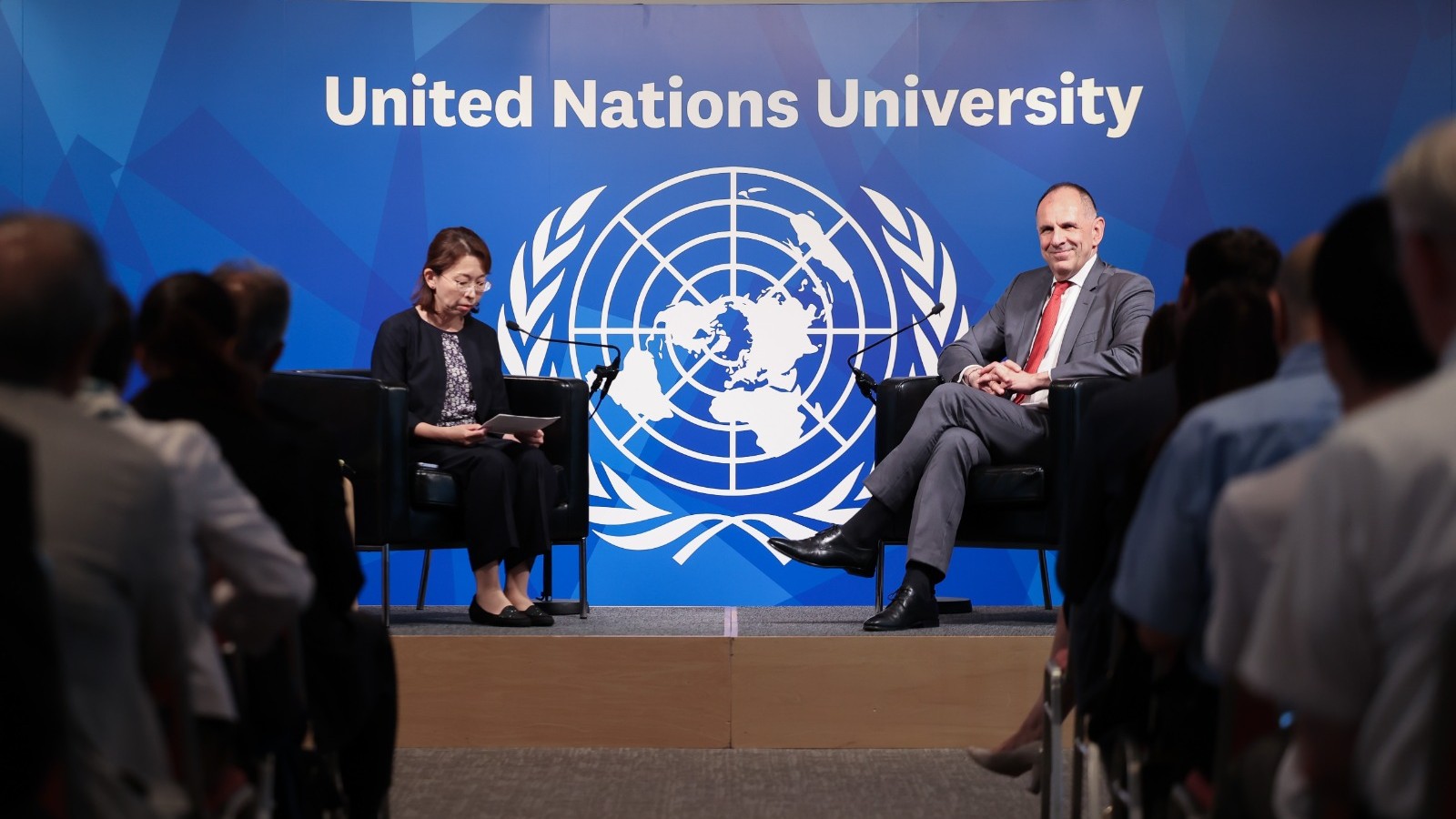
A. SUZUKI: Hello everyone, and thank you very much for joining us today. My name is Aya Suzuki, and I'm the Senior Vice-Rector of the United Nations University. So, I am very delighted to welcome you all today to the United Nations University Conversation Series. And today we are very honored to welcome His Excellency George Gerapetritis, Minister of Foreign Affairs of the Hellenic Republic.
Minister Gerapetritis previously served as Minister of State from 2019 to 2023, acting as a principal advisor to the Prime Minister, Kyriakos Mitsotakis, on institutional and legislative reform. He brings with him a distinguished legal career, litigating high-profile public law cases before European courts, and remains to this day a Professor of Constitutional Law at the National and Kapodistrian University of Athens. Our conversation today will explore the emerging multipolar international order, Greece's current role as a non-permanent member of the United Nations Security Council, and the future of international cooperation in an era of geopolitical uncertainty. Minister Gerapetritis, welcome to UNU.
As a quick reminder of this format, we will begin with a 30-minute conversation on stage, and after that we will open the floor to the audience for questions. Thank you very much, Minister, for joining us. This evening's conversation is entitled "The New Multipolar International Order." How would you define this emerging order, and what does it mean in practice for a country like Greece?
G. GERAPETRITIS: First of all, I would like to thank you wholeheartedly for this invitation. It is a great honor to be here at this distinguished University associated with the United Nations. It is not simply an academic environment of high prestige, but it is also strictly associated with international multilateralism, for which we are all having a very distinctive feeling. It is a great honor, and truly I could not find a better venue to express my ideas about multilateralism and the new version of multipolar world that we are all facing at the moment. So, thank you very much. It is wonderful to be here with you.
First of all, I would like to say that we are living at very challenging times. Sometimes we say this in a very trivial way, but the truth is that normally we understand that times are challenging once they pass. Whereas now, I think we're living at those very turbulent times, and we realize the historic moments that we are facing, an overall transformation of the international security architecture as established in the post-war era. So, I think we are truly living a historic moment.
The contemporary multipolarity, Professor Suzuki, comes from a combination of three different issues. The first is that we are experiencing tectonic geopolitical changes. The second is that we are living in a totally different type of communication between people and nations. And the third is that we are living in a new type of industrial revolution.
I would begin from the industrial revolution. We all see how Artificial Intelligence is completely changing the idea of how we perceive the world, with all challenges concerning not only technoethics, but also the interaction between people and machines. And this might seriously hamper the fundamentals of democracy. The second is the change in the communication models, the rise of the social networks, which essentially dominate not only the communication between people, but also the flow of information concerning ideas, ideologies, and news around the world. And that entails a more speedy communication, which, nevertheless, comes alongside with a lack of integrity of the information on many occasions. Because everybody is sacrificing the accuracy of the information in favor of speed in a situation. And the most important, I think, is the change in the geopolitical perception, the tectonic changes we encounter nowadays. I would start with the fact that we see how international multilateralism is essentially retreating in the last few years, and this is something that completely changes, I think, the geopolitical landscape around the globe.
I think what happened with Russia and Ukraine, the Russian aggression against Ukraine five years ago, has not been addressed by international organizations, unfortunately, including the United Nations, but also all other international organizations, and I'm just reflecting as self-criticism, the same happens obviously with the European Union, NATO, and other international organizations to which Greece participates.
And this can be attributed, Professor Suzuki, in my eyes, primarily to the structures of such international organizations. We all know how the United Nations developed in the 1950s with a view to have an operational, functional system of international structures where the winners of the Second World War could have a meaningful say, whereas at the same time the rest of the world could be proportionately represented. I think this structure has gone downhill, to be honest. We have not been able within the UN to take even a single decision to condemn Russia for the illegal invasion of Ukraine in spite of tremendous effects around the globe, just because of the veto right of Russia, so essentially of the veto rights of the permanent members of the Security Council. Whereas, of course, one could reasonably challenge the legitimacy and accountability of the UN concerning all those major crises.
So, structures within the United Nations are getting rapidly obsolete and, in any case, cannot address contemporary challenges. The UN 80 Agenda is obviously very relevant, but it's not an easy exercise because there is a lot of inertia associated with the change of the United Nations. It is not going to be an easy task.
At the same time, the inadequacy of international organizations to address the current challenges have resulted in the rise of medium and strong countries around the world in order to cover the existing gap of international organizations. And what we see is that the good services historically provided by international organizations and predominantly by the United Nations, are now the initiatives of major countries. And you see how it goes. If international organizations of high caliber are not capable of actually pulling off some solutions to contemporary crises, it is obvious that these will eventually be covered by strong states. And this has tremendous repercussions around the world. And I am not talking only about the major wars and conflicts. Obviously, we see that in Ukraine or in the Middle East or in Iran, the inadequacy of international organizations to provide some sort of a meaningful process of peace has resulted in the intervention of strong powers, and especially the United States.
But if one sees what is happening now, for example, in Africa, I think they would be totally astonished. Everywhere in Africa, and especially in sub-Saharan Africa, in the Sahel zone, where there are plenty of armed conflicts and humanitarian crises, what is happening is a tremendous arms race of medium states exercising strong external influence. And this geopolitical competition has resulted clearly in an upscaling of crises. And the more external influence is rapidly escalating, the more difficult it becomes to have a process of solution to the relevant crisis. So, I think at the moment what we see - to cut a long story short - is a significant retreat of international organizations, especially because of structural deficiencies, the rise of strong and medium countries, and the competition between all those countries, not only in their respective territories but around the globe. The extraterritoriality of interference now is getting to unprecedented scales, and this is an explosive mix in my eyes.
Now, how a country like Greece would react to this, as you rightly asked me, Professor Suzuki, is the million-dollar question. I have not really found a response to this. And it is not easy, obviously, to find a response.
But I can tell you what the options are. The options are two, and, you know, I'm trying to put it concretely instead of having a very abstract and gray response to your questions. Option A is to actually try and employ a strategy of a rules-based and principled foreign policy, that would be based essentially on uncompromising adherence to International Law, not meaning that we ignore realities on the field, the pragmatic aspects of geopolitics. You cannot obviously ignore geopolitics on the ground, but the truth is that you need to employ a strategy based on rules. And what you try to do in this respect is to have a coherent and consistent foreign policy to avoid any kind of multiple standards in exercising foreign policy. The second way to perceive foreign policy is to actually put more emphasis on realities as opposed to rules and principles. And this could easily lead to a more pragmatic view of foreign policy that would eventually result in more benefits for your country. But at the end of the day, a much more transactional policy, because if you try to just maximize national benefits it goes without saying that you are going to be more transactional in your approach.
What it means to be transactional in foreign policy nowadays is, I think, employing multiple standards. And the case of multiple standards is a huge pathology now in geopolitics and diplomacy. And I have to tell you that this is one of the reasons why some international organizations are also losing credibility vis-à-vis the people, because they employ different standards in almost identical cases. And the art of multiple standards could be considered as the art of politics, but in my eyes, this is a tremendous danger, I think, for the international community.
So, if you ask me, at the end of the day, which of the two options I would employ for the Greek foreign policy, clearly I would go for the former, the rules-based and principled international approach, not because I think it is a matter of principle - it is also a matter of principle, obviously, to have a rules-based approach - but basically because I think that for the vast majority of small and medium countries, it is to the benefit of the country to actually have that type of foreign policy. And what I think, comes out from the multiple crises of the last 5 years is an effort to actually develop cross-regional alliances in order to be able to combat those phenomena of transactional policies of power. I understand those employing the transactional policies because, obviously, when you have the power, you would like to make the most out of it. But for me, the motto that “might is right and even makes right” is a recipe for disaster, I think, for the international security architecture. And I think we should make a strong statement about it. I can see rising powers from not so strong regions and states, I see the Global South coming up rapidly, and Japan has a very strong role to perform in this respect. I think Greece - and we have made it possible, I hope, during our term in office at the Security Council - we have made a strong statement of a rules-based international security architecture.
We try to bridge the gaps between the South and the North, the East and the West. Our geography clearly calls for this because we are at the crossroads of three continents but, yes, I am very proud that my country has been very consistent in supporting International Law. And, just to close my initial statement, international law is either the whole package of international law rules and principles or it's nothing. We cannot have any type of cherry-picking in international law because I see, and I would say with great concern and fear, that there are powerful states, people, essentially claiming for cherry-picking in International law. I think that would be the end of International law as a discipline of law, but also, I think, that would seriously jeopardize the integrity of International law as a whole.
A. SUZUKI: Thank you very much for a very comprehensive answer to the first question, which actually covered a lot of questions that I had prepared, but it was very clear that you have two options. One is a rule-based foreign policy, and the other is more focused on the realities, but you would go for the former, and I personally really agree with what you've been saying.
As I was preparing for this, I was reading about how Greece is doing in the UN system and stuff, and I think there was a lot of mentioning about your country being really consistent in emphasizing legal positioning rather than trade benefit, and that really kind of increased the trust among other countries. But as a constitutional lawyer yourself, what do you think it would take to repair trust in International law? Because I think it's ideal, but it's also difficult, you know, when somebody's using double standards and, you know, trying to have private benefits. So, what do you think, how can we rebuild the trust?
G. GERAPETRITIS: You know, sometimes it's difficult to speak as a politician. It's much better to speak as an academic because you have the freedom to speak freely, whereas when you speak on behalf of a country or - even worse - if you speak on behalf of an international organization, you need to be very cautious about it. I do have a very strong view about what is happening in the world, and I'm not happy with what is happening because I think that we are losing credibility. And now I also speak as a member state participating in the decision-making of the United Nations. I think we're losing credibility, as I mentioned, because we speak different languages. And I don't mean the variety and diversity, the linguistic diversity. We speak differently. And this is a huge, huge trauma for the credibility of ourselves.
You see, once I heard something that was obviously very realistic, but, you know, very painful. I heard a statement coming from an EU official indicating that politics is the art of double standards. Well, this might be actually true and a lesson, but it's scary to death, truly, if you just perceive politics like this, because that results in a jungle. In my capacity as a constitutional lawyer, I kept on saying to my students that the most important parts of any kind of governance are: first, legitimacy and second, accountability. Those are the two facets of any kind of solid governance. And this is also the benchmark of success of any governance, be it domestic or international.
We have problems in both aspects today. Accountability is something that is almost nonexistent. Sometimes what is happening is we just try to become accountable ex post. We do something and we're trying to just seek accountability once we have the fait accompli, which is the exact opposite of accountability. Accountability should be prior engagement and then ex post accountability on the basis of the commitments you have made; whereas now it's a blurred situation.
And when it comes to legitimacy, I think the problem is that the issue of legitimacy is used primarily by those who actually want to do something even beyond the letter or the spirit of International law. Because formal legitimacy is a good aspect, it's a necessary aspect, but it's not an adequate aspect, because on the ground of formal legitimacy the most serious crimes of humanity have taken place. What we need to see is that legitimacy is not only an aspect of formality. It's an ongoing process and it's a matter of substance. We have some sort of an inbound legitimacy, coming from the source of power. Obviously, there is a legitimate power of any government which has come out of legitimate democratic elections. But is this enough? I would say “no”. Because legitimacy is not a one-off type of thing. It has to be a consistent and perpetual thing.
Why governing? And this is why I speak of an outbound legitimacy, which should be the benchmark of any meaningful governance. And this is combined with how we perceive legitimate power. Legitimate power means something more than simple power. It is the legitimate power. And you have to just see that legitimacy is not only a matter of the source of the power, but it's also a matter of how you exercise this power. And in the academic discussion, in constitutional law, but also international discussions, there is a tendency to actually identify some aspects of utilitarianism when it comes to the exercise of power. Something is legitimate, if the product is beneficial for the public. It's not always the case, though. I mean, something which is seemingly beneficial, something that is seemingly very useful for a nation or for the globe could have some long-term repercussions, if it's not legitimate power. Why? Because it creates a precedent. And we have to understand today, with all the challenges that we face, that this is the period of precedent setting. What is happening today is a precedent of tomorrow. And this is really frightening. We need to take the contemporary international politics very seriously.
Just take the example of what is happening with the Strait of Hormuz today. Everybody's talking about the need to have freedom of navigation and maritime security, etc. We all understand this. This is written explicitly in the UN Convention on the Law of the Sea. It's something that we all understand very easily. And this is why we claim, even within the Security Council, but essentially in all international fora, that we need to have uninhibited waterways. Because otherwise it's going to be a serious consequence, not only in terms of oil transport, but also food security in third world countries. But we need to understand what it means to actually establish something that would raise a barrier to uninhibited waterways today. That would be the end of what we perceive as humanitarian goods. The mere fact that international law essentially prohibits any sort of fees or tolling for crossing the waterways is exactly because it is considered that this could have some serious consequences for the globe.
So, what happens today could be the benchmark tomorrow. It's not only about Iran and the Strait of Hormuz. It's a totally different vision about the future. You are studying international law here, and I used to teach international law during my academic career. Look, there is obviously the formal international law, what is actually written within the conventions, and also primarily, for example, in our case, in UNCLOS. But there is something more than formal international law. This is the international customary law. The fact that international law binds not only signatories but also non-signatory states, it's actually probably the most spectacular achievement of international law diachronically, in the course of time. Why? Because in that way we can say that we have some ecumenical principles. If we just distinguish now formal international law from international customary law, which prohibits every state, this would be a tremendous problem in the future. And this is why I keep on saying: “no concession to international law is allowed today”. We need to make a strong alliance to actually safeguard international law, because this is the defense of the nations.
A. SUZUKI: Thank you very much for your strong statement about what's happening in the world. You had a lot of answers to my questions which were prepared. So, thank you very much.
July 15, 2026