


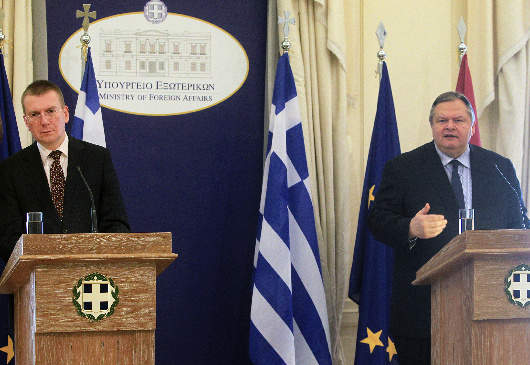
 E. VENIZELOS: It is a great pleasure to welcome my dear colleague the Foreign Minister of Latvia, Edgars Rinkēvičs, to Athens. We meet very often in Brussels and in Luxembourg at the other meetings of the EU Foreign Ministers, but it is very important for us to have an organized, bilateral meeting here in Athens, and I thank him very much for being here.
Our one-on-one meeting was very friendly, naturally, but also specific. We looked at the level of our bilateral relations. The level is very good, but there is much room for improvement, particularly in the economic and trade sector, as well as in the investments sector. The indicators are excellent in the tourism sector – there is a lot of room for developing the tourism sector.
I briefed the Minister on the course of the implementation of the Greek programme, which he is monitoring and is apprised of in any case. Latvia went through a tough experience of implementing a fiscal adaptation programme a few years ago. So they are very well aware of the repercussions of the crisis, what recession means, what curtailing income means, what unemployment means, because that is our big problem.
From this perspective, we talked about the priorities of the Greek Presidency in the first half of 2014. Mr. Rinkēvičs knows the priorities and is aware of our collaboration with the Italian Presidency in the second half of 2014, within the framework of the Mediterranean year in 2014, because Latvia is preparing to hold the Presidency immediately following Italy, in the first half of 2015. So from this point of view as well, we have many common interests, particularly regarding the Eastern Partnership, on the one hand, and the Southern Partnership as well. This is something in which we have a mutual interest.
Our stance is that we will implement the decisions of the Vilnius Summit Meeting on the Eastern Partnership, and the Latvian Presidency will of course show its interest in the Southern Partnership and in our policies regarding the Mediterranean.
I expressed my warm thanks to Mr. Rinkēvičs for Latvia’s support, throughout this time, on issues concerning our confronting migration flows and illegal migration in particular. Latvia’s contribution to Frontex, which is active in Greece, is very important, and this is a gesture of friendship and cooperation that we very much appreciate.
We are also preparing to welcome Latvia to the Eurozone, to a very complex group of expanded cooperation. With Latvia’s participation, the 17 will become 18. Of course, the Eurozone, like the European Union, needs to think very seriously about the new rules for economic governance in order to safeguard the institutional equality of the member states of the EU and the Eurozone.
I also briefed my colleague on the new initiatives being taking by Greece, together with Italy and Malta, regarding the protection of the European coastline and the European Union’s border in the Mediterranean – in the southern region – in general.
This is a problem that the European Union as a whole is confronting, and it is obvious that we will have many joint initiatives, always with the aim of fair sharing of the burden and of showing real solidarity between the member states in this very, very difficult and sensitive sector. This is an issue that must be confronted at its source: in the countries that are in crisis, forcing people to abandon their homelands and seek protection of their lives and better fortunes elsewhere.
With these thoughts I welcome my dear colleague to Athens, and I ask him to take the floor.
E. RINKĒVIČS: Thank you very much, sir. It is really great to be back in Athens, in Greece, after actually ten years, and the last time I was visiting Greece, in 2003. And I have to say that to some extent Greece is playing a particular role in Latvia’s European path.
Exactly ten years ago, it was a Greek Presidency when Latvia joined, signed the necessary treaties and agreements to join the European Union, and it is going to be Greece again and a Greek Presidency, when Latvia, on the 1st of January 2014, joins the Eurozone, as the Minister has just mentioned.
So from that point of view I would like to thank Greece for continuous support to our European course, and also for your assistance and support for starting OECD accession talks, which have started also thanks to Greek support.
Talking about some of the issues that my friend and colleague has just mentioned, I just want to reiterate a couple of those. First of all, we discussed indeed the upcoming Greek Presidency priorities, and I just want to reiterate our full support for all four priorities of the Greek Presidency, for the further reform and development of the European Monetary Union, immigration and maritime security issues.
As the Minister has just mentioned, we have always supported, also through practical means, your immigration policies of Frontex, and we will continue to do that. We also understand concerns of our Greek colleagues, and also countries of EU that are here in the Mediterranean, concerning illegal immigration, and we are prepared to work very closely on existing mechanisms, on existing frameworks for tackling illegal immigration, which we understand is one of the major challenges for the whole EU, not only for some countries.
When it comes to our bilateral cooperation, I am very happy to see that political dialogue is not only conducted in Brussels and Luxemburg, but also in Athens, here.
I had a very good meeting with the Prime Minister earlier this morning. We discussed and exchanged some experiences on how to tackle economic and financial crisis.
We also discussed issues that are related to Eastern and Southern partnership. I think that it is very important that the Association Agreement is signed with Ukraine. Ukraine initiated this, Moldova and Georgia. We want to work with the Greek Presidency and then with the Italian Presidency to advance both eastern partnership and southern partnership policies of the European Union, so that in our Presidency we can also review what can be done further at the Riga Summit of EU Eastern Partners.
I think we have already got very good economic cooperation. Our figures are going upward, our tourists are coming to Greece. I hope also that more Greek tourists will come to Latvia to see our country. We also see excellent cooperation when it comes to culture and education, and we of course are ready to continue that.
And finally, I just want to thank my Greek colleague Minister for the hospitality, and I hope to see him in Riga. I think that even if we have this opportunity to meet very frequently on the occasion of meetings of EU or NATO or the United Nations ministerial meetings, still, bilateral contacts are very important, and still I think that we have to sometimes devote more time to discuss and to coordinate bilateral positions as well.
We have had very good experience already as a part of the ‘Friends of Cohesion’ group, and we were working together to get a better deal out of the Multiannual Financial Framework of 2014-2020. We have already had very good cooperation within NATO, and I am very much looking forward to continuing that.
November 5, 2013