


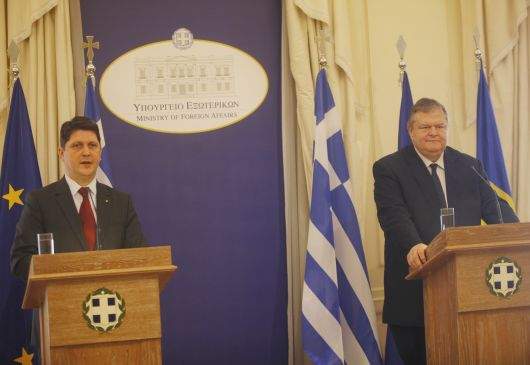
 E. VENIZELOS: It is a great pleasure to welcome my colleague the Foreign Minister of Romania, Titus Corlatean, to Athens, to the Foreign Ministry. We are linked by close ties of friendship, and we frequently have the opportunity to meet in Brussels, in New York, in Luxembourg, but it is very important for us to exchange visits on a purely bilateral level.
Romania and Greece are linked by very close historical and political ties, as well as many economic ties. The two countries’ relations in the sector of the real economy of enterprises and investments, and in the sector of financial economy, are very, very important.
Our cooperation in the European Union is very harmonious, and we are happy that Romania is a member of the European Union. We cooperate in NATO, as members of the Alliance, at the UN, in the OSCE, in all the major international and regional organizations.
Allow me to refer in particular to the South East European Cooperation Process (SEECP), of which Romania holds the Chairmanship this year. And I am pleased because, now that Greece will be holding the Presidency of the Council of the European Union in the first half of 2014, we will organize a meeting between the two presidencies in Thessaloniki. It will be an opportunity for us to coordinate our activities.
We talked about all the bilateral issues, the situation prevailing in the European Union, and the major international and regional issues. We are in agreement on everything.
My colleague is very familiar with the priorities of the upcoming Greek Presidency, which, as we have said, will be working with the Italian presidency, which comes in the second half of 2014, to make 2014 a Mediterranean year.
All of the priorities of Greece and Romania are shared by the two countries, and allow me here to make special mention of the need for the practical implementation of the principle of burden-sharing among the EU member states in the difficult sector of migration and management of migration flows.
I would like to take this opportunity to express my deep sadness at the tragedy that occurred in Lefkada, with the deaths of young children and other people who were seeking a better fortune. These phenomena, which reached a very extreme form in Lampedousa and Sicily, are unacceptable. The European Union must realize that there is a need for initiatives, for funding, for mechanisms – and there is a need for real solidarity among member states.
We also have much to discuss afterwards, during the working luncheon. We are also very interested in our trilateral cooperation with Bulgaria. I hope we will soon have trilateral consultations on the level of Foreign Ministers. The energy sector is always a key priority, following the choice of the Trans Adriatic Pipeline (TAP), and of course we have to deal with the major pressures all European societies are under due to the crisis.
I briefed my colleague on the state of play in Greece’s effort to exit the Memorandum and the crisis. Because we are now in the final stage, and we need a national effort, with social consensus, with social cohesion, if we are to achieve our goal, which is to regain our institutional equality, to function within the Eurozone and the European Union as an absolutely equal member, as a strong European economy.
But, as I have said repeatedly, we want our institutional partners to understand the real economic data, to perceive and respect the great sacrifices of the Greek people, to understand that the goals are not just macroeconomic. That is, they also concern growth and employment. Otherwise, they cannot achieve what we want – not even the fiscal goals.
I am very pleased that, on the occasion of a football match, I had the opportunity to receive my dear friend and colleague today. I want to wish both teams success, in the framework of fair play, because Greece is the birthplace of the Olympic ideals, and therefore the birthplace of fair play.
Τ. CORLATEAN: Thank you very much. Ευχαριστώ. Ladies and gentlemen, I would like first of all to mention the fact that I am very pleased to be today in Athens, at the invitation of my colleague and friend, Deputy Prime Minister and Minister of Foreign Affairs of Greece Evangelos Venizelos, and to thank him for his warm hospitality.
We had a very substantial bilateral dialogue today, referring to both the bilateral dimension of our cooperation but also of course to topics related to the regional, the European and the international agenda.
Our bilateral dialogue today confirms once again the excellent political relations existing between Romania and Greece, and of course the huge potential for increasing our economic and trade exchanges.
Also part of the conclusions of today’s discussions are reflected in the very similar or common views related to the important, important regional or European or international affairs.
In this regard we agreed commonly to continue to support a very good, ambitious political bilateral agenda, and this is why we agreed to support the visit of the Romanian Prime Minister, Mr. Victor Ponta, next year to Greece.
Both of us also agreed to support closer bilateral contact at the ministerial level, particularly in the fields of economy, energy, employment, regional development, education, culture and tourism.
Of course the economic exchanges are a key part of our bilateral dialogue, and from this perspective I want to welcome the fact that there is a positive trend in the increasing of the bilateral economic exchanges. Bilateral trade increased in the first semester of this year by 2%, compared to the same period last year.
The amount that was the result of the bilateral trade in the first semester is around €560 million, which is important but definitely is far from the potential. So we decided to work together and to support the increase of bilateral trade exchanges.
For your information, Greece is the sixth foreign investor in Romania. We have in Romania around 5,700 registered companies with Greek capital, which are doing a very good business on the Romanian market.
I also want to mention in this framework the very dynamic role and the contribution of the Romanian community in Greece and the Greek community in Romania and to develop the relations between our peoples and cultures. We are interested in supporting cultural exchanges and the valuable contribution of both communities in our both countries.
Going very fast to the regional aspect, I want also to express our appreciation – and it’s a common position for the valuable trilateral forum of cooperation between Greece, Romania and Bulgaria – and of course to confirm the fact that next year, under the Greek presidency of the EU, and also in the national capacity, the next meeting of this trilateral forum will be organised here in Greece.
We also had a comprehensive exchange of views on the EU Council presidency priorities of Greece, starting on 1 January 2014. I want to state publicly that Romania supports the priorities of the Greek EU presidency, and we are very happy to see priorities related to economic growth, reducing unemployment among young people, ensuring cohesion in the European Union, strengthening the economic and monetary union, the management of migration issues and the integrated maritime policy goals, and also to underline the principle of solidarity within the EU. These are fundamental principles and priorities which Romania supports.
In this context I would like to express the thanks and the appreciation of the Romanian government for the constant and vocal support of Greece towards Romania’s and Bulgaria’s accession to Schengen.
Also at the European level we discussed of course the future objectives of the very close Eastern Partnership Summit in Vilnius on the Eastern Partnership, and of course being very supportive of the very good results related, for instance, to the Republic of Moldova, Ukraine and also Georgia.
Having in mind also in the same fact that the first semester there will be the same period for the Hellenic EU presidency, which will coincide with the Romanian chairmanship-in-office of the South East European Cooperation Process, we agreed to have a constant consultation and coordination between the EU presidency and the Romanian chairmanship-in-office of the SEECP, and I want to confirm the fact that that there will be an official meeting and consultation at the level of ministers next year in Greece. I didn’t mention the place – it’s up to you.
I want to make an important comment, which is having the mandate of my government to express in this moment, as a partner and neighbouring friend of Greece in this part of Europe. I convey a firm message of support and solidarity, which are fundamental values of the EU in this still complicated context, economic and social context.
We appreciate the efforts made by the Greek government for the economic recovery and understand the sacrifices of the Greek people in these times of austerity, as a consequence of the economic crisis.
These efforts implied professionalism, courage and intelligence from the Greek government, and I want to express appreciation for all those efforts that were promoted by the Greek government.
And in Romania we are fully convinced that Greece will successfully overcome this difficult period, economically and socially.
It will be my pleasure to invite the Foreign Minister of Greece to visit Romania next year at a time that we will arrange through diplomatic channels.
And the final comment is related to the football match that we will be listening to between Greece and Romania. The match is extremely important. The challenges are huge. Going to the world championship in Brazil is really something special for both sides. Knowing the fact that both the Greeks and the Romanians are passionate and emotional, being Latins, my only comment will be the following.
I will avoid any subjective approach, because if you ask Minister Venizelos he will tell that of course he wants Greece to win this evening. If you ask me I will be subjective and I will say definitely I want Romania to win. But I think the wisest approach is that the best to win in the end.
I want to thank you once again.
JOURNALIST: Mr. Deputy Prime Minister, you said in your statement that our institutional partners have to understand all the sacrifices the Greek people are making so that they can emerge from the crisis.
Do you think, following Mr. Dijsselbloem’s statements yesterday, that we are moving in that direction – that they understand, that they see we are making sacrifices? Because we saw some statements that weren’t the ones we expected. Do you still believe and insist on this, because you have said we are moving toward political negotiation?
And regarding the football match, the Romanian Foreign Minister’s response was diplomatic – we want win tonight. Thank you.
E. VENIZELOS: I don’t know whether my colleague wants to make a comment on the football part of the question.
T. CORLATEAN: If you want to accept the challenge, I can accept the challenge, but my answer will be very tough. So I already expressed a very polite and diplomatic answer. I really want to see a beautiful match in a fair play period. And once again, who is the best to win.
E. VENIZELOS: Now, regarding you question concerning our partners, the numbers are obvious. Greece has achieved a fiscal adjustment that is unique in the economic history of Europe and of the West in general, I would say. the sacrifices of the Greek people are obvious and quantifiable, so it isn’t difficult for our institutional partners to understand precisely what is happening.
We don’t want a political negotiation in the sense of avoiding an economic discussion or lowering the economic goals. We want political institutional collocutors who have a spherical understanding of the economic issues, who read the numbers correctly, in order to protect our common European goals, because Greece’s success is success for the Eurozone as well, success for Europe, a few months before the European elections. That’s what we want.
So there is no way for a pending matter to be perpetuated, there is nothing pending. The numbers say that the fiscal targets have been met and that, in any case, they can be met. The Greek debt has been rendered sustainable, and what we want now is to send the Greek people and the international markets a clear message regarding our priorities.
Our priorities are investments, the structural changes, the privatizations, new opportunities, new jobs, a change in the climate and the gradual remedying of injustices that resulted from the sacrifices the Greek people had to make.
So very clear lines have been drawn, and these are not lines that have been drawn by the Greek government. They are lines drawn by common sense, and when I say this I’m not saying it just in the name of the Greek people. I’m saying it in the name of European interests, in the name of all the European societies.
JOURNALIST: I have a question for both of you, because you have basically answered my questions regarding Romania, Bulgaria, Greece. Can you say a few words about you joint plans?
T. CORLATEAN: This is an already consolidated format of trilateral cooperation between Romania, Greece and Bulgaria. Last time we had, in November last year, the final meeting at the level of foreign ministers in Sofia.
Of course this dialogue includes important political aspects in this frame of Romania, Greece and Sofia. That also implies economic projects and investments between our countries. That implies of course a look at the regional cooperation and the interest of advancing with the EU enlargement process, but based on the respect of the criteria by all the aspirant countries. And of course that implies exchanges on some more European aspects.
It’s a very substantial format of cooperation, and of course we are waiting for the next meeting that will be organised by Greece here next year.
And a final comment. That format implies not only the meeting of the foreign ministers that we had in Bucharest, we had in Sofia, which will come maybe in Athens, or that depends on the invitations, but also a meeting at the level of ministers of interior, which is a very useful format of cooperation.
E. VENIZELOS: Greece is fortunate that Romania and Bulgaria are now members of the EU and NATO. We tried to help them in this direction, and we are pleased because we now have two neighbouring friends and allies in all the Euroatlantic institutions.
This cooperation is significant, first of all, because we are three countries in Southeast Europe that are members of the European Union, and we truly share the same outlook on the European problem and European integration perspective.
The EU is an ongoing, open negotiation. The coming months, leading up to the elections for a new European Parliament, are months during which a major pan-European debate will be carried out regarding European integration.
It is of very great importance for the three countries of the region to have a common, single outlook.
We also have a number of current issues that we have to cooperate on. My dear colleague mentioned cooperation in the sector of justice and internal affairs. Twenty years ago I was very involved, as Justice Minister, with Romania’s and Bulgaria’s preparations to join the European Union, and shortly before that, as Transport Minister, I dealt with the pan-European transport corridors, the bridges over the Danube, with issues that are of very great importance, like transport and energy.
Moreover, we need to discuss the southern neighbourhood, the Eastern Neighbourhood. Moldova is a country that has close historical ties. The Greek Revolution, with Alexandros Ypsilantis, started from Moldova’s capital, Chisinau. And it is very important that the goal of Romania and Bulgaria joining the Schengen area be met – and this is a goal that the Greek side firmly supports, of course.
Thank you.
November 15, 2013