


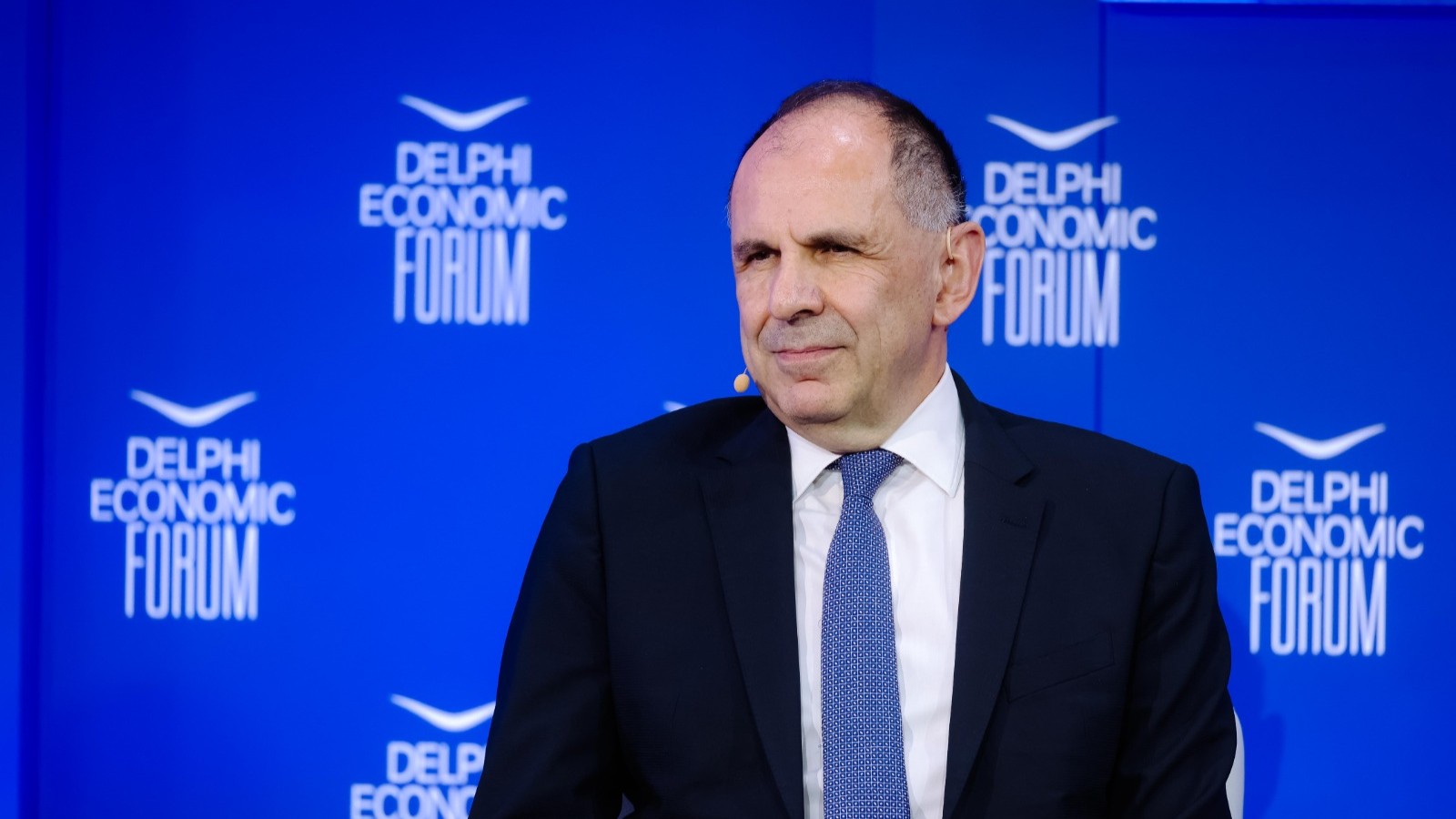
First intervention
G. GERAPETRITIS: Thank you so much. It's wonderful to be here in Delphi, and it's truly a great honor to be among friends, among neighbors, distinguished members of the respective governments of the Western Balkans. It feels like home. We are family, and we consider our Western Balkan neighbors as an inextricable part of our regional identity. This is why we go back to Thessaloniki in 2003. Greece - then the only member of the region within the European Union - took the initiative with the Thessaloniki Agenda to become the driving force for the accession of the Western Balkans to the European family.
The truth is, that throughout those 23 years there have been a lot of disappointments. Europe has not managed to present a very clear vision, a very tangible vision for enlargement of the Western Balkans. There have been a lot of setbacks, and this is why we consider this as the perfect timing, but also the perfect place to actually revitalize the Thessaloniki Agenda. I am very, very proud to say that all six Partners of the Western Balkans and Greece endorsed, a few hours ago, the Delphi Declaration, which is the follow-up of the Thessaloniki Agenda Declaration.
What we really think - all of us here at the panel -, is that we need to try and move forward from words to actions. Greece has already taken a very strong initiative to actually accelerate the process of enlargement when it comes to the Western Balkans. We have set up a whole project in order to try and further motivate the enlargement. I am going to visit all capitals within the next few months in order to customize our technical assistance to the Western Balkans. And, most importantly, I think we need to convey a very strong message on the part of the European Union that the Western Balkans' path to Europe is a one-way path.
We need to actually fully enhance this way. It's a matter of stability, prosperity, and peace for Europe. We should try and reverse the possible disappointment or fatigue on the part of the Western Balkans and people. I heard today something really important: the accession of the Western Balkans is essentially a path to reunification of Europe. And I think this is truly important. The Western Balkans are at the heart of Europe. We cannot imagine Europe without the Western Balkans.
And after all, at the end of the day, it's a matter of credibility for Europe. We promised something that we were not able to deliver duly and timely. And my aspiration as Foreign Minister preparing the presidency - the Greek presidency of the European Council during the second semester of 2027 - is to actually welcome a member or members of the Western Balkans to the European family. We have been already discussing with my colleagues and friends how Greece could be of meaningful assistance to the path towards Europe. Be that when it comes to fundamentals of democracy and the rule of law, or interconnectivity in all respects - transport, energy, data - and of course combating irregular migration. A series of public policies that are of key importance.
I could just - since we're here at the Omphalos of Earth, the Navel of Earth, and at the major oracle of Greek antiquity - I can give you the omen that during our presidency in 2027, we will be welcoming members from the Western Balkans. The merit-based process will persist, but we need to see this process in a much more ideological and historic manner in order to be able to see the credit in the Western Balkans joining Europe, because this is not only a matter for the current generation. This is a matter for future European generations, and Europe will be stronger and more resilient under the current geopolitical situation, if our neighbors become full members of the European Union.
Second intervention
MODERATOR: You gave us some sense of what was signed, but maybe to dig a bit deeper, everyone here has talked about implementation, about actionable agreement, about putting things from paper into action. So, can you give us 2 or 3 elements that you see happening between now and the Greek Presidency of the Council?
G. GERAPETRITIS: To start with, I should reiterate what has already been said, that this is probably the longest ever non-delivered promise in history. Since 2003, and for 23 years, we all understand that we need to actually revitalize this process, and I think we couldn't find a better venue than Delphi. And I'm sure that Mr. Tsomokos, who's present here, would be really grateful to see that the Delphi Economic Forum has become a key diplomatic venue for the declaration. We are grateful to you, sir, and thank you so much for convening this very prestigious economic forum for 11th— is it 11th time? Okay, well done. I am referring to the Delphi Declaration now just to say that we are trying to put words into an action plan. An action plan that could have significant tangible deliverables. We are already working very hard with our Lithuanian and Irish counterparts in the context of the European Trio, with the expectation that the second semester of 2027 will be critical timing for the enlargement. In the meantime, we are going to provide some customized technical assistance to all Partners. Obviously, this is a very difficult and sometimes volatile process, in the sense that each Partner may have some tailor-made needs that need to be addressed.
In Greece, we place particular emphasis on the fundamentals. We think the basic milestone for the accession process is adherence to the principle of democracy and the rule of law, as well as the Common Foreign and Security Policy, that you're going to address in a while. So, we are focusing on these elements. We are going to provide very strict, very tailor-made assistance, technical assistance, to all Partners. And we are hoping to have a very strict timeline. Our aspiration, through the Delphi Declaration, is to turn the roadmap into a timeline. A timeline with specific time benchmarks, with progress reports, and with a driving force that we're going to provide either as a single country, as Greece, or through the network of the Friends of Western Balkans that we are going also to further enhance. I have to say that…
MODERATOR: My timeline is ticking too, if this could be your final…
G. GERAPETRITIS: Greece is not only at the heart of the European Union, but currently I think it's probably at the heart of all international organizations, being elected member of the Security Council of the United Nations and essentially critical actors in all international organizations. I think this multilayer presence allows us to further promote the idea that the Western Balkans should be at the core of the European Union, first as a gradual accession process and then as full membership.
MODERATOR: Okay, thank you for that. So, I asked for 3 points, I think we got 6, which is good, actionable points.
G. GERAPETRITIS: You wanted news, I delivered.
MODERATOR: Thank you very much.
April 22, 2026