


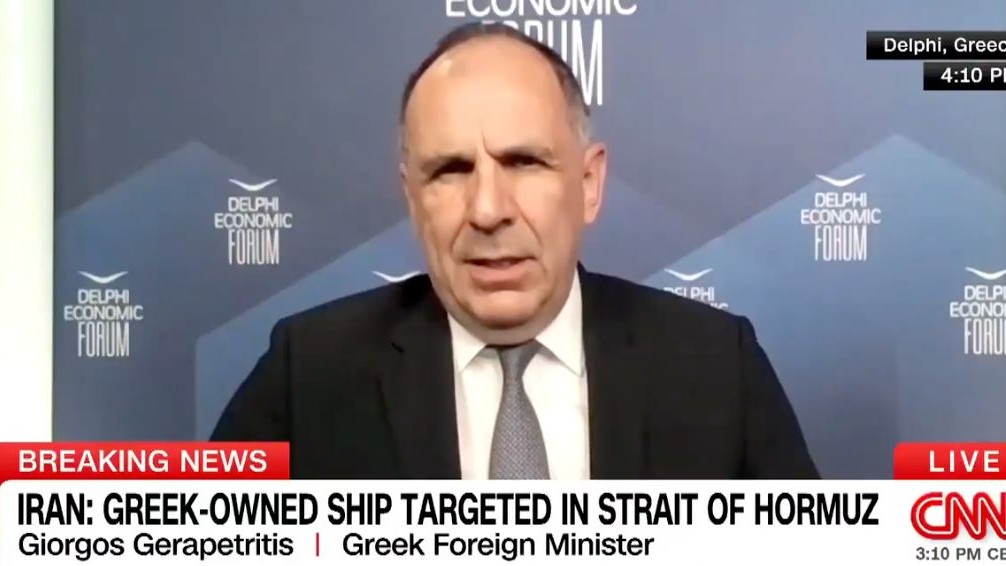
JOURNALIST: Joining us to discuss this is the Greek Foreign Minister, George Gerapetritis. It's good to have you, sir. Thank you for joining us. It's an important day to have this discussion. What can you tell us about this Greek-owned ship caught up in Iran's attack today and its crew?
G. GERAPETRITIS: Thank you for the invitation. I can confirm that there was an attack against a Greek-owned cargo ship, but I cannot confirm that it has been seized by the Iranians. So, there are extensive damages, but at the moment it is not being detained.
JOURNALIST: Has your office or any Greek government office, that you know of, heard from the crew or anyone directly involved with the Greek-owned ship since it was targeted?
G. GERAPETRITIS: We have already spoken to the owner of the cargo ship and the company, which is actually monitoring the ship. All seafarers are well in health. There have been extremely wide damages, but at the moment there is no risk of having any further damage or of the cargo ship to be sunk.
JOURNALIST: This was, as I understand it, a Greek-owned, Liberian-flagged, vessel heading to India, as we understand it. Can you give us any more details about the circumstances of that vessel?
G. GERAPETRITIS: Indeed, it was a Liberian-flagged and Geek-owned ship. It was trying to get out of the Strait of Hormuz. It was a cargo ship and it was heading to a destination that I cannot confirm, unfortunately. The situation on the field is quite disturbing. It is not an easy and relaxed situation, obviously. So, we have sent an overall notice to all Greek-owned ships to be very mindful, to exercise maximum self-restraint, and to avoid crossing the strait.
JOURNALIST: Do you know of any Greek shipping companies or crews on Greek-owned or Greek-flagged ships who have worked directly with the IRGC and/or paid a toll fee for safe passage?
G. GERAPETRITIS: At the moment, I can confirm that there are 11 Greek vessels, Greek-flagged vessels within the Gulf, and they remain there. And we have at least 40, 50 more which are Greek-owned but other countries' flag. I can confirm that there have been efforts in order to get out of the Straits, but I am not in a position to confirm that there were toll fees paid to the Iranian government or the Revolutionary Guard for this. But indeed, there have been some, a small number of cases of tankers that have been out of the Straits of Hormuz.
JOURNALIST: You say that you can't, you can't say whether or not they paid a fee in order to get through that trip. I'm struggling to understand why you're unable to provide that information. Apologies.
G. GERAPETRITIS: Because I do not have this information, because this has been kept by the shipowners. There are some, you know, industrial secrets that cannot be revealed. So, to the extent of my knowledge, I can confirm that there are some cases that have been out, but I cannot say whether there was a toll fee paid or not.
JOURNALIST: Understood. Will Greece investigate any ships that are alleged to have worked directly with the IRGC, which of course is a designated terror organization by the European Union?
G. GERAPETRITIS: If there is some strong evidence to support any kind of interlink with terrorist organizations, obviously the Greek authorities will take action accordingly. At the moment, there is no such information or such feedback, so I cannot say that we're going to do further investigation. We are coordinating with the other EU member states in relation to coordinated action to investigate such cases, but at the moment we do not have any hard evidence about it.
JOURNALIST: How do you expect these Iranian attacks on, as we understand it, three ships at least at this point, to impact this ceasefire that the US president just extended hours ago? What's your assessment at this point?
G. GERAPETRITIS: This is not a constructive approach. I have, first of all, to commend President Trump's initiative to extend unilaterally the ceasefire. It is important that we exhaust any possible means of diplomacy in order to resolve the conflict. It is absolutely critical not only for the two countries, for Iran and the United States, but also for the globe, because it strongly affects the economy of all states. So, it is important to carry on further diplomacy. I urge the Iranian authorities to exercise maximum self-restraint when it comes to such attacks. Freedom of navigation is non-negotiable.
JOURNALIST: Greece is heavily involved in the EU's naval mission ASPIDES, protecting ships, of course, in the Red Sea. EU foreign policy chief, Kaja Kallas, told me just recently that there are discussions about expanding that mission to include the Strait of Hormuz. Can you confirm that that is a possibility that's being discussed at the EU ministerial level? And how did Greece respond to that idea?
G. GERAPETRITIS: This has, indeed, been discussed among the EU Foreign Ministers. And there are some other initiatives, basically from the United Kingdom and France, to the effect that there is a future operation - essentially a ship-escorting operation - in the Strait of Hormuz. At the moment, we have not yet decided to extend the mandate of the ASPIDES operation. As rightly pointed out, Greece is among the few countries that have provided battleships to actually assist the situation in the Red Sea, which is also quite volatile. Our original position is that we do not exclude a European operation in the Gulf, but this can only happen if the armed conflict is at least ceased, or over.
JOURNALIST: Understood. Briefly, can you just give us a sense of the impact on the Greek shipping industry of this conflict? Very specifically, what is going on in the strait, and indeed the impact that Greece has had, the knock-on impact, that so many countries around the world are feeling, from this energy supply and other product supply issues.
G. GERAPETRITIS: As you rightly mentioned, Greece has the largest merchant fleet, so obviously there is a tremendous ramification upon the Greek economy and the Greek shipowners' community. At the moment, as I mentioned, we have 11 Greek-flagged and another 40-50 Greek-owned ships, which are essentially blocked within the Gulf. We do suffer from surging prices concerning oil, crude oil and other petroleum products. We expect to encounter further increases in prices in other goods. At the moment, we have significant inflation, when it comes to specific goods such as fertilizers and oil products, but we expect that there's going to be a domino in other prices. We coordinate our action with our EU partners in order to see how we manage the situation. Today, the Greek Prime Minister announced a significant package of financial measures for vulnerable people to address issues of shortage or price increases in terms of the use of petroleum. We will carry on supporting people to address the situation. But the truth is that unless we have a true sustainable resilient peace in the region, the economy will be in significant turbulence worldwide.
JOURNALIST: Georgios Gerapetritis, it is really good to have you on sir. An important conversation. I very much appreciate your time today. Thank you.
April 22, 2026