


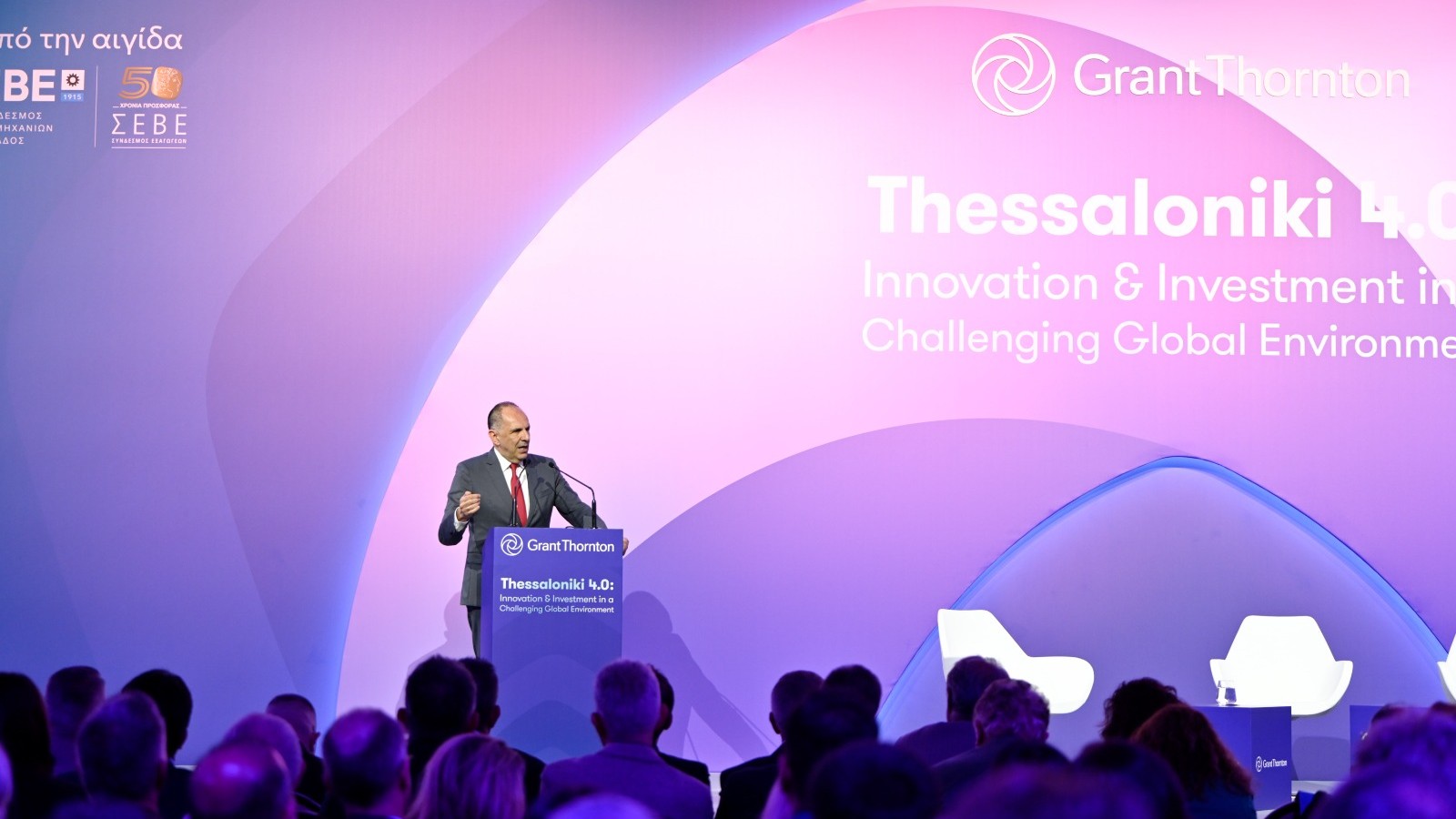
I would like to warmly thank Grant Thornton for giving me, first and foremost, the opportunity to participate in a forum where numbers and logic prevail over intolerance and passion, and where we can engage in a discussion that leads to a productive outcome.
As I was listening to the very interesting discussions and presentations, I found myself reflecting on the risk that delivering the keynote speech at the end of the conference entails. One may arrive with a prepared set of remarks in mind, only to find that the various data already presented requires a substantial adjustment of what one had intended to say.
I would therefore like to focus on some of the issues that have been raised, in order to examine how our rapidly changing world is actually taking shape, the challenges we face on a daily basis, and whether we can make any predictions about the future.
Any prediction, of course, entails a degree of risk, particularly now. I believe that what characterizes today's world above all is profound vulnerability and volatility. In the past, what a government, state, or association of states would primely do, was to develop scenarios for the future. Today, however, predictability has become virtually impossible. This is due to the unprecedented interaction between global phenomena and the extraordinary speed at which they unfold, making it exceedingly difficult to develop a scenario that contains even the slightest degree of predictability.
At the same time, all phenomena are completely interconnected. All phenomena are of supranational nature. We are witnessing tectonic transformations, not only in the international security architecture established after the Second World War, but also in the very way we understand economic realities, including the foundations of free-market economy, in light of the growing resurgence of state protectionism. Consequently, assumptions that we once regarded as global constants no longer hold true today."
This environment places enormous pressure on all countries and governments. We are currently witnessing protracted wars in some of the world's most geopolitically sensitive regions: in the Middle East, a region that has historically produced some of the deadliest conflicts, and in the heart of Europe, for the first time since the Second World War. These are changes that affect us all and expose problems and shortcomings.
Against this backdrop, the European family finds itself in an exceptionally difficult position, called upon to manage unprecedented challenges emerging in our neighborhood. That is because, in my view, Europe never considered its global competitiveness as its primary driving force on the global scene. Its foremost concern was the internal free market, how to ensure that the internal free market functioned effectively in order to generate benefits for European consumers. Europe never truly viewed itself as a single unit that needed to compete with international actors such as the United States, China, Russia, and, today, India. It spent considerable political and economic capital to ensuring free and undistorted competition within Europe itself, but it did not shield Europe from external risks. Today, it finds itself in the difficult position of having to reassess its assumptions in light of recent developments. It is evident that the rise of state interventionism will affect Europe.
The prevailing notion that resilience is linked to a strong defense will affect Europe. For many years, Europe - perhaps somewhat complacently - operated on the assumption that the security architecture provided by the North Atlantic Treaty Organization (NATO) would protect it. Today, we all recognize the pressing need for European strategic autonomy, competitiveness, and, particularly, for stronger defense. Because we can no longer assume that Europe will remain at peace indefinitely.
In light of all these realities, we are called upon to reassess much of what we knew. How should we respond? First and foremost, by placing facts in their proper perspective. The pace and intensity of events are often such that we forget to do so. I listened to the distinguished speakers who referred to the major challenges, to the structural challenges that do indeed exist and are faced by the Greek economy. Yet we should not forget that our economy has reawakened not from a period of dormancy, but from a near-death experience. Greece came close not merely to an economic crisis, but to the effective collapse of its economy. Only seven years separate us from that lowest point. Today, we are able to engage in discussions of existential economic importance for the country: whether Greece can withstand the geopolitical upheavals unfolding in its neighborhood and across the world. At the same time, we can also afford to have secondary discussions about the development model that needs to be reconsidered. Greece has long suffered from enormous economic imbalances. It has relied on a limited model of economic production that has not always enabled it to withstand shocks. But, we must also acknowledge that today Greece has achieved the strongest position it has even held, despite the most adverse global geopolitical juncture.
And all of this just 7 years after emerging from a deeply painful economic crisis that cost the country nearly a quarter of its GDP. So that we can now be in a position to discuss whether and how we should diversify our productive model and whether, ultimately, we need a different mix of economic policies to bring us to this new world, which is constantly changing. As was rightly noted earlier, every crisis creates opportunities. It creates opportunities for entrepreneurship, which should be dynamic, proactive and respond to challenges.
At the same time, this presents an equally important challenge for governments themselves. How many countries managed to emerge unscathed from the major energy crisis that followed the war in Ukraine? Let me remind you that Greece, like most European countries, was absolutely over-dependent on Russian natural gas. Maybe that was not so much the case for other countries but Greece was absolutely over-dependent. Yet, within an exceptionally short period of time, Greece succeeded in diversifying its energy mix by expanding renewable energy sources. Today, we can affirm that Greece is a net exporter of energy, whereas not long ago it was to a large extent an energy importer.
How was this achieved? By developing the necessary channels to become an energy hub in every sense: through natural gas pipelines, electricity interconnections, and substantial expansion of renewable energy sources. All of this was accomplished in less than five years, allowing renewable energy to become the dominant component of the energy mix today. And yes, it is very important - almost existential - for businesses, citizens, and social cohesion alike that affordable electricity and energy remain accessible to all.
At the same time, the resilience of an economy also depends on the nature and quality of its energy mix. Because being dependent on foreign natural gas or oil is very different from an energy mix relying on energy sources that the country can secure by itself. Today, beyond any doubt - and indeed beyond any prediction - Greece is the largest energy hub in Southeast Europe. It supplies energy to all of our neighboring countries and serves as a pillar of energy security for the wider region. This is how we are viewed by our neighbors, by our European partners, and by our allies.
Let me begin with a key concept that I believe deserves particular emphasis: extroversion. In 2019, the Greek Government made a strategic choice to invest in the extroversion of the Greek economy. In practice, it invested in a new organizational framework for the country's economic extroversion. It established a pillar within the Ministry of Foreign Affairs promoting both foreign direct investment and exports.
This is particularly significant because it links the extroversion of the Greek economy with diplomacy and foreign policy. It then developed the tools to make our economy genuinely outward-looking. Today, Greek investments abroad have multiplied. Foreign direct investment has increased by 50%. These investments may not always be of the type we would ideally envisage, nor as productive as we would like, but they have nevertheless increased by 50% and I will explain why. At the same time, our exports as a share of GDP have doubled. I believe that the current environment presents a tremendous opportunity for outward-looking entrepreneurs. At the same time, we are creating the necessary safeguards, because extroversion must also help reduce the risks associated with a free and open economy, through the screening of foreign investment in Greece. Greece has enacted legislation providing for the screening of foreign investments on grounds that include potential geopolitical risks, particularly when they concern critical infrastructure. This ensures that Greece avoids risks of becoming a a field of conflict and danger.
If you ask any investor today, they will tell you that Greece is one of the safest investment destinations in the Western world. This is no coincidence. It is the result of a comprehensive action and a mixed policy aimed at strengthening Greece's credibility internationally, maintaining stable economic conditions, and exponentially increasing the country's diplomatic footprint globally.
Credibility and stability are cornerstones of any truly sustainable and prosperous economy. It was mentioned earlier that entrepreneurship is influenced primarily by microeconomic rather than macroeconomic factors. With all due respect, I consider that to be a short-sighted view. Entrepreneurship is, of course, influenced by macroeconomic indicators, because those indicators ultimately reflect the resilience of an economy. No serious investor will invest where there is sovereign risk, or where a country has failed to create the conditions for long-term resilience.
Today, Greece has achieved the largest reduction in public debt, the most significant reduction in unemployment, and growth rates well above the European average. As we speak, Greece is borrowing on more favorable terms than Italy and on the same terms as France.
This is Greece today, seven years after emerging from the crisis. Certainly, systemic and structural challenges remain. There is the issue of energy self-sufficiency, the decades long issue of deficient infrastructure, particularly in network systems. However, we should avoid nihilism and recognize that the years since the crisis have not merely brought Greece back to normality. What we are witnessing today is not simply a return to normality. It is a period of economic flourishing, albeit the challenges and shortcomings.
Significant structural issues remain, of course. But we must also look at the broader picture that the Greek economy is currently on a genuinely positive trajectory. The election of Greece's Minister of Economy as President of the Eurogroup is not merely a symbolic achievement for the Greek economy. It is, in reality, a validation of a policy that has positioned Greece among the countries regarded as safe for investors. It is a signal from the Eurogroup - the most influential exclusive economic club - that Greece is a safe investment destination. Based on this foundation, we have advanced the country’s geopolitical footprint.
Today, Greece possesses the strongest diplomatic capital it has enjoyed in decades. You may ask whether the prosperity of an economy ultimately depends on its diplomatic capital. My answer is unequivocally “yes”. At present, Greece is able to engage with partners and allies not merely as an equal, but as a strategic actor with substantial influence on international developments. Greece currently serves as an elected member of the United Nations Security Council - the most exclusive club responsible for shaping the international security architecture, while only a couple of days ago Germany failed to get elected. Greece was elected to serve for the 2025-2026 term almost unanimously.
During the last seven years, Greece assumed a leading role within the European Union regarding all the major issues that have arisen. Greece was the one to raise the issue of the Recovery and Resilience Facility, the results of which are now evident, and it ranks among the first in terms of absorption. Who would have expected Greece to be the first in terms of absorbing the funds of the Recovery and Resilience Facility?
We all remember very well what was happening in the past with the absorption of European funding instruments. Who would have expected that Greece would be in a position to achieve near 100% absorption of the loan component and, essentially, the Recovery and Resilience Facility as a whole? Greece was also among the countries that brought forward the concept of strategic autonomy, of financing instruments for European defense, as well as the digital certificate during the pandemic.
All the major initiatives bear Greece's imprint. Upon this strong position, we built the alliances that today make us stronger than ever before. Greece has developed strategic relationships with the United States, Israel, all Gulf countries, India, and the countries of North Africa. Greece has closed all major chapters and open wounds. Tomorrow, we will hold discussions with the Government of Libya on the delimitation of maritime zones. Who would have imagined that we would now find ourselves with no open fronts?
We are closing old chapters and opening Greece to the world. Who would have imagined that Greece would possess the capital and the determination to place new arguments to the table, without fear of cost? Because strength does not fear cost. Who would have thought, only a few years ago, that Greece would become an exporter of security in its wider region? Today, Greece is a provider of security not only for Cyprus. We have witnessed this in practice. Greece is also an exporter of security in the Balkans and even to the Gulf region.
Greece is now regarded as a strong regional power, characterized by great stability and significant diplomatic footprint that enables it to exert meaningful influence on global developments. When this is the case, investors are naturally far more inclined to come, without being deterred by the associated risks. This is why the time gained through the strategic decision to close open chapters and open wounds in our foreign policy has been so important. That time has allowed us to have a thriving economy, a resilient defense, and a very strong foreign policy.
All of these elements are indispensable in order to maintain a strong investment community and a prosperous economy. These are necessary preconditions. An economy cannot exist and flourish by itself. It requires the support of genuine resilience within an international environment that increasingly demands partnerships and collective action.
So, do we find ourselves in a position that allows us to be optimistic? Have we achieved economic security and investment self-sufficiency? If you were to ask me - not as a member of the executive branch, but as your adviser - whether you should expand your business activities or wait patiently and remain on the defense, my answer would be the following: Greece has not merely survived successive crises, it has emerged stronger from each one of them. It emerged stronger from the pandemic. It emerged from the energy crisis with a more diversified energy mix. Through the crises and the two ongoing wars, it forged strategic partnerships that had never previously existed. Ultimately, what distinguishes a state that plans ahead and acts with foresight is its ability to turn crisis into opportunity.
And yes, with all the confidence that my position allows me, I can say that Greece -regardless of the geopolitical volatility affecting our region and the world - will continue along this path of stability, creating the conditions for even greater growth. Risks will always exist. We are all aware of what is happening in the Middle East. However, in the coming years, Greece will become the gateway connecting the East and the South with Europe. It will serve as a principal hub of the India–Middle East–Europe Economic Corridor (IMEC). Through the GREGY pipeline it will have a green energy electricity interconnection and, potentially in the future, hydrogen interconnection, to Egypt. Through the Vertical Corridor, Greece will be the country that ensures energy security for Romania, Moldova, and Ukraine. Through its continuously strengthening and increasingly self-reliant defense, it will be able to become a security provider. The risks are real. But there is something else as well: a steadfast determination to manage those risks and transform them into opportunities.
There is, however, one great risk. There is, admittedly, one danger about the future that keeps me awake at night. It is the danger of succumbing to economic populism, to simplistic slogans, or even to political nihilism and a form of hollow patriotism that inevitably leads to confrontation and suffering. Whenever such divisive approaches and complacent patriotism have prevailed in Greek history, the country has been led to crises.
Any government - not only the current one - has a duty to preserve seriousness, responsibility, and sound judgment. We will not depart from that course. We will continue, with the same sense of responsibility, to provide assurances to you - the healthiest part of the economy and entrepreneurship - and to all citizens that, despite the significant challenges we face, particularly those arising from the persistent rise in the cost of living, we will continue working towards genuine convergence to maintain and strengthen social cohesion. Allow me to add that this responsibility does not rest solely with the State. It is also a responsibility of the business community.
Because, at the end of the day, as it has been rightly mentioned, the objective is not simply to develop entrepreneurship. The objective is for entrepreneurship to develop in a balanced way that yields dividends for society. We must all understand that we are on the same boat. A strong Greece means a greater dividend for all - for businesses, for society, for people, for citizens.
Thank you very much.
June 9, 2026